California code section 2026

Get Form
california code section Preview on Page 1

Here's how it works

01. Edit your form online
Type text, add images, blackout confidential details, add comments, highlights and more.
02. Sign it in a few clicks
Draw your signature, type it, upload its image, or use your mobile device as a signature pad.
03. Share your form with others
Send it via email, link, or fax. You can also download it, export it or print it out.

How to use or fill out California Code Section with our platform

Form edit decoration
9.5
Ease of Setup
DocHub User Ratings on G2
9.0
Ease of Use
DocHub User Ratings on G2
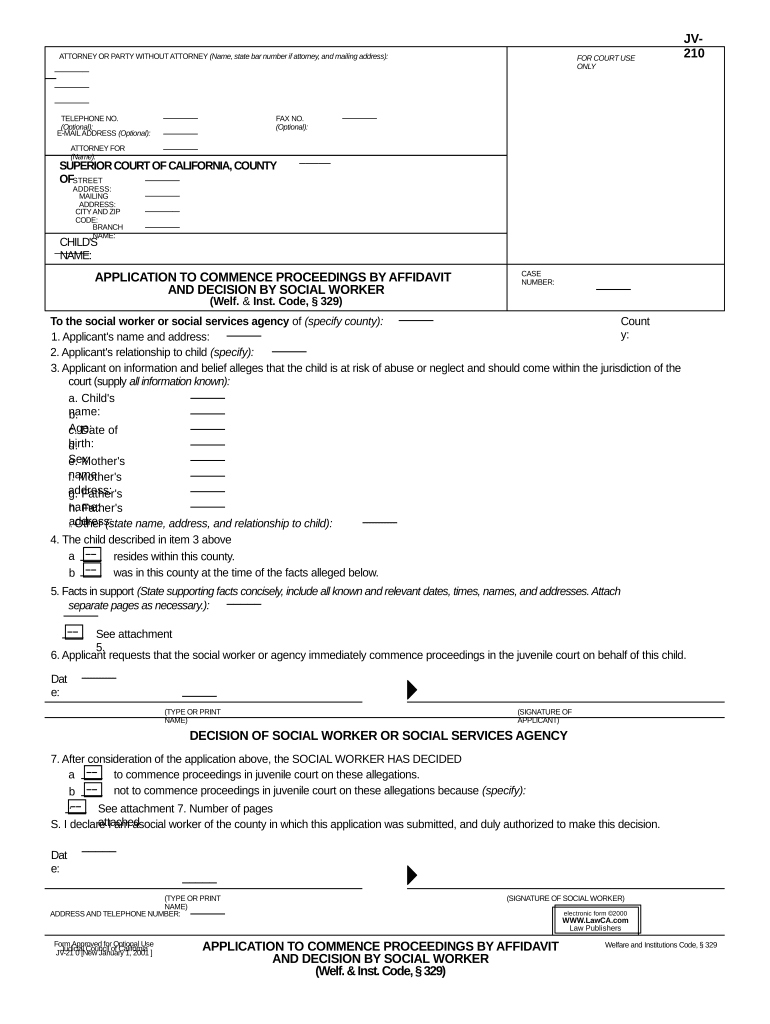
  1. Click ‘Get Form’ to open the California Code Section document in the editor.
  2. Begin by entering your name, state bar number (if applicable), and mailing address in the designated fields for 'ATTORNEY OR PARTY WITHOUT ATTORNEY'.
  3. Provide your optional telephone number and email address to facilitate communication.
  4. Fill in the 'SUPERIOR COURT OF CALIFORNIA, COUNTY' section with the appropriate court details including street address, mailing address, city, and zip code.
  5. In the 'APPLICATION TO COMMENCE PROCEEDINGS BY AFFIDAVIT' section, input the child's name, age, date of birth, and sex as required.
  6. Complete the applicant's relationship to the child and provide all relevant information regarding potential abuse or neglect.
  7. Detail supporting facts concisely in item 5. Attach additional pages if necessary using our platform’s attachment feature.
  8. Finally, sign and date the application at the bottom before submitting it for review by a social worker.

Start filling out your California Code Section form today for free on our platform!

be ready to get more

Complete this form in 5 minutes or less

Get form

Got questions?

We have answers to the most popular questions from our customers. If you can't find an answer to your question, please contact us.
Contact us

eSignatures are a great replacement for traditional signing, as they save time, effort, and money people spend on printing, scanning, and paper delivery. You can electronically sign your california code section utilizing a reliable and robust online document management services like DocHub. It complies with main eSignature policies (ESIGN and UETA), so all forms approved there are legally binding and have the same validity as physically signed ones.

When you edit your california code section with DocHub, you only need a stable internet connection and virtually any web browser installed on your device. No need to set up any third-party applications or research guides. Just open a tab with DocHub, drag and drop your file, and modify it on the spot.

California State laws California law consists of the state Constitution, statutes, and 29 codes, covering various subject areas. In general, to support your position in California state court, you will want to research California Codes. Codes are a collection of laws organized by subject.
After the session laws are passed, they are organized into subject areas (codified) so they can be found. California statutory law consists of 29 titles, called codes, covering the following subject areas: Business and Professions Code, Civil Code, Code of Civil Procedure, Commercial Code, Corporations Code,
California codes are arranged in 29 subject categories. California does not publish an official printed code. Commercially published annotated codes are used instead.

Security and compliance

At DocHub, your data security is our priority. We follow HIPAA, SOC2, GDPR, and other standards, so you can work on your documents with confidence.

Learn more
ccpa2
pci-dss
gdpr-compliance
hipaa
soc-compliance

People also ask

According to code 1954, a landlord or agent must give the tenant reasonable notice in writing prior to an intended entry. The notice must include the date, approximate time of entry, and reason for the entry.
The time in which any act provided by law is to be done is computed by excluding the first day and including the last, unless the last day is a holiday, and then it is also excluded.
Divisions. The Code is divided into 53 titles (listed below), which deal with broad, logically organized areas of legislation. Titles may optionally be divided into subtitles, parts, subparts, chapters, and subchapters.

Related links