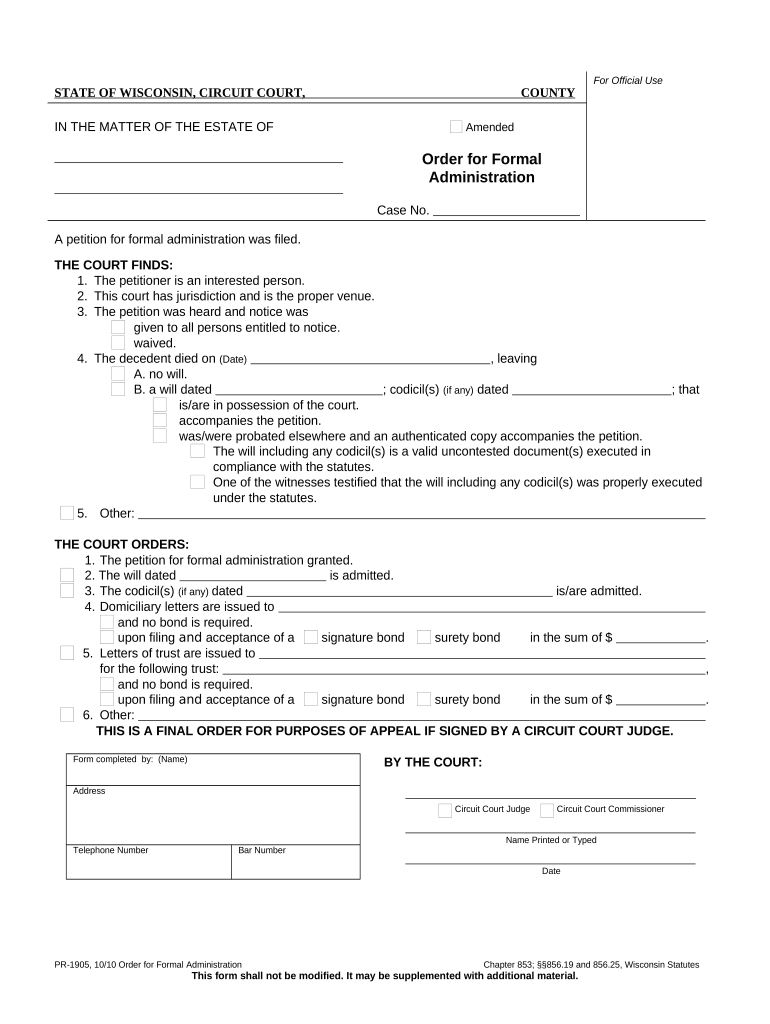
Order for Formal Administration - Wisconsin 2026

Get Form
Order for Formal Administration - Wisconsin Preview on Page 1

Here's how it works

01. Edit your form online
Type text, add images, blackout confidential details, add comments, highlights and more.
02. Sign it in a few clicks
Draw your signature, type it, upload its image, or use your mobile device as a signature pad.
03. Share your form with others
Send it via email, link, or fax. You can also download it, export it or print it out.

How to use or fill out Order for Formal Administration - Wisconsin with our platform

Form edit decoration
9.5
Ease of Setup
DocHub User Ratings on G2
9.0
Ease of Use
DocHub User Ratings on G2
  1. Click ‘Get Form’ to open the Order for Formal Administration in the editor.
  2. Begin by entering the case number at the top of the form. This is essential for tracking your petition.
  3. Fill in the decedent's date of death and indicate whether there is a will, including details about any codicils if applicable.
  4. In the 'THE COURT ORDERS' section, specify who will receive domiciliary letters and whether a bond is required. Ensure all necessary fields are completed accurately.
  5. Complete the form by providing your name, address, telephone number, and bar number if applicable. Review all entries for accuracy before finalizing.

Start using our platform today to streamline your document editing and ensure a smooth completion of your Order for Formal Administration!

be ready to get more

Complete this form in 5 minutes or less

Get form

Got questions?

We have answers to the most popular questions from our customers. If you can't find an answer to your question, please contact us.
Contact us
Formal Administration is the formal court-supervised administration of a decedents estate. Formal Administration is supervised by the Court (Judge/ Court Commissioner). Generally, Formal Administration requires formal court appearances before a Judge/Court Commissioner assigned to the probate matter.
Out of the deceased persons assets, certain assets bypass probate by default, including those with designated beneficiaries or co-owners, such as: Life insurance proceeds. Jointly owned property with rights of survivorship. Retirement accounts with named beneficiaries. Assets held in a trust.
The Probate Process in Wisconsin: A Step-by-Step Guide Filing the Will and Petition. Appointing the Personal Representative. Inventory and Appraisal of the Estate. Paying the Estates Debts and Taxes. Distributing the Estate.
Probate and estate administration are crucial processes in managing and distributing a deceased persons estate. While probate refers to the legal process of validating a Will, estate administration covers the broader task of managing the estates assets, paying debts, and distributing assets to beneficiaries.
Formal administration is the most common form of probate. During formal administration, the probate court validates the decedents will, creditors make claims against the estate, the estate is valued, and assets are distributed to beneficiaries.

Security and compliance

At DocHub, your data security is our priority. We follow HIPAA, SOC2, GDPR, and other standards, so you can work on your documents with confidence.

Learn more
ccpa2
pci-dss
gdpr-compliance
hipaa
soc-compliance

People also ask

Generally, Wisconsin wants an estate to be probated within 18 months of death but it does vary by county. Some counties in Wisconsin want the estate to be probated within a year.
Formal probate is the process of proving a will is valid in court. Informal probate is a more simplified process that does not involve court proceedings.

Related links