






Definition and Meaning of the STATE OF HAWAII - Hawaii State Judiciary
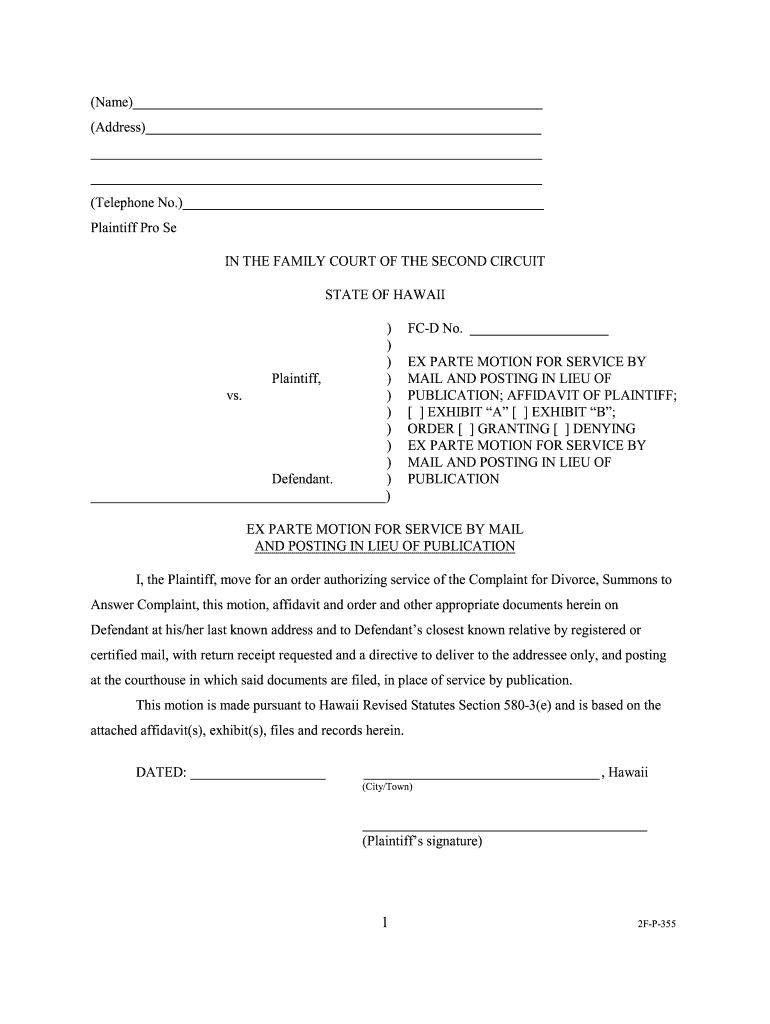
The STATE OF HAWAII - Hawaii State Judiciary refers to the judicial branch of the government in Hawaii responsible for enforcing laws, interpreting statutes, and adjudicating legal disputes. This institution includes various courts such as the Family Court, which handles matters like divorce, custody, and other family-related issues. The judiciary's role extends to statewide administration of justice, ensuring fair and impartial trials, and interpreting the constitution and state laws. Its relevance in legal documentation often involves motions and orders specific to case proceedings.
How to Use the STATE OF HAWAII - Hawaii State Judiciary Form
The STATE OF HAWAII - Hawaii State Judiciary form is typically used to facilitate judicial processes in family law cases, such as divorce proceedings. It allows plaintiffs to request specific court actions, such as alternative methods of serving legal documents if traditional methods prove unsuccessful. To effectively use this form, understanding the required information and steps is critical:
- Identify the Type of Motion: Determine the specific legal request you need to file.
- Complete the Form Accurately: Fill in all required fields with precise details, ensuring clarity and completeness.
- Attach Supporting Documents: Include any affidavits or additional documents that support your motion.
- Submission: Deliver the completed form to the appropriate court, either via mail or in person.
Properly using this form involves careful adherence to court instructions and ensuring all relevant information is included.
Steps to Complete the STATE OF HAWAII - Hawaii State Judiciary Form
Filling out the STATE OF HAWAII - Hawaii State Judiciary form requires precise attention to detail. Here’s a step-by-step guide to completing it:
- Read Instructions Carefully: Understand the specific requirements and purposes of the form.
- Provide Personal and Case Information: Clearly state your name, case number, and other relevant details.
- Outline the Request: Specify what action you are requesting from the court, such as an alternative service method.
- Attach Justifications and Affidavits: Provide supporting documentation, including any evidence of attempts to serve documents traditionally.
- Review for Accuracy: Double-check all information for accuracy and completeness.
- Submit the Form: File the form with the court and retain copies for your records.
Each step is crucial to ensure your request is processed without delays.
Important Terms Related to the STATE OF HAWAII - Hawaii State Judiciary
There are several key terms associated with the STATE OF HAWAII - Hawaii State Judiciary that individuals may encounter:
- Ex Parte Motion: A motion made to the court by one party without notifying the other party.
- Affidavit: A written statement confirmed by oath, used as evidence.
- Alternative Service: A legal procedure to deliver documents in a manner other than personal service when the defendant cannot be located.
- Jurisdiction: The legal authority of the court to hear and decide a case.
- Plaintiff and Defendant: The parties involved in a lawsuit, with the plaintiff bringing the case and the defendant responding.
Understanding these terms is essential for navigating legal documents and proceedings effectively.
State-Specific Rules for the STATE OF HAWAII - Hawaii State Judiciary
While the general process for legal forms is consistent across many jurisdictions, Hawaii has specific rules to consider:
- Residency Requirements: Certain actions require parties to meet residency criteria, often affecting family law cases.
- Service Methods: Hawaii permits alternative service methods under specific circumstances, especially when traditional methods are ineffective.
- Local Court Rules: Each court within the judiciary may have particular procedural guidelines, necessitating familiarity with local regulations.
Adherence to these state-specific rules ensures proper legal processing and avoids complications.
Examples of Using the STATE OF HAWAII - Hawaii State Judiciary in Divorce Proceedings
The STATE OF HAWAII - Hawaii State Judiciary form is commonly used in divorce cases when conventional service of documents is challenging:
- Financial Hardship: If a plaintiff is financially unable to afford traditional service methods, they may request alternative service.
- Defendant Unreachable: In cases where a defendant is difficult to locate, the plaintiff can seek court approval for service by mail or posting.
- Court Approval Process: The plaintiff must demonstrate efforts to contact the defendant, such as previous attempts at personal service.
Each scenario exemplifies how these forms facilitate legal proceedings when standard procedures fall short.
Required Documents for Filing with the STATE OF HAWAII - Hawaii State Judiciary
When filing motions or requests in the Hawaii State Judiciary, several documents may be required:
- Completed Motion Form: The primary document outlining the request.
- Affidavit of Service Attempts: Evidence of previous attempts to serve documents.
- Supporting Affidavits: Statements or documents supporting the necessity of the request.
- Financial Disclosure: In some cases, disclosing financial hardship may be required to justify alternative service methods.
Assembling these documents in advance ensures a streamlined filing process.
Form Submission Methods: Online, Mail, or In-Person
Hawaii provides multiple submission methods for the STATE OF HAWAII - Hawaii State Judiciary forms:
- Online Submission: Many forms can now be filed electronically, offering convenience and efficiency.
- Mail: Forms can be mailed to the appropriate court, but timing for delivery should be considered.
- In-Person: Directly submitting forms at the courthouse provides immediate confirmation of receipt.
Choosing the optimal submission method depends on urgency and available resources.