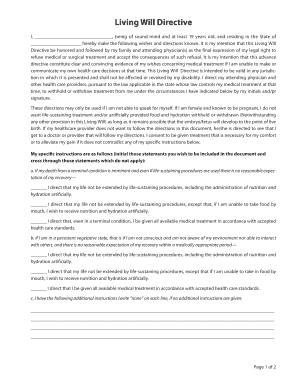
01. Edit your tpd discharge online
Type text, add images, blackout confidential details, add comments, highlights and more.

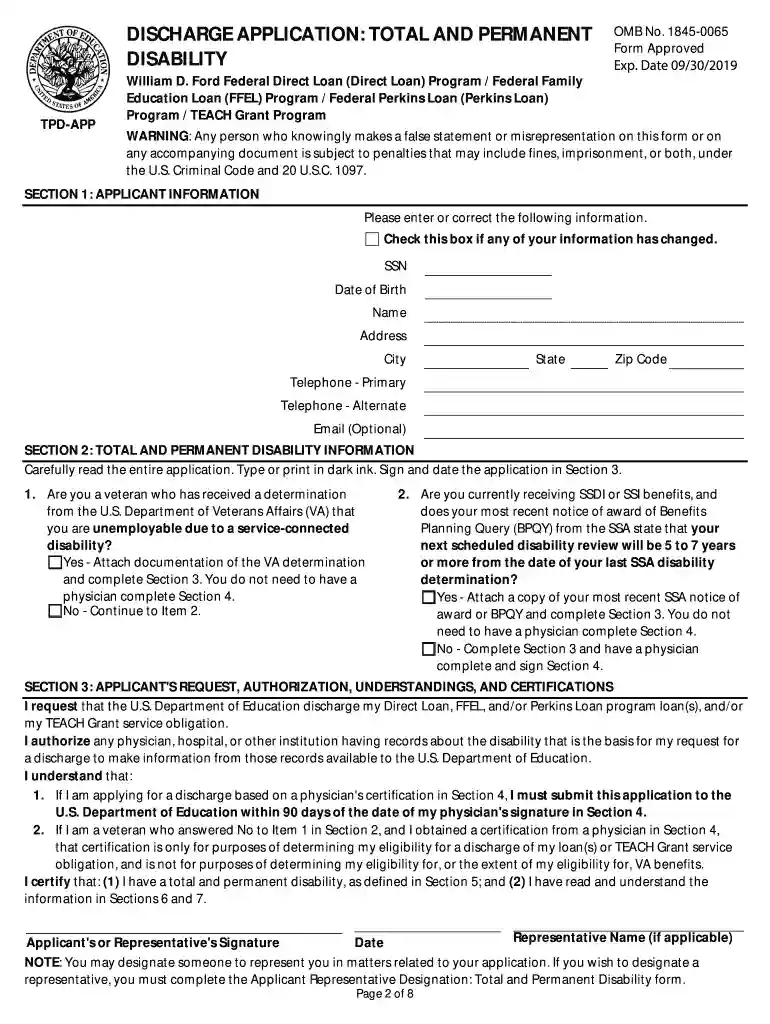
Type text, add images, blackout confidential details, add comments, highlights and more.

Draw your signature, type it, upload its image, or use your mobile device as a signature pad.

Send tpd discharge application via email, link, or fax. You can also download it, export it or print it out.
The term "disability discharge" refers to the process through which individuals with a total and permanent disability can have their federal student loans and TEACH Grant obligations discharged. This discharge relieves individuals from repaying their loans or fulfilling their service obligations under specific conditions. The process involves verifying the disability status through documentation from a physician or the Social Security Administration. Understanding the specifics of what qualifies as a total and permanent disability is crucial for applicants seeking discharge.
Eligibility for a disability discharge requires meeting defined criteria that demonstrate total and permanent disability. Applicants need to provide evidence from one of the following: certification from a U.S. licensed physician, Social Security Administration award for SSDI or SSI benefits with a notice of medically determined disability review status of no more frequently than every five to seven years, or documentation from the U.S. Department of Veterans Affairs showing a service-connected disability determination. It's essential to accurately prepare and submit the required documentation to support the claim.


Applying for a disability discharge involves several steps. Initially, applicants need to fill out pertinent sections of the form including personal details and type of documentation provided. As part of the process:
Adhering to these steps helps streamline the application and prevents potential delays.
The disability discharge form includes crucial sections designed to capture essential information from the applicant. These sections generally cover:
Accurately completing each section is necessary to avoid processing delays or rejections.
The disability discharge form is a legal document that facilitates the release of federal loan obligations based on disability. Its use must comply with established guidelines to ensure valid cancellation of responsibilities. This legal discharge, afforded under the Higher Education Act, demands strict adherence to the eligibility and documentation requirements. Misrepresentation of information can lead to legal ramifications, including reinstatement of discharged obligations.
Understanding key terms associated with disability discharge is indispensable for applicants. Terms commonly referenced include:
Each term comes with distinct stipulations that have implications for the application and approval process.
The application process begins by submitting the discharge form along with necessary supporting documents. Approval times may vary but typically range from several weeks to a few months. During this period, applicants may receive requests for additional documentation or clarification. It’s vital to respond promptly to such inquiries to expedite processing. Once the application is approved, borrowers will receive confirmation and detailed information about the discharge status.
Applicants must submit specific documents to verify their claim for discharge. These include:
Providing comprehensive and accurate documentation ensures a smoother review and approval process.
Real-world scenarios can help illustrate the form's application. For instance, an applicant who receives determination from the SSA indicating disability reviews no more frequent than every five years can apply for discharge without physician certification. Veterans with a service-connected condition resulting in 100% disability also qualify for automatic discharge approval. These situations highlight the diverse contexts in which the form can be effectively utilized to alleviate loan burdens.
With technological advances, many resources have become available to assist in completing the disability discharge form digitally. Compatible software programs like DocHub, enable applicants to fill out, sign, and submit their forms online. This digital approach not only saves time but also reduces the likelihood of errors often associated with manual submissions. Electronic submissions also provide a traceable processing timeline, offering applicants greater clarity and peace of mind regarding their application's status.
We've got more versions of the tpd discharge form. Select the right tpd discharge version from the list and start editing it straight away!
Yes, electronically drawing your signature is acceptable, but only if you utilize a tool that complies with industry laws and regulations. Try DocHub, which guarantees eSignature validity under ESIGN and UETA requirements. All you need to approve your tpd pending final approval electronically is an account with DocHub and an internet connection. After you open your paperwork in our editor, click Sign and choose the Draw tool.
You can complete and sign your disabilitydischarge com check status online, even on a tight deadline. All you need to access top-notch editing instruments on any device is a DocHub account, which you can register within a couple of moments. After you register, upload your document or find what you are searching for in our catalog, complete it using the editing instruments you need, and place your electronic signature on it at the end.
At DocHub, your data security is our priority. We follow HIPAA, SOC2, GDPR, and other standards, so you can work on your documents with confidence.