




01. Edit your flu vaccine administration record template online
Type text, add images, blackout confidential details, add comments, highlights and more.

Type text, add images, blackout confidential details, add comments, highlights and more.

Draw your signature, type it, upload its image, or use your mobile device as a signature pad.

Send flu vaccine administration form via email, link, or fax. You can also download it, export it or print it out.
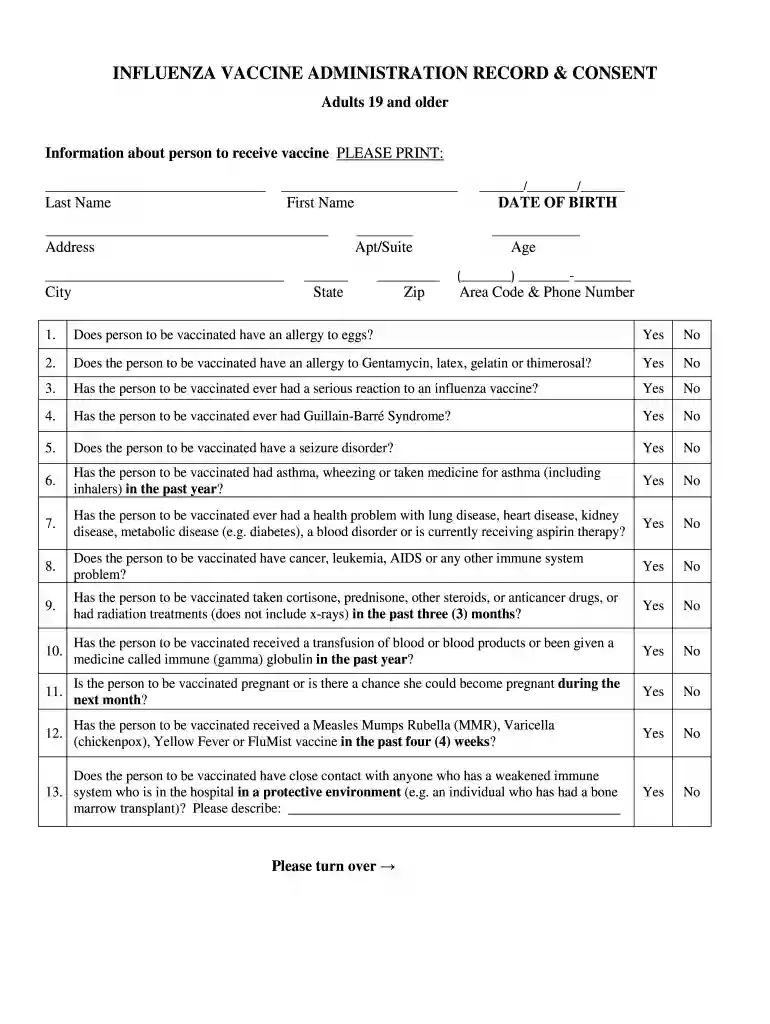
The Influenza Vaccine Administration Record and Consent form serves as an essential documentation tool for individuals receiving the flu vaccine. This form is designed for adults aged nineteen and older and facilitates the collection of critical personal information, medical history, and explicit consent for vaccination. It plays a crucial role in ensuring that recipients understand the implications of the vaccine and any associated risks.
The form includes several key sections:
Completing the Influenza Vaccine Administration Record and Consent form involves several straightforward steps:
The form encompasses several important dimensions:
The Influenza Vaccine Administration Record and Consent form is primarily used by:
The Influenza Vaccine Administration Record and Consent form is legally binding under U.S. healthcare regulations. It satisfies legal requirements for informed consent by ensuring that all critical information is presented to the recipient. Providers must retain completed forms in line with state and federal guidelines for medical records, contributing to high standards in healthcare documentation.
Several important aspects of the form stand out:
The Influenza Vaccine Administration Record and Consent can be utilized in different contexts:
There are various related documents that may be required in conjunction with the Influenza Vaccine Administration Record and Consent form:
This comprehensive examination of the Influenza Vaccine Administration Record and Consent highlights its critical roles in healthcare, legal compliance, and public health management.
We've got more versions of the flu vaccine administration record template form. Select the right flu vaccine administration record template version from the list and start editing it straight away!
| Versions | Form popularity | Fillable & printable |
|---|---|---|
| 2014 | 4.6 Satisfied (54 Votes) |
Upload your flu shot record form to DocHub (once you’ve set up an account for this). If you need to complete fields in it, use proper tools from the top pane. For instance, drop Signature Fields, assign each to a particular party, and click on Sign → Request signatures from others. Personalize your message for your recipients and click Send Request. You can also send your document by fax or as a Signing link instead of using email (you’ll locate these options by navigating to the Menu → Send)
You may find and modify your flu vaccine record template online by using DocHub. Its straightforward yet feature-rich design allows you to begin productive work immediately after you sign up your account. Create your account and add your file, then our user interface will guide you via our stress-free form completion experience.
At DocHub, your data security is our priority. We follow HIPAA, SOC2, GDPR, and other standards, so you can work on your documents with confidence.
Request a copy of your immunization records online in 2 easy steps: Fill out the Authorization for Release of Immunizations Records Form; Upload a copy of yourRead more
Identifying and addressing the unmet health needs of local communities is a fundamental responsibility of hospitals and health systems across the UnitedRead more


