Sellers disclosure missouri 2026

Get Form
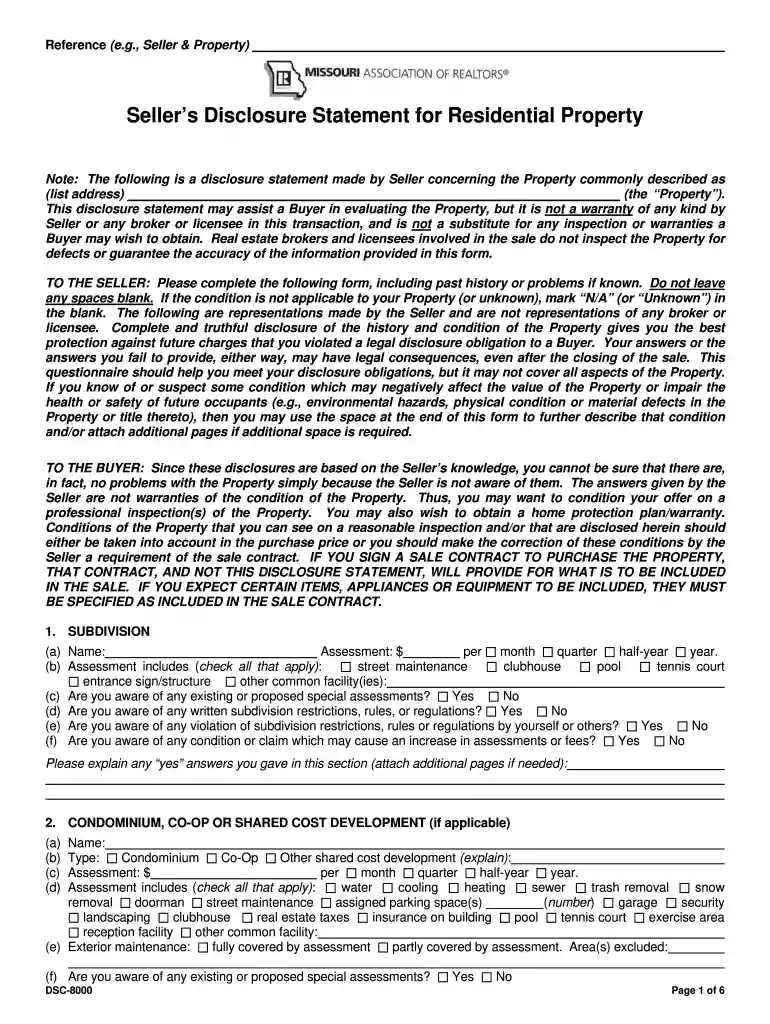
seller's property disclosure form Preview on Page 1

Here's how it works

01. Edit your seller's property disclosure form online
Type text, add images, blackout confidential details, add comments, highlights and more.

02. Sign it in a few clicks
Draw your signature, type it, upload its image, or use your mobile device as a signature pad.

03. Share your form with others
Send missouri seller disclosure form via email, link, or fax. You can also download it, export it or print it out.

How to use or fill out sellers disclosure missouri with our platform

Form edit decoration
9.5
Ease of Setup
DocHub User Ratings on G2
9.0
Ease of Use
DocHub User Ratings on G2
  1. Click ‘Get Form’ to open the sellers disclosure missouri in the editor.
  2. Begin by entering the property address at the top of the form. This is crucial for identifying the specific property being disclosed.
  3. Proceed to Section 1, where you will provide details about subdivision assessments. Check all applicable items and note any special assessments or restrictions.
  4. In Section 2, if applicable, indicate whether your property is part of a condominium or co-op. Fill in assessment details and check relevant services included.
  5. Continue through each section, providing accurate information regarding heating, cooling, plumbing systems, and any known issues. Use 'N/A' for non-applicable questions.
  6. At the end of the form, review your entries for completeness and accuracy before saving or sharing your completed document.

Start filling out your sellers disclosure missouri today for free using our platform!

be ready to get more

Complete this form in 5 minutes or less

Get form

Got questions?

We have answers to the most popular questions from our customers. If you can't find an answer to your question, please contact us.
Contact us
Here are the essential elements to include in your property disclosure checklist: Structural and Mechanical Aspects: This includes the condition of the propertys foundation, roof, electrical systems, plumbing, heating, and cooling systems. Its important to note any known issues or past repairs.
Missouri homeowners must comply with state-mandated real estate disclosure laws when selling their home. These laws require sellers to disclose all known facts about the property, including the presence of mold. If you plan to sell your Missouri home and find mold, you must legally disclose this to potential buyers.
Standard Real Estate Disclosure Form Used in Missouri For example, you are asked how old the home is, whether it is the subject of any liens or lawsuits, and whether you are aware of any major problems with its various features (heating, cooling, electrical, plumbing, water source, sewage, and so forth).
Sellers must disclose any known infestations or damage. Structural Issues: If there are known foundation cracks or past repairs, they should be noted. Environmental Hazards: If the home has lead-based paint (common in homes built before 1978) or asbestos, it must be disclosed.Mar 16, 2025
Yes, Missouri has a 3-day buyers remorse or cooling-off period for certain contracts, primarily home solicitation sales (door-to-door sales) and contracts with credit services organizations, allowing you to cancel without penalty by midnight of the third business day after signing, but car purchases and real estate deals generally arent covered by this specific rule, although some dealers offer their own policies. To cancel, you must send a written notice by mail, postmarked within the period, and sellers must provide you with the required cancellation notice and refund your money within 10 days of receiving your notice. When the 3-Day Rule Applies (Examples): Home Solicitation Sales: Contracts for goods or services personally presented and signed in your home (e.g., home improvements, certain health club memberships). Credit Services: Contracts with credit repair or debt relief companies. Other Covered Contracts: May include some time-share purchases, health club memberships, or weight loss programs, depending on the exact terms. When It Usually Doesnt Apply: Automobile Purchases: Generally not covered under the 3-day rule, though some dealerships offer their own policies (like 3-7 days). Real Estate: Typically not part of the standard cooling-off period. Online/Phone Sales: Usually exempt. Emergency Repairs: If you requested emergency service, you might lose the right to cancel. How to Cancel: Write a Notice: Clearly state you are canceling the contract, sign it, and date it. Mail It: Send it via certified mail to the sellers address (get a return receipt for proof). Deadline: Ensure its postmarked by midnight of the third business day (weekends/holidays excluded). Sellers Obligations: Provide a written notice of your cancellation rights. Refund payments within 10 days of receiving your notice. For legal advice, consult a professional. Revised Statutes of Missouri, RSMo Section 407.937Missouri Revisor of Statutes (.gov)Revised Statutes of Missouri, RSMo Section 407.642MO.gov

Security and compliance

At DocHub, your data security is our priority. We follow HIPAA, SOC2, GDPR, and other standards, so you can work on your documents with confidence.
Learn more
ccpa2
pci-dss
gdpr-compliance
hipaa
soc-compliance
be ready to get more

Complete this form in 5 minutes or less

Get form

People also ask

An Intro to Missouris Disclosure Requirements Missouri follows a sellers disclosure rule, which requires property owners to provide accurate information about known defects. Unlike some states that follow strict disclosure laws, Missouri follows a caveat emptor or buyer beware approach.Apr 15, 2025
While specific disclosures are dependent on state and local law, sellers are typically required to list any completed repairs, information about natural hazards, property defects, missing essentials, land-use limitations, HOA guidance, deaths on the property, and any other conditions that might negatively impact the
A sellers disclosure is a mandatory legal document in most home sales where the seller reveals any known material defects or issues with the property, protecting both buyer and seller by promoting transparency, covering problems like past water damage, foundation issues, or even neighborhood nuisances, and reducing future lawsuits by documenting known conditions before the sale closes. What it includes Physical Defects: Water intrusion, mold, pests, roof leaks, foundation cracks, and drainage problems. System Conditions: Age and problems with HVAC, plumbing, and electrical systems. Property History: Previous repairs, renovations, or even deaths that occurred on the property (depending on state law). Environmental Hazards: Presence of lead paint, radon, or nearby nuisances. HOA Neighborhood: Information about Homeowners Association fees, rules, or DocHub neighborhood issues like excessive noise. Why its important For Buyers: Provides crucial information to make informed decisions and understand the propertys true condition beyond a standard inspection. For Sellers: Protects them from liability for issues that were fully disclosed, as buyers acknowledge the known conditions by signing. Legal Protection: Prevents surprises and potential legal action after the sale by ensuring sellers dont hide DocHub defects. Key considerations State Laws Vary: Disclosure requirements differ DocHubly by state, with some states having stricter laws than others (e.g., California). Not a Substitute for Inspection: Its a statement of the sellers knowledge, not a warranty, and buyers should still get professional inspections. AI can make mistakes, so double-check responsesSeller disclosure statement - WikipediaIn the United States, a seller disclosure statement is a form disclosing the sellers knowledge of the condition of the property. WikipediaConsumer Guide: Seller Disclosures - National Association of REALTORSSeller disclosures are certain material defectselements of a home that may negatively impact its valuethat sellers must discloseNational Association of REALTORS

seller's disclosure form