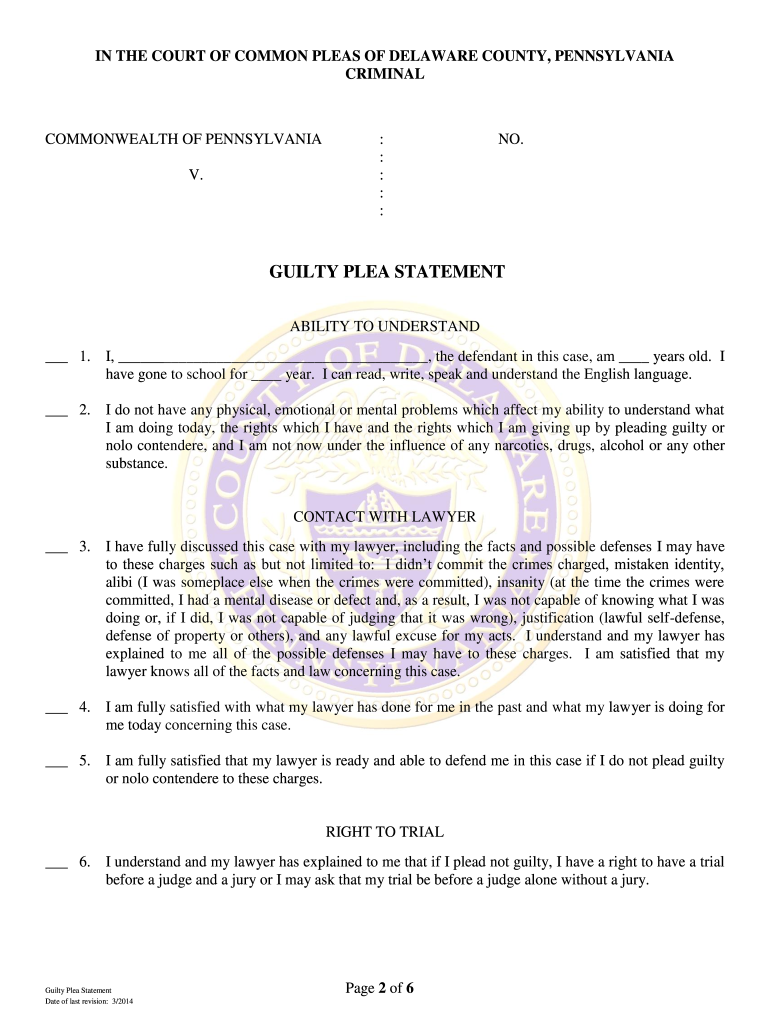
Pennsylvania plea statement form 2026

Get Form
pennsylvania plea statement form Preview on Page 1

Here's how it works

01. Edit your form online
Type text, add images, blackout confidential details, add comments, highlights and more.
02. Sign it in a few clicks
Draw your signature, type it, upload its image, or use your mobile device as a signature pad.
03. Share your form with others
Send it via email, link, or fax. You can also download it, export it or print it out.

How to use or fill out Pennsylvania Plea Statement Form with DocHub

Form edit decoration
9.5
Ease of Setup
DocHub User Ratings on G2
9.0
Ease of Use
DocHub User Ratings on G2
  1. Click ‘Get Form’ to open the Pennsylvania Plea Statement in our editor.
  2. Begin by filling in your personal information, including your name and age, in the 'Ability to Understand' section. Ensure you accurately represent your educational background and language proficiency.
  3. In the 'Contact with Lawyer' section, confirm that you have discussed your case thoroughly with your attorney. Initial each statement after confirming your understanding and satisfaction with their representation.
  4. Proceed to the 'Right to Trial' section. Here, acknowledge your rights if you choose to plead not guilty. Carefully read each statement and initial accordingly.
  5. In the 'Effect of Plea' section, understand the implications of pleading guilty or nolo contendere. Fill in any relevant details about the charges against you and initial each point after comprehension.
  6. Finally, review all sections for accuracy before signing. Use our platform’s features to save or share your completed form as needed.

Start using our platform today for free to complete your Pennsylvania Plea Statement efficiently!

See more pennsylvania plea statement form versions

We've got more versions of the pennsylvania plea statement form form. Select the right pennsylvania plea statement form version from the list and start editing it straight away!
Versions Form popularity Fillable & printable
2014 4.8 Satisfied (60 Votes)
be ready to get more

Complete this form in 5 minutes or less

Get form

Got questions?

We have answers to the most popular questions from our customers. If you can't find an answer to your question, please contact us.
Contact us
You may file a suit with a magisterial district judge at the Magisterial District Court if you have a complaint against a person or business and wish to recover an amount of money totaling $12,000 or less. This is called a civil lawsuit.
IN PENNSYLVANIA, small claims cases can be decided by Magisterial District Judges. A case can be filed in Magisterial District Court by any person who thinks he or she has a legal right to recover money from another person, or from a business.
All criminal cases (felonies, misdemeanors, and infractions, like traffic tickets); Small claims cases and appeals of small claims cases; Appeals of civil cases involving $35,000 or less; and. Appeals of infraction (like traffic) and misdemeanor cases.
The Court of Common Pleas, as the trial court, hears major civil and criminal cases. The Court also decides cases involving adoption, divorce, child custody, abuse, juvenile delinquency, estates, guardianships, charitable organizations and many other matters.
Generally, you need to stop into the court in person to enter a not guilty plea, but some courts will let you enter the plea by mail, phone, or online. Avoid delay.

Security and compliance

At DocHub, your data security is our priority. We follow HIPAA, SOC2, GDPR, and other standards, so you can work on your documents with confidence.

Learn more
ccpa2
pci-dss
gdpr-compliance
hipaa
soc-compliance
be ready to get more

Complete this form in 5 minutes or less

Get form

People also ask

A common pleas court has legal authority over adult felony criminal cases, bigger civil cases, and all other cases not handled by another, more specialized court.
Court of Common Pleas judges hear a broad spectrum of cases, including: Adult and juvenile criminal prosecutions. Lawsuits involving money or property. Divorce. Custody disputes. Child support issues. Adoptions. Estates.

Related links