Ohio ec99 1 2026

Get Form
ohio ec99 1 Preview on Page 1

Here's how it works

01. Edit your form online
Type text, add images, blackout confidential details, add comments, highlights and more.
02. Sign it in a few clicks
Draw your signature, type it, upload its image, or use your mobile device as a signature pad.
03. Share your form with others
Send it via email, link, or fax. You can also download it, export it or print it out.

How to use or fill out ohio ec99 1 with our platform

Form edit decoration
9.5
Ease of Setup
DocHub User Ratings on G2
9.0
Ease of Use
DocHub User Ratings on G2
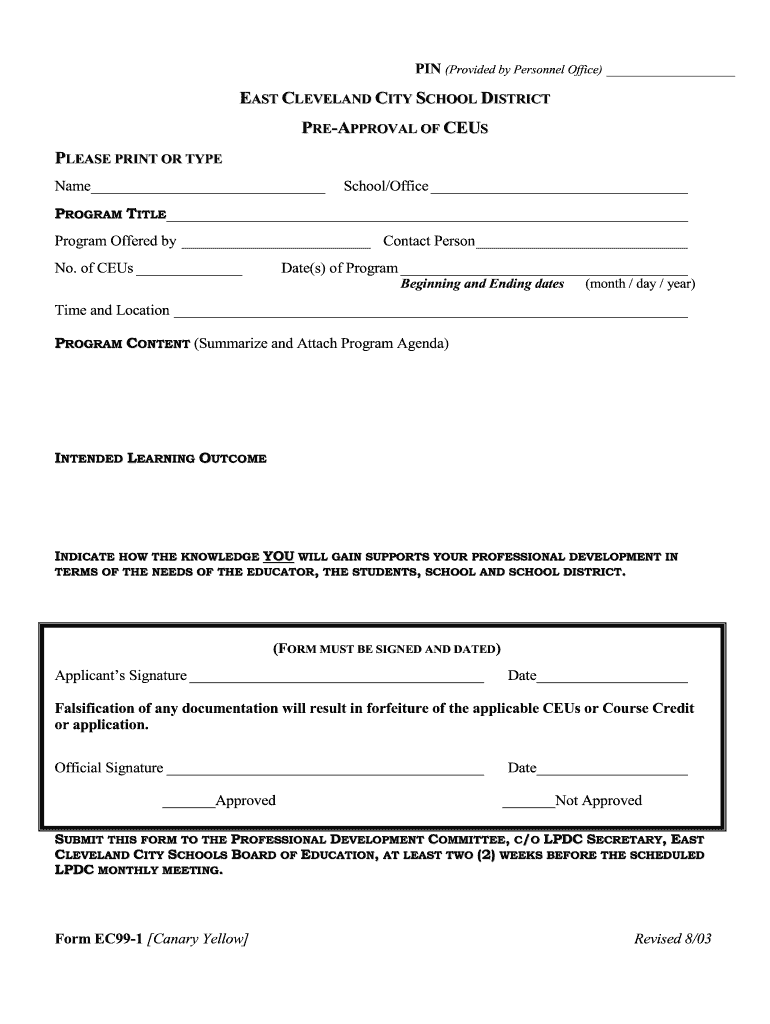
  1. Click ‘Get Form’ to open the ohio ec99 1 in the editor.
  2. Begin by entering your PIN provided by the Personnel Office at the top of the form.
  3. Fill in your name and school/office details clearly. Ensure that all information is printed or typed for legibility.
  4. Complete the program title, contact person, and number of CEUs. Be specific about the program offered.
  5. Input the dates of the program, including beginning and ending dates in the specified format (month/day/year).
  6. Summarize the program content and attach an agenda if necessary. Clearly state intended learning outcomes.
  7. Indicate how this knowledge supports your professional development needs, focusing on educators, students, and district goals.
  8. Sign and date the form at the bottom before submission to ensure compliance with requirements.

Start using our platform today to streamline your document editing and form completion process for free!

See more ohio ec99 1 versions

We've got more versions of the ohio ec99 1 form. Select the right ohio ec99 1 version from the list and start editing it straight away!
Versions Form popularity Fillable & printable
2003 4.8 Satisfied (160 Votes)
be ready to get more

Complete this form in 5 minutes or less

Get form

Got questions?

We have answers to the most popular questions from our customers. If you can't find an answer to your question, please contact us.
Contact us
Generally, HB 86 aimed to reduce the incarcerated population by utilizing community alternatives to incarceration particularly among low-level offenders, increasing the use of judicial release, and mandating risk assessments to better understand the needs of offenders and reduce recidivism.
Under Ohio law, you could be charged with drug possession if you had Schedule III, IV, or V drugs. If you have Schedule I or II drugs you could be charged with aggravated possession of drugs. Aggravated charges carry harsher penalties.
Only inmates who have completed the mandatory portion of their sentence are eligible to file for judicial release. An inmate whose criminal activities took place while holding public office or were directed against witnesses might not be eligible if the crime is one of those specified in Revised Code section 2929.20.
For a misdemeanor of the first degree, violators are not to serve more than six months in jail or pay more than $1,000 in fines. Examples of first-degree misdemeanors in Ohio include driving under the influence (DUI), driving under suspension (DUS), domestic violence, assault, or theft of property valued under $500.
Ohio House Passes Senate Bill 1. The Ohio House of Representatives today approved Senate Bill 1 legislation that works to bring a Students First agenda to Ohio Public Universities.

Security and compliance

At DocHub, your data security is our priority. We follow HIPAA, SOC2, GDPR, and other standards, so you can work on your documents with confidence.

Learn more
ccpa2
pci-dss
gdpr-compliance
hipaa
soc-compliance
be ready to get more

Complete this form in 5 minutes or less

Get form

People also ask

(D) A shareholder who knowingly receives any dividend, distribution, or payment made contrary to law or the articles shall be liable to the corporation for the amount received by that shareholder that is in excess of the amount that could have been paid or distributed without violation of law or the articles.
Among the changes, House Bill 86: (1) increases the maximum penalty for a first degree felony to 11 years incarceration; (2) modifies the range of penalties available for a third degree felony; (3) increases opportunities for eligible inmates to earn credit as a deduction from a prison term; (4) re-defines the term

Related links