Transform your document operations with Washington Real Estate Documents

Your workflows always benefit when you are able to discover all the forms and documents you will need at your fingertips. DocHub offers a a huge collection of form templates to alleviate your daily pains. Get a hold of Washington Real Estate Documents category and quickly find your form.

Start working with Washington Real Estate Documents in several clicks:

  1. Browse Washington Real Estate Documents and find the form you need.
  2. Click on Get Form to open it in the editor.
  3. Begin editing your document: add more fillable fields, highlight paragraphs, or blackout sensitive data.
  4. The application saves your modifications automatically, and once you are ready, you can download or share your file with other contributors.

Enjoy fast and easy record management with DocHub. Explore our Washington Real Estate Documents category and locate your form right now!


Video Guide on Washington Real Estate Documents management

video background

Commonly Asked Questions about Washington Real Estate Documents

Government Entities Government entities, whether federal, state, or local, are exempt from excise taxes. This includes government purchases and sales, as well as activities carried out by public schools and universities.
If you are thinking about purchasing or selling real estate in Vancouver or southwest Washington, you may wonder whether you really need to involve a real estate attorney. While many states legally require a real estate lawyer to participate in the closing process, Washington and Oregon do not.
A Washington self-proving affidavit form is a sworn statement that may be attached to a last will and testament in order to make it a self-proving will. The purpose of the affidavit is to provide the sworn testimony of any or all witnesses who signed the testators will.
Chapter 82.45 RCW imposes an excise tax on every sale of real estate in this state, at on a staggered rate based on the selling price. Unless otherwise specifically exempt from tax, all sales of real property are subject to the real estate excise tax.
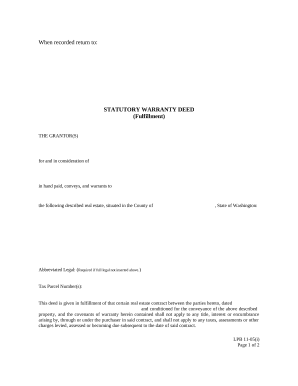
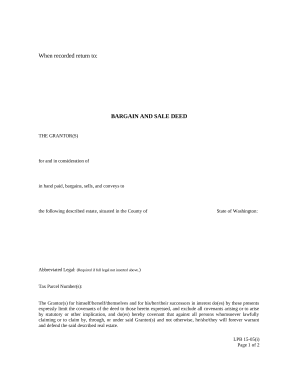
The deed includes the name of the buyer and seller and a detailed description of the property. Most importantly, the deed must contain proper legal language that conveys the transfer of property.
The seller of the property typically pays the real estate excise tax, although the buyer is liable for the tax if it is not paid. Unpaid tax can become a lien on the transferred property. REET also applies to transfers of controlling interest (50% or more) in entities that own real property in the state.
The REET is a percentage of the sale price of the property, and the exact rate varies depending on the location of the property and the type of sale. For most residential properties, the REET is between 1.1% and 3% of the sale price.
What is a reseller permit? Reseller permits are distributed by the State and allow: Retailers and wholesalers to purchase items for resale without paying sales tax. Manufacturers to purchase ingredients or components that are used to create a new article for sale without paying sales tax.