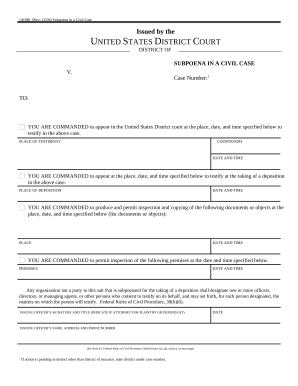
Improve your productivity with US District Court Legal Forms

Record managing consumes to half of your business hours. With DocHub, you can reclaim your time and effort and increase your team's efficiency. Get US District Court Legal Forms online library and explore all templates relevant to your everyday workflows.

Effortlessly use US District Court Legal Forms:

  1. Open US District Court Legal Forms and employ Preview to find the suitable form.
  2. Click Get Form to start working on it.
  3. Wait for your form to open in the online editor and start modifying it.
  4. Add new fillable fields, symbols, and images, adjust pages, etc.
  5. Fill out your file or prepare it for other contributors.
  6. Download or share the form by link, email attachment, or invite.

Speed up your everyday document managing with our US District Court Legal Forms. Get your free DocHub profile right now to discover all templates.


Video Guide on US District Court Legal Forms management

video background

Commonly Asked Questions about US District Court Legal Forms

Decisions of the United States Supreme Court bind all other federal courts; decisions of the various Circuit Courts of Appeals bind the federal district courts located within each circuit; and the decisions of district courts generally have no bind- ing precedential effect.
There are three general classes of cases in California: criminal, civil, and juvenile.
Federal case files are maintained electronically and are available through the internet-based Public Access to Court Electronic Records (PACER) service. PACER allows anyone with an account to search and locate appellate, district, and bankruptcy court case and docket information. Register for a PACER account.
District courts handle trials within the federal court system both civil and criminal. The districts are the same as those for the U.S. Attorneys, and the U.S. Attorney is the primary prosecutor for the federal government in his or her respective area.
Answer: Both civil and criminal cases are tried in U.S. District Courts. The specific kinds of cases are set forth in Article III of the U.S. Constitution and in federal statutes. These are controversies to which the United States is a party and controversies between two or more States.
More specifically, federal courts hear criminal, civil, and bankruptcy cases. And once a case is decided, it can often be appealed.
The U.S. district courts are the trial courts of the federal court system. The district courts can hear most federal cases, including civil and criminal cases.
The U.S. district courts are the trial courts of the federal court system. The district courts can hear most federal cases, including civil and criminal cases. There are 94 federal judicial districts in the United States and its territories. Each district includes a U.S. bankruptcy court.