

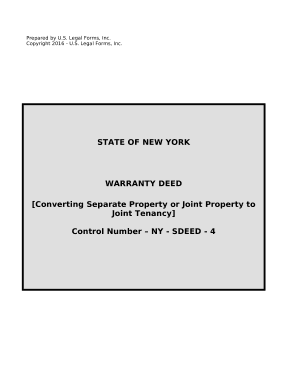
Separate or Joint Property Deeds

Get and manage Separate or Joint Property Deeds online

Accelerate your form operations with the Separate or Joint Property Deeds collection with ready-made document templates that suit your needs. Get the document, edit it, complete it, and share it with your contributors without breaking a sweat. Begin working more effectively with the forms.

The best way to manage our Separate or Joint Property Deeds:

  1. Open our Separate or Joint Property Deeds and look for the form you need.
  2. Preview your form to ensure it’s what you want, and click Get Form to start working on it.
  3. Change, add new text, or highlight important information with DocHub tools.
  4. Prepare your form and preserve the changes.
  5. Download or share your form with other people.

Examine all the opportunities for your online file administration with the Separate or Joint Property Deeds. Get your totally free DocHub profile right now!


Video Guide on Separate or Joint Property Deeds management

video background

Commonly Asked Questions about Separate or Joint Property Deeds

When you married your spouse, you may have already owned property or had cash savings or investments. Your spouse also may have entered the marriage with property, cash and/or investments. This is called separate property. During the marriage, you and your spouse most likely obtained more property and cash.
Joint Tenancies are co-ownership interest in real property. A Joint Tenancy must include these four unities: Unity of interest: The interest of each owner is equal. Unity of time: The interest of the owners is acquired at the same time. Unity of possession: The owners have the right of survivorship.
Generally, separate property is: Anything you earned or owned (or a debt) from before you married or after you separated. Anything you buy with separate property or you earn from separate property. Gifts or inheritance (to one of you) even if it was given or inherited when you were married.
In a joint family, family members share living spaces, resources, and responsibilities. A nuclear family focuses primarily on the core unit, and members often have separate living spaces. There is a sense of interconnectedness and interdependence among family members, and decisions are often made collectively.
Joint family property, comprising ancestral assets and contributions from family members, serves the collective needs of the family. In contrast, self-acquired property, attained through individual effort, grants exclusive ownership rights to the acquirer.
If a co-owner has outstanding debts, their creditors could seize an interest in your home or bank account. Relationship Issues. Holding an asset jointly can complicate a divorce or other relationship problems. If you have a jointly held bank account, your co-owner could withdraw all of the money without your consent.
Separate Property Trusts can be used to: Protect children from a previous marriage and their right to inherit. Protect personal assets from financial risks brought on by the other spouse. Ensure that new children (if a spouse remarries) do not have access to certain assets titled in the separate property Trust.
In the case of a Hindu joint family, there is a community of interest and unity of possession among all the members of the joint family and every coparcener is entitled to joint possession and enjoyment of the coparcenary property.
