Get and manage Right to Cure Lease Breach online

Speed up your file operations using our Right to Cure Lease Breach library with ready-made document templates that meet your needs. Get your document, change it, complete it, and share it with your contributors without breaking a sweat. Start working more effectively with the forms.

How to use our Right to Cure Lease Breach:

  1. Open our Right to Cure Lease Breach and look for the form you want.
  2. Preview your document to ensure it’s what you want, and click on Get Form to begin working on it.
  3. Modify, include new text, or point out important information with DocHub features.
  4. Fill out your form and save the adjustments.
  5. Download or share your form template with other recipients.

Examine all the opportunities for your online file management using our Right to Cure Lease Breach. Get your totally free DocHub account today!

Video Guide on Right to Cure Lease Breach management

video background

Commonly Asked Questions about Right to Cure Lease Breach

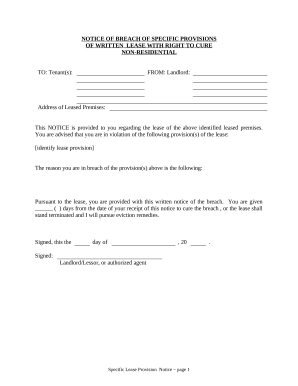
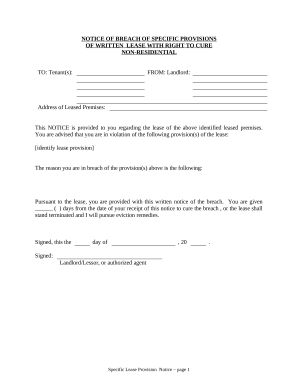
Cure or quit is a notice given to tenants to stop violating a clause of their lease agreement. Either state statute or the lease agreement will determine how long the tenant has to respond to or stop the prohibited activity. If the tenant refuses to stop, the landlord will file to evict the tenant.
Notice to Cure means a writing sent by one party to the other setting forth in detail an Event of Default by the receiving party and commencing the thirty (30) day period to cure the default.
Option to cure is a contract principle that, where available, allows a party to a contract to have the opportunity to correct their performance to align with their obligations in the contract.
The Notice to Cure gives you time to fix the problem. Important! If you dont correct the problem by the deadline in the notice, the landlord/owner must give you Notice of Termination ending your lease before starting a case against you. How does the landlord/owner start the case?
Generally, the longest cure period available under the law is until the last day of the calendar quarter following the quarter in which the missed payment was due. For example, if a borrower misses a monthly payment due in July, they would typically have until the end of December to make up the missed payment.
Notice and Cure Period: The clause may include a cure period, which gives the bdocHubing party an opportunity to correct the bdocHub within a specified timeframe. Termination: If the bdocHub is not cured within the cure period, the non-bdocHubing party may have the right to terminate the contract.
A Standard Clause for loan agreements permitting the parent company of the borrower or its financial sponsor to make an equity contribution to the borrower so that it can satisfy its financial covenant tests in the loan agreement.
In the context of contract law, the term cure means to correct or remove a defect that would be considered a bdocHub by the curing party. For example, a landlord may give the tenant a set amount of time to correct, or cure, a lease violation or face an eviction lawsuit.
A cure clause usually states that the non-bdocHubing party must give notice to the bdocHubing party of a bdocHub of contract that occurs, and that if the bdocHub is not fixed or cured within a certain time period, the contract will be terminated, canceled or litigation may commence.
Definition: Curing title is the process of fixing any issues or defects in a land title to make it legally valid and marketable. This is done to ensure that the property can be sold or transferred without any legal complications.