

Transform your form management with Quitclaim Deeds

Your workflows always benefit when you can easily obtain all of the forms and documents you will need on hand. DocHub supplies a a large collection form templates to alleviate your daily pains. Get a hold of Quitclaim Deeds category and easily discover your document.

Begin working with Quitclaim Deeds in a few clicks:

  1. Access Quitclaim Deeds and get the form you need.
  2. Click Get Form to open it in our online editor.
  3. Start adjusting your form: add more fillable fields, highlight sentences, or blackout sensitive info.
  4. The application saves your adjustments automatically, and after you are ready, you can download or share your form with other contributors.

Enjoy fast and easy form administration with DocHub. Explore our Quitclaim Deeds category and discover your form right now!


Video Guide on Quitclaim Deeds management

video background

Commonly Asked Questions about Quitclaim Deeds

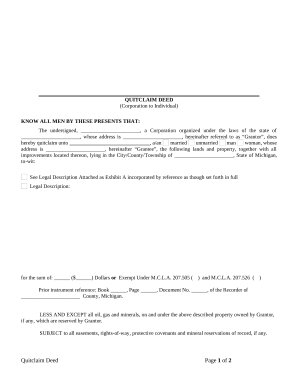
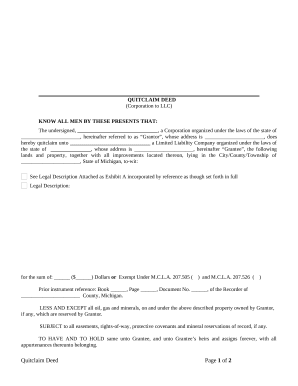
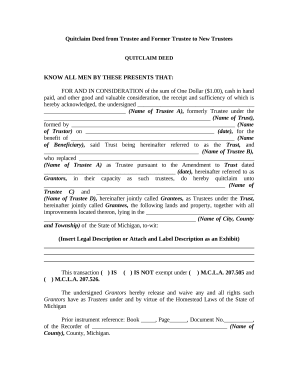
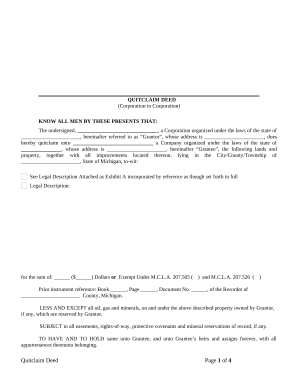
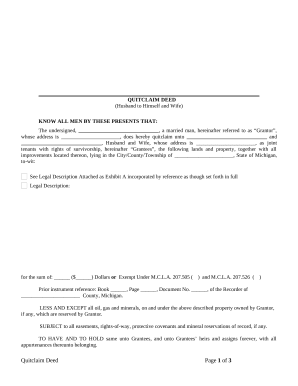
The process through which owners quit the claim on their properties is called quitclaim deeds. A quitclaim deed is named as such because it means that the owner is leaving behind their claim on the property. Unlike warranty deeds, quitclaim deeds offer zero buyer protection.
Generally, a quitclaim is a formal renunciation of a legal claim against some other person, or of a right to land. A person who quitclaims renounces or relinquishes a claim to some legal right, or transfers a legal interest in land.
A quitclaim is an act of giving up your ownership of a property and transferring it to another person. If your grandmother signs her house over to your dad, thats a quitclaim.
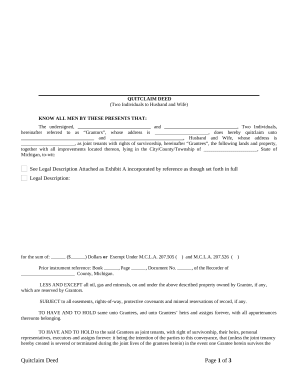
A quit claim deed is a form for the conveyance of interest in real property (real property is land. and anything permanently fixed on the land, such as a house). A quit claim deed must have a. Grantor (person conveying the property), a Grantee (person receiving the property), be in.
Quitclaim deeds lack certain protections and promises found in other types of deed to real property. Because of this, they should only be used under certain circumstances. These include transferring real estate between close family membersfor instance, from a parent to a child.
Canterbury, quitclaim of, 1189. Anglo-Scottish treaty. Immediately after Henry IIs death, William the Lion petitioned Richard I for full release from the oppressive terms imposed on Scotland by the treaty of Falaise.
Quitclaim deeds are typically used to transfer property in non-sale situations, such as transfers of property between family members.
