Enhance your output with Plaintiff Discovery Forms

Form administration occupies to half of your business hours. With DocHub, it is simple to reclaim your office time and boost your team's efficiency. Access Plaintiff Discovery Forms category and discover all form templates related to your everyday workflows.

The best way to use Plaintiff Discovery Forms:

  1. Open Plaintiff Discovery Forms and apply Preview to find the appropriate form.
  2. Click on Get Form to start working on it.
  3. Wait for your form to upload in the online editor and begin editing it.
  4. Add new fillable fields, symbols, and pictures, modify pages, etc.
  5. Fill out your document or set it for other contributors.
  6. Download or share the form by link, email attachment, or invite.

Accelerate your everyday document administration using our Plaintiff Discovery Forms. Get your free DocHub account right now to discover all templates.


Video Guide on Plaintiff Discovery Forms management

video background

Commonly Asked Questions about Plaintiff Discovery Forms

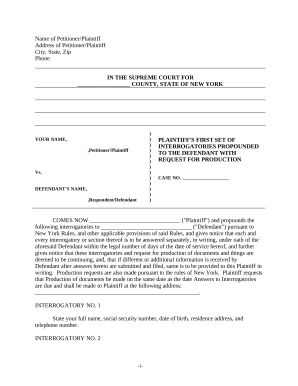
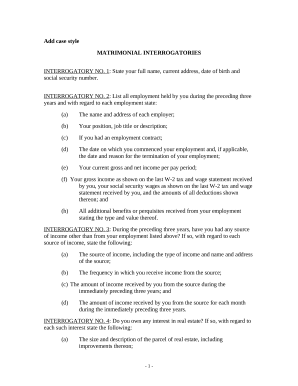
Formal Written Discovery is written questions and requests for documents. Its a time-consuming process, but necessary to gather the evidence we need for a final trial. This is where we ask questions and request documents from the other party, who must answer them under oath and with detail.
Discovery is how you gather the evidence you will need to prove your case as plaintiff, or defeat the plaintiffs case as a defendant. You use discovery to find out things like: What the other side plans to say about an issue in your case. What facts or witnesses support their side.
In the United States, there are five basic forms of discovery: depositions, interrogatories, requests for production of documents (or permission to inspect), physical and mental examinations, and requests for admission.
Steps in a Trial It s designed to prevent trial by ambush, where one side doesn t learn of the other side s evidence or witnesses until the trial, when there s no time to obtain answering evidence. One of the most common methods of discovery is to take depositions.
Discovery may be carried out by directly asking a person questions (oral depositions), by sending a person written questions (interrogatories and depositions on written questions), and by requesting that the person provide documents (motions for production, subpoenas duces tecum).
Disclosure is accomplished through a methodical process called discovery. Discovery takes three basic forms: written discovery, document production, and depositions.
Depositions are probably the most powerful discovery tool. Depositions, however, can be extremely expensive and are not always necessary or appropriate.
Write out each fact you wish the other party to admit is true. When writing these facts, be as clear and concise as possible. Each request must be for a single fact; do not include multiple facts, compound questions, or subparts.