

Transform your file management with Minnesota Real Estate Deeds

Your workflows always benefit when you can locate all of the forms and documents you need at your fingertips. DocHub supplies a vast array of forms to ease your day-to-day pains. Get hold of Minnesota Real Estate Deeds category and quickly find your form.

Start working with Minnesota Real Estate Deeds in several clicks:

  1. Gain access to Minnesota Real Estate Deeds and get the form you need.
  2. Click Get Form to open it in our online editor.
  3. Begin changing your form: add fillable fields, highlight paragraphs, or blackout sensitive details.
  4. The app saves your modifications automatically, and once you are all set, you can download or share your form with other contributors.

Enjoy seamless document administration with DocHub. Check out our Minnesota Real Estate Deeds online library and find your form today!


Video Guide on Minnesota Real Estate Deeds management

video background

Commonly Asked Questions about Minnesota Real Estate Deeds

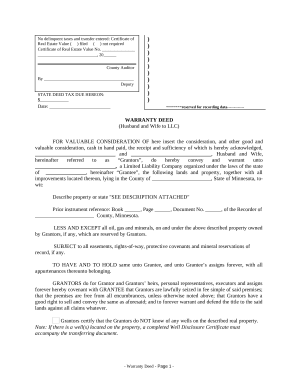
Current Owner and New Owner Information. A Minnesota deed must include the names of the current owner (the grantor) signing the deed and the new owner (the grantee) receiving title to the property. Deeds customarily state each partys address and marital status.
All types of documents Include date and signature. Verify that the legal description is complete and correct. Provide drafted by statement, which includes both the name and address of the document drafter. Acknowledgment must include: date, legible notary seal, notary signature and commission expiration date.
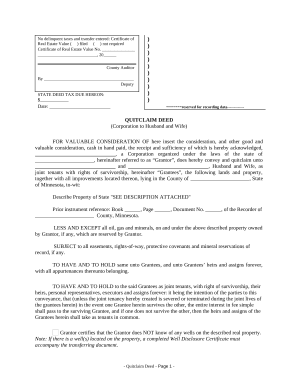
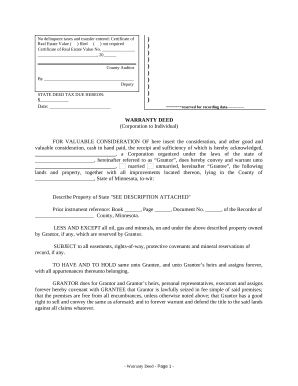
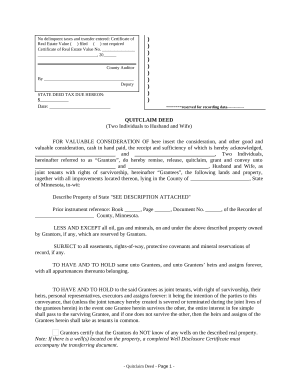
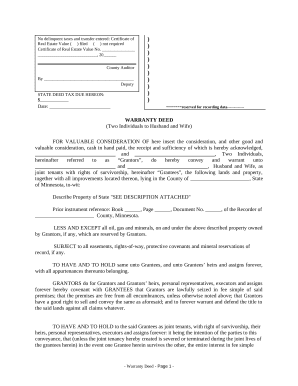
A Minnesota Quitclaim Deed does not provide any of the statutory covenants of title which are provided by a Minnesota Warranty Deed. In addition, the interest conveyed by the grantor in a Minnesota Quitclaim Deed: is limited to that which the grantor held at the time of execution of the deed, and.
There are several different essentials to a valid deed: 1. It must be in writing; 2. The parties must be properly described; 3. The parties must be competent to convey and capable of receiving the grant of the property; 4.
A deed is a written document which is executed with the necessary formality (that is, more than a simple signature), and by which an interest, right or property passes or is confirmed, or an obligation binding on some person is created or confirmed. Deeds are generally enforceable despite any lack of consideration.
For a deed to be valid, it must contain several essential elements, including the operative words of conveyance, description of the property, signatures, delivery, proper formatting and execution, absence of defects and encumbrances, legal capacity of parties, proper recording, and voluntary execution.
In Minnesota there are two systems of public real estate records, Abstract and Torrens. Abstract System of recording evidence of real estate title.
A gift deed, or deed of gift, is a legal document voluntarily transferring title to real property from one party (the grantor or donor) to another (the grantee or donee). A gift deed typically transfers real property between family or close friends.
