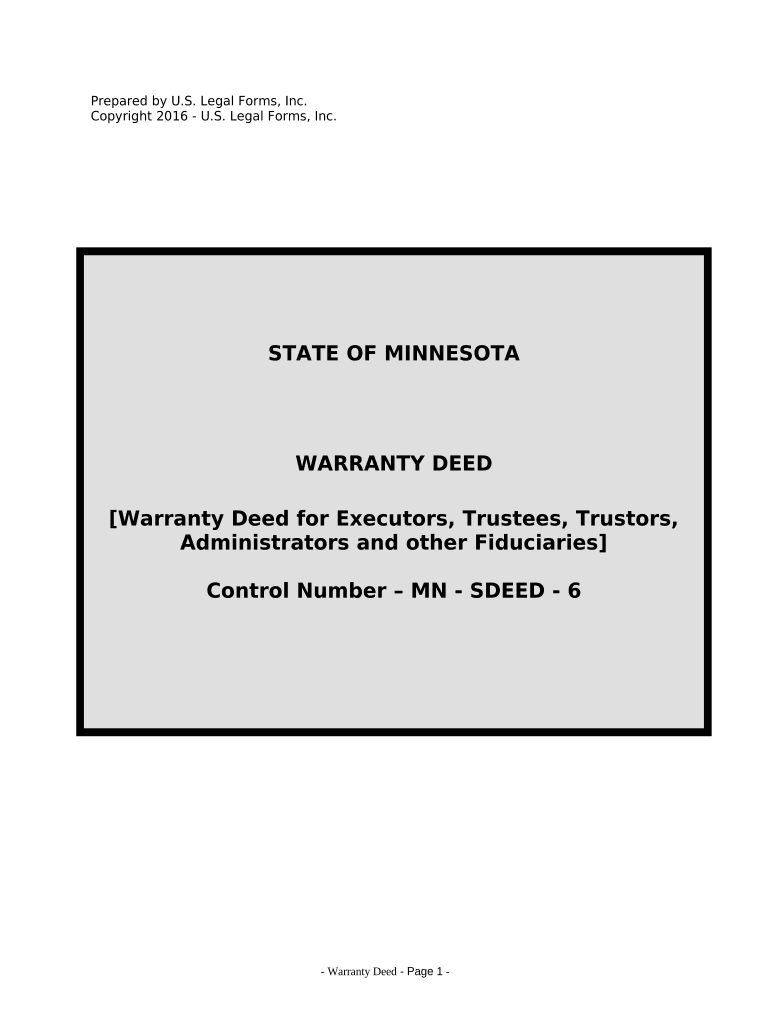
Fiduciary Deed for use by Executors, Trustees, Trustors, Administrators and other Fiduciaries - Minnesota 2025

Get Form
Fiduciary Deed for use by Executors, Trustees, Trustors, Administrators and other Fiduciaries - Minnesota Preview on Page 1

Here's how it works

01. Edit your form online
Type text, add images, blackout confidential details, add comments, highlights and more.
02. Sign it in a few clicks
Draw your signature, type it, upload its image, or use your mobile device as a signature pad.
03. Share your form with others
Send it via email, link, or fax. You can also download it, export it or print it out.

How to use or fill out Fiduciary Deed for use by Executors, Trustees, Trustors, Administrators and other Fiduciaries - Minnesota with our platform

Form edit decoration
9.5
Ease of Setup
DocHub User Ratings on G2
9.0
Ease of Use
DocHub User Ratings on G2
  1. Click ‘Get Form’ to open it in the editor.
  2. Begin by filling in the 'Grantor' section. Enter the name of the executor, trustee, or administrator along with their county and state.
  3. In the 'Grantee' section, specify the individual(s) receiving the property. Ensure you select whether they are joint tenants or tenants in common.
  4. Describe the property being transferred in detail. If necessary, attach a separate description document.
  5. Complete any additional fields regarding prior instruments and tax statements as required.
  6. Finally, sign and date the document where indicated. Ensure that a notary public acknowledges your signature for legal validity.

Start using our platform today to streamline your Fiduciary Deed completion process for free!

be ready to get more

Complete this form in 5 minutes or less

Get form

Got questions?

We have answers to the most popular questions from our customers. If you can't find an answer to your question, please contact us.
Contact us
Executors and trustees are both held to the highest fiduciary standard of care. They must act in the best interests of the beneficiaries, especially if it means putting their own interests aside. As fiduciaries, they must avoid any conflicts of interest.
Like a mortgage, a trust deed makes a piece of real property security (collateral) for a loan. If the loan is not repaid on time, the lender can foreclose on and sell the property and use the proceeds to pay off the loan. Deed of Trust and Promissory Note - Step by Step Guide Sacramento County Public Law Library resourcelibrary deed-of-trust-and- Sacramento County Public Law Library resourcelibrary deed-of-trust-and-
When someone dies owning an interest in real estate, the legal instrument used to transfer the property is a personal representative deed. Personal representative deeds provide essential information about the specific probate estate and related property transfer in one document.
A Fiduciary refers to any individual acting on behalf of another, and in Estate Planning this often means in a legal capacity. An Executor, on the other hand, is a much more narrow responsibility. Executors can only act on the terms laid out in a Will. Fiduciary vs Executor of Estate: What is the Difference? | Trust Will Trust Will learn fiduciary-vs-executor-o Trust Will learn fiduciary-vs-executor-o
warranty deed A warranty deed offers the strongest protection. It protects the party receiving the property title in case there turns out to be any issues with the title. Warranty Deed vs Quit Claim Deed: Whats the Difference? - Trust Will Trust Will learn warranty-deed-vs-quit- Trust Will learn warranty-deed-vs-quit-
be ready to get more

Complete this form in 5 minutes or less

Get form

People also ask

A fiduciary is someone who manages money or property for someone else. When youre named a fiduciary and accept the role, you must by law manage the persons money and property for their benefit, not yours. What is a fiduciary? | Consumer Financial Protection Bureau Consumer Financial Protection Bureau ask-cfpb what-is-a Consumer Financial Protection Bureau ask-cfpb what-is-a

Related links