Get and manage Legal Easement Documents online

Boost your form managing with the Legal Easement Documents collection with ready-made form templates that suit your needs. Get the document, change it, complete it, and share it with your contributors without breaking a sweat. Begin working more efficiently together with your forms.

How to use our Legal Easement Documents:

  1. Open our Legal Easement Documents and look for the form you need.
  2. Preview your form to ensure it’s what you want, and click Get Form to start working on it.
  3. Edit, include new text, or point out important information with DocHub features.
  4. Prepare your form and save the changes.
  5. Download or share your document with other recipients.

Examine all the possibilities for your online file administration with our Legal Easement Documents. Get a free free DocHub account today!


Video Guide on Legal Easement Documents management

video background

Commonly Asked Questions about Legal Easement Documents

In New York, an easement is a legal right that allows someone to use or access another persons property for a specific purpose. It grants a non-possessory interest in the land, meaning that the easement holder does not own the property but has a limited right to use it.
The two most common types of property easements are an express easement and a prescriptive easement. Out of the two types of easements, an express easement is the most common type of easement.
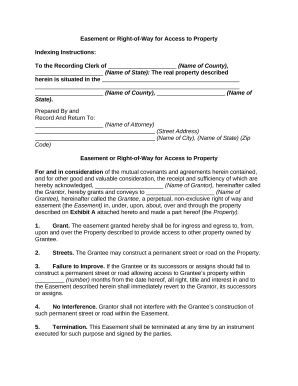
a. Express Grant: An easement can be created through a written agreement between the property owner (the grantor) and the person receiving the easement (the grantee). The agreement should be properly executed, signed, and recorded in the county where the property is located.
There are generally two types of easements described in New York State case law: (1) an easement appurtenant (or an easement that runs with the land); and (2) an easement in gross (or a personal easement/license).
Easements come in various forms, with two main types being Easement Appurtenant and Easement in Gross. These categories have unique characteristics, legal implications, and aspects related to transferability.
A prescriptive easement is a permanent legal right to use the real property belonging to another person, and is a form of adverse possession. It is created, not in a deed or other transaction, but by conduct: the open and hostile use of anothers property for a continuous period of at least 10 years (i.e., the New
An easement allows another person the right to use your land for a specific purpose. The most usual easements are those granted to public utility or telephone companies to run lines on or under your private property and to neighboring houses to use a common driveway to give access to their home.
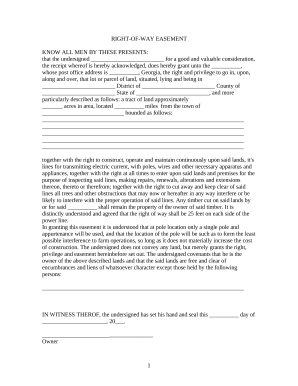
An easement gives people or organizations the right to access and use another persons property in specific situations for a limited purpose. A right of way is a type of easement that establishes the freedom to use a pathway or road on someone elses property, without conferring ownership.