
Enhance your output with Lease Agreement Violation Notices

Papers administration consumes to half of your office hours. With DocHub, you can reclaim your time and increase your team's productivity. Access Lease Agreement Violation Notices collection and investigate all document templates related to your everyday workflows.

The best way to use Lease Agreement Violation Notices:

  1. Open Lease Agreement Violation Notices and apply Preview to find the suitable form.
  2. Click Get Form to begin working on it.
  3. Wait for your form to open in our online editor and begin editing it.
  4. Add new fillable fields, icons, and pictures, modify pages, etc.
  5. Fill your template or prepare it for other contributors.
  6. Download or deliver the form by link, email attachment, or invite.

Speed up your everyday file administration with our Lease Agreement Violation Notices. Get your free DocHub account right now to explore all forms.


Video Guide on Lease Agreement Violation Notices management

video background

Commonly Asked Questions about Lease Agreement Violation Notices

In Texas, landlords have the right to issue a lease violation notice when tenants fail to comply with the terms of their lease. The notice should clearly outline the violation and provide a reasonable time frame for the tenant to remedy the issue or face potential eviction.
Inclusions of a Tenant Warning Letter The date that the tenant warning letter was written. The name and the basic personal information of the tenant. The name of the landlord or the owner of the property. The reason why a tenant warning letter has been written. The incident or situation that the tenant is involved in.
In a warning letter, you need to tell the tenant how they can resolve the problem after informing them of the violation. The solution may be paying money or stopping a specific action. Set out clear terms and consequences if the tenant continues their violation.
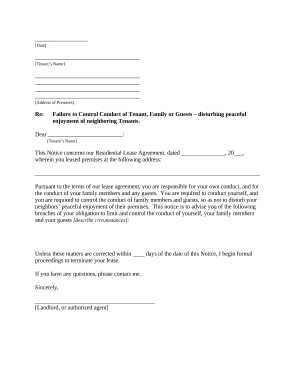
Dear [Tenants Name], This letter serves as notice that you are in violation of the lease agreement for the property located at [Property Address]. Specifically, the lease agreement requires that [specific lease violation]. We have received several complaints from other tenants regarding [specific violation].
Under Texas state law, a landlord is allowed to evict a tenant for violations of the rental or lease agreement, which could include unlawful stay, not moving out of the rental property after termination, and other similar scenarios.
