Raise your productiveness with Irrevocable Trust Agreements

Papers managing takes up to half of your office hours. With DocHub, it is easy to reclaim your time and effort and boost your team's productivity. Access Irrevocable Trust Agreements collection and explore all templates related to your daily workflows.

Easily use Irrevocable Trust Agreements:

  1. Open Irrevocable Trust Agreements and employ Preview to find the appropriate form.
  2. Click Get Form to begin working on it.
  3. Wait for your form to open in our online editor and begin editing it.
  4. Add new fillable fields, symbols, and pictures, adjust pages order, etc.
  5. Complete your form or set it for other contributors.
  6. Download or deliver the form by link, email attachment, or invite.

Improve your daily document managing using our Irrevocable Trust Agreements. Get your free DocHub account today to explore all templates.


Video Guide on Irrevocable Trust Agreements management

video background

Commonly Asked Questions about Irrevocable Trust Agreements

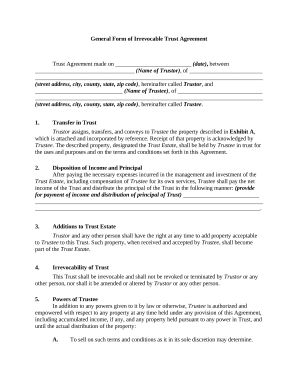
The grantor forfeits ownership and authority over the trust and its assets, meaning theyre unable to make any changes without permission from the beneficiary or a court order. A third-party member, called a trustee, is responsible for managing and overseeing an irrevocable trust.
There are several types of assets that should not be included in trusts for various reasons: Individual retirement accounts (IRAs) and 401(k)s. Health savings accounts (HSAs) and medical savings accounts (MSAs). Life insurance policies. Certain bank accounts. Motor vehicles. Social Security benefits.
With an irrevocable trust, the transfer of assets is permanent. So once the trust is created and assets are transferred, they generally cant be taken out again. You can still act as the trustee but youd be limited to withdrawing money only on an as-needed basis to cover necessary expenses.
Irrevocable trust distributions can vary from being completely tax free to being taxable at the highest marginal tax rates, and in some cases, can be even higher.
Some downsides of an irrevocable trust include the following: You will give up much more control over your financial affairs. Additional tax returns may need to be filed for the irrevocable trust, which can add cost and complexity. Irrevocable trusts may be more difficult to create and are nearly impossible to modify.
Types of Irrevocable Trusts Irrevocable life insurance trust (ILIT) Grantor-retained annuity trust (GRAT), spousal lifetime access trust (SLAT), and qualified personal residence trust (QPRT) (all types of lifetime gifting trusts)