

Security agreement 2026

Get Form
agreement security Preview on Page 1

Here's how it works

01. Edit your agreement security online
Type text, add images, blackout confidential details, add comments, highlights and more.
02. Sign it in a few clicks
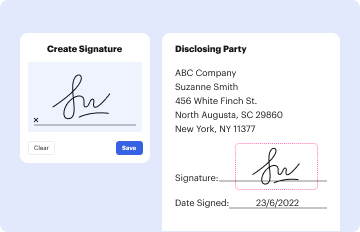
Draw your signature, type it, upload its image, or use your mobile device as a signature pad.
03. Share your form with others
Send online security agreement via email, link, or fax. You can also download it, export it or print it out.

How to use or fill out security agreement with our platform

Form edit decoration
9.5
Ease of Setup
DocHub User Ratings on G2
9.0
Ease of Use
DocHub User Ratings on G2
  1. Click ‘Get Form’ to open the security agreement in the editor.
  2. Begin by filling in the date at the top of the document. This is crucial as it establishes when the agreement takes effect.
  3. Next, enter the names and addresses of both parties: the Debtor and the Secured Party. Ensure accuracy to avoid any legal complications.
  4. In Section 1, define 'Collateral' by listing all tangible personal property that will secure the obligations. Refer to Exhibit 'A' for detailed descriptions.
  5. Proceed to Section 2 and confirm that you are granting a security interest in the collateral. This section solidifies your commitment.
  6. Complete Sections 3 through 10 by providing necessary representations, warranties, and covenants regarding the collateral's condition and insurance coverage.
  7. Finally, ensure all signatures are collected on the execution page at the end of the document. This finalizes your agreement legally.

Start using our platform today for free to streamline your document editing and signing process!

See more security agreement versions

We've got more versions of the security agreement form. Select the right security agreement version from the list and start editing it straight away!
Versions Form popularity Fillable & printable
2010 4.7 Satisfied (60 Votes)
be ready to get more

Complete this form in 5 minutes or less

Get form

Got questions?

We have answers to the most popular questions from our customers. If you can't find an answer to your question, please contact us.
Contact us
A security interest exists when a borrower enters into a contract that allows the lender or secured party to take collateral that the borrower owns in the event that the borrower cannot pay back the loan. The term security interest is often used interchangeably with the term lien in the United States.
A security agreement is the contract that protects a promissory note with collateral. The security agreement might describe the property or assets put up for collateral and will detail whether the lender can hold the collateral or how the lender can seize the collateral should non-payment occur.
A General Security Agreement (GSA) grants a security interest over personal property or assets, the collateral pledged for many types of financing. The contract is executed by a debtor (borrower) in favor of a creditor (lender). A GSA can support various lender obligations, including personal and commercial loans.
Types of Security Agreements Collateral: Collateral can be of various types as discussed previously. Intangible Goods: Often collateral can be intangible, such as software rights or intellectual property. Floating Liens: Floating liens can appear in security agreements. Security Agreement: Definition, Overview, Key Elements contractscounsel.com security-agreement contractscounsel.com security-agreement
Whats the difference between a security agreement and a UCC-1 filing? Security agreement = private contract creating the lien (must be specific). UCC-1 = public notice filing that can use all assets description under UCC 9-504.

People also ask

Security Agreements will routinely include provisions entitling the lender to seize and sell the collateral subject to the Security Agreement in the event of a payment or other default. Security Agreements typically come into two different formats, a General Security Agreement and; a Specific Security Agreement.
Security agreements can be ruled invalid because of mistakes in the debtors name. Be careful of related entities to make sure that the signature on your security agreement matches the correct legal name of the debtor.