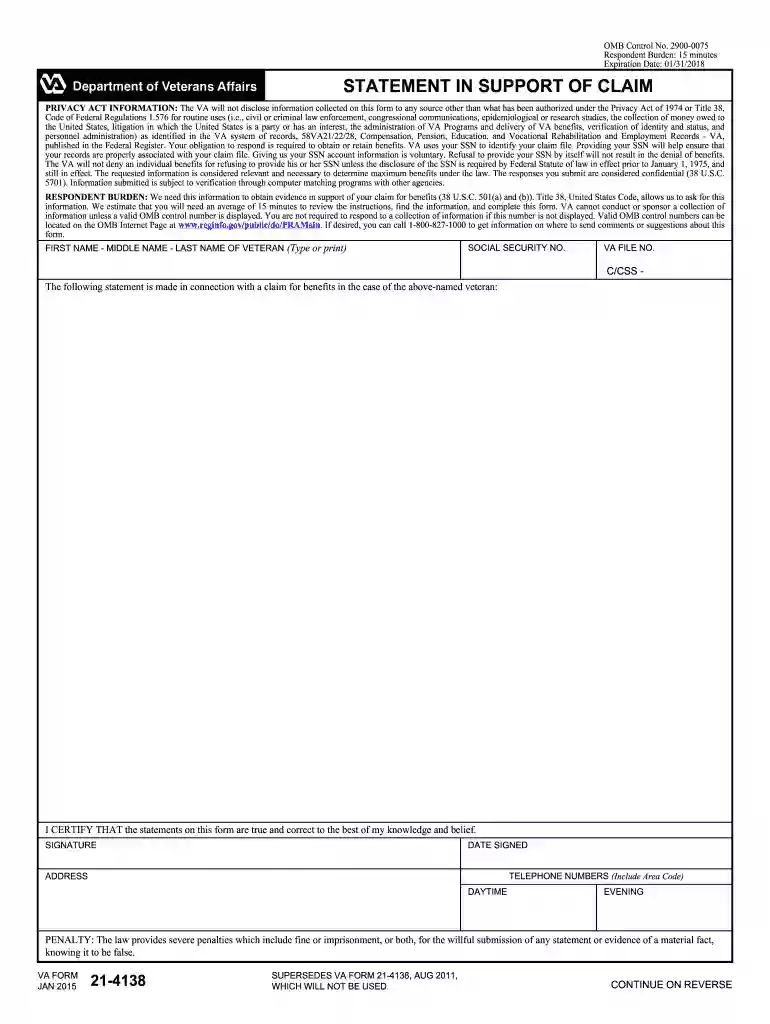
Va form 21 4138 2011-2026

Get Form
va for 21 4138 Preview on Page 1

Here's how it works

01. Edit your va for 21 4138 online
Type text, add images, blackout confidential details, add comments, highlights and more.

02. Sign it in a few clicks
Draw your signature, type it, upload its image, or use your mobile device as a signature pad.

03. Share your form with others
Send who signs va form 21 4138 via email, link, or fax. You can also download it, export it or print it out.

Definition and Meaning of VA Form 21-4138

VA Form 21-4138, also known as the Statement in Support of Claim, is a critical document utilized by veterans to provide information relevant to their benefits claims. This form serves as a platform for veterans to offer detailed accounts of personal experiences, service-connected events, or any supporting evidence they wish to accompany their claim for benefits. At its core, the VA Form 21-4138 acts as a narrative tool, allowing claimants to articulate their circumstances in a structured manner that supports their request for benefits.

Importance in Veterans Affairs Processing

  • Personal Statements: Allows veterans to provide firsthand accounts that detail the nature of their claims.
  • Supplementary Evidence: Complements other formal documents submitted during the claim application process.
  • Adjustment Requests: Can be used for appealing previous claims decisions, offering additional support or corrections.

How to Use the VA Form 21-4138

Effectively utilizing VA Form 21-4138 involves understanding its role in the veterans’ benefits claim process. Veterans should approach this form as an opportunity to elaborate on their claims with personal narratives or additional evidence that might not fit into other standardized forms.

  1. Provide Detailed Information: Clearly outline the events or conditions leading to the submission of the claim.
  2. Include Supporting Evidence: While the form itself is a statement, attaching medical records, service documents, or other pertinent materials enhances the claim's validity.
  3. Be Concise Yet Comprehensive: Clearly express details without omitting crucial information that could impact the claim.

Obtaining the VA Form 21-4138

Accessing the VA Form 21-4138 is straightforward, with various options available to ensure veterans can promptly begin their claims process.

Sources for Obtaining the Form

  • VA Regional Offices: Physical copies can be collected from regional Veterans Affairs offices.
  • Online Access: The form is available for download on the official VA website, allowing for easy online access.
  • Third-Party Sites: Some legitimate websites may offer the form for educational or information purposes; however, verifying the source is always prudent.

Steps to Complete the VA Form 21-4138

This section guides veterans through the necessary steps for accurately and efficiently completing the VA Form 21-4138.

  1. Download or Obtain Form: Start by acquiring the form via any of the mentioned channels.
  2. Complete Personal Information: Fill out required fields such as name, Social Security number, and contact details.
  3. Draft the Statement: Clearly articulate the particulars of your claim. Use headings or bullet points for clarity if needed.
  4. Attach Additional Documents: Supplement your statement with any supporting documents.
  5. Review and Submit: Double-check for any errors or omissions before submitting the form through designated channels.

Key Elements of the VA Form 21-4138

Understanding the composition of the VA Form 21-4138 helps in effectively completing and submitting the claim.

Primary Components

  • Claimant Information: This includes personal details like address and contact information.
  • Statement Section: The main body where veterans describe the claim details.
  • Signature Requirement: Ensure that the form is signed and dated to validate the submission.

Eligibility and Typical Users of VA Form 21-4138

The use of VA Form 21-4138 is crucial for specific groups within the veterans' community.

Typical Users

  • Veterans Seeking Benefits: Individuals applying for or appealing a VA benefits decision.
  • Spouses or Family Members: Sometimes used by family members involved in a veteran's claims process.
  • Representatives of the Veteran: Individuals assisting the veteran in claims, such as legal representatives or service officers.

Legal and Supportive Use of VA Form 21-4138

VA Form 21-4138 holds significant legal weight and serves several purposes within the claims process.

Utilization by the VA

  • Claims Clarification: Provides context or clarification for claims evaluators during the review process.
  • Appeals and Adjustments: Essential in the appeals process where additional information or statements are critical.
  • Documentation of Events: Acts as an official record of events, ensuring that veterans’ voices are documented in their claims.

Examples and Use Cases for VA Form 21-4138

To illustrate its utility, consider practical scenarios where VA Form 21-4138 is indispensable.

Real-World Applications

  • Service-Connected Injuries: A veteran details specific incidents during service leading to their injury or condition.
  • Claim Appeals: Elaborating on previously submitted claims that require reevaluation or additional evidence.
  • Additional Evidence Presentation: Providing supplementary statements that bolster existing medical or service records.

These sections offer a comprehensive understanding of VA Form 21-4138, ensuring that veterans are well-equipped to navigate their benefits claims effectively.

See more va form 21 4138 2011 versions

We've got more versions of the va form 21 4138 2011 form. Select the right va form 21 4138 2011 version from the list and start editing it straight away!
Versions Form popularity Fillable & printable
2021 4.7 Satisfied (96 Votes)
2017 4.4 Satisfied (135 Votes)
2011 4.4 Satisfied (632 Votes)
2004 4.1 Satisfied (49 Votes)
2000 3.9 Satisfied (33 Votes)
be ready to get more

Complete this form in 5 minutes or less

Get form

Got questions?

We have answers to the most popular questions from our customers. If you can't find an answer to your question, please contact us.
Contact us
See which service-connected conditions the VA is most likely to approve for veterans disability benefits. Tinnitus, mental health conditions, musculoskeletal disorders, scars, and presumptive disorders are frequently approved VA disability claims.Sep 16, 2025
Under that code, slight impairment of the posterior thigh group, hamstring complex, warrants a noncompensable rating. A 10 percent rating is warranted for moderate impairment of such muscles. A 30 percent is warranted for moderately severe impairment and a 40 percent rating is warranted for severe impairment.
Under diagnostic code 6604, the VA disability rating for COPD is 10%, 30%, 60% or 100%, depending on the severity of the condition. The VA evaluates how long it takes the veteran with COPD to breathe, how much air theyre inhaling, how much air theyre exhaling, and the capacity to exercise.Sep 3, 2025
Friends, family, or coworkers can use VA Form 21-4138 to support the veterans claim and verify the physical or social limitations the veteran experiences due to their disability.Mar 10, 2023
Some of the most common hurdles in the VA claims process include: Lack of medical evidence: The absence of a diagnosis or insufficient documentation linking the condition to service can lead to denial. Missing service records: Lost or incomplete service records can weaken a claim.

Security and compliance

At DocHub, your data security is our priority. We follow HIPAA, SOC2, GDPR, and other standards, so you can work on your documents with confidence.

Learn more
ccpa2
pci-dss
gdpr-compliance
hipaa
soc-compliance

People also ask

Yes, you can submit VA Form 21-4138 (Statement in Support of Claim) online through the VA.gov website by uploading it as part of your claim or appeal, often using the QuickSubmit tool, or you can still mail the form if preferred, says VA.gov Home and Reddit r/VeteransBenefits. After completing the form (either digitally or by hand), you sign in to your VA account, find the option to submit supporting documents, and upload the scanned form to expedite your claim processing. How to submit VA Form 21-4138 online: Download Complete: Get VA Form 21-4138 from VA.gov and fill it out, then sign it. Scan: Scan the signed form to your computer. Log in: Sign in to your account on the VA.gov website. Upload: Use the QuickSubmit tool or the upload feature within your specific claim or decision review page to submit the form electronically. Other submission methods: Mail: Send the completed form to the VA Evidence Intake Center. In-Person: Submit at a VA Regional Office or VA medical center. AI can make mistakes, so double-check responsesAbout VA Form 21-4138 | Veterans Affairs - VA.govDec 18, 2025 Downloadable PDF. Download VA Form 21-4138 (PDF)VA.gov Home | Veterans AffairsUpload Evidence To Support Your Disability Claim | Veterans AffairsJun 9, 2023 If youre a service member filing a disability compensation claim through the Benefits Delivery at Discharge (BDD) progVA.gov Home | Veterans Affairs
The hardest VA claims to get often involve subjective conditions or proving a strong link (nexus) to service, with PTSD (especially from Military Sexual Trauma - MST), sleep apnea, chronic pain, tinnitus/hearing loss, and claims for aggravation of pre-existing conditions (like flat feet) being notoriously difficult due to lack of objective proof, poor in-service documentation, or proving the worsening went beyond natural progression. Exposure-related illnesses and secondary conditions also present DocHub challenges. Why These Claims Are Hard: PTSD/MST: Requires a verified stressor (hard for MST) and subjective symptoms, often lacking in-service records. Sleep Apnea: Needs a sleep study and proving service connection if not diagnosed in service, often linked to obesity or other issues. Tinnitus Hearing Loss: Common but require specific, calibrated audiograms and functional impact documentation, with tinnitus having a low maximum rating. Chronic Pain/Invisible Injuries: Difficult to objectively measure and often require detailed functional limitation descriptions. Aggravation of Pre-existing Conditions: Requires showing service worsened it beyond normal progression, needing strong before/after evidence and expert opinions. Toxic Exposures (Non-Presumptive): Proving exposure, latency, and nexus without robust scientific evidence is tough. Key Challenges Across Difficult Claims: Lack of In-Service Records: Missing documentation of events or symptoms at the time. Subjective Symptoms: Conditions like pain or mental health struggles are hard to objectively measure. Nexus (Link) Requirement: Proving the military event directly caused or aggravated the condition. How to Improve Your Chances: Gather Extensive Evidence: Buddy statements, personal journals, private medical records, and detailed timelines. Get Expert Opinions: Nexus letters from specialists are crucial. Document Functional Impact: Show how the condition affects your daily life and work. Build a Consistent Record: Show a clear story over time. AI can make mistakes, so double-check responsesWhat is the Hardest VA Claim to Get?Coskrey LawTop 10 Hardest VA Claims to Get Approved!Jan 27, 2026 doesnt meet the VAs cut offs above 0% you may only receive 0% service connected rating. and as long as the evidence YouTube VA Claims Insider
To prove erectile dysfunction (ED) to the VA, you need a current diagnosis, evidence linking it to service (direct or secondary to another condition like diabetes/PTSD), a medical nexus letter connecting the two, service treatment records (STRs), and supporting statements from yourself, a spouse, or buddies, along with potential SMC-K compensation. Gather medical records, get a strong nexus letter, detail your service event, and consider a spouse statement for a robust claim. Key Evidence to Gather Current Diagnosis: A formal diagnosis of ED from a doctor. Service Connection (The Nexus): Prove your ED stems from service. Direct: An injury (e.g., pelvic trauma) or event during service caused it. Secondary: It developed from a condition already service-connected (e.g., diabetes, prostate issues, PTSD, back problems) or medications for it. Medical Nexus Letter: A letter from your doctor (VA or private) stating your ED is at least as likely as not caused by service or another service-connected condition. Service Treatment Records (STRs): Military medical records showing issues or events during service. Post-Service Records: Continuous treatment records for ED and any underlying conditions. Supporting Statements: Your Statement: When it started, severity, impact on life/relationships. Spouse/Partner Statement: Details on the impact on your relationship. Buddy Statements: From fellow service members who witnessed the in-service event. VA Compensation Pension (CP) Exam: The VA examiner provides an opinion on service connection. How to Establish Service Connection For Direct Connection: Show a specific injury, event, or exposure in service led to ED. For Secondary Connection: Link ED to an existing service-connected condition (like diabetes) or its treatment, with a strong medical opinion. Additional Considerations Special Monthly Compensation (SMC-K): Even with a 0% rating, you might qualify for SMC-K for loss of a creative organ. Underlying Causes: ED can signal other issues like heart disease, depression, or diabetes, which should be explored and documented. This is for informational purposes only. For medical advice or diagnosis, consult a professional. Getting Veterans (VA) Disability for Erectile Dysfunction - CCK LawJul 29, 2025 Medical records and service records are usually the best forms of evidence to provide to ensure your VA claim is as stCCK LawVA Disability Rating for Erectile Dysfunction - Veterans GuideTo meet the VAs requirements for erectile dysfunction, youll need to show that you have a medical diagnosis. Youll also need toVeterans Guide

va form 21 4138 instructions