



Railroad commission of texas form p 5lc 2010-2026

Get Form
texas rrc login Preview on Page 1

Here's how it works

01. Edit your texas rrc login online
Type text, add images, blackout confidential details, add comments, highlights and more.

02. Sign it in a few clicks
Draw your signature, type it, upload its image, or use your mobile device as a signature pad.

03. Share your form with others
Send it via email, link, or fax. You can also download it, export it or print it out.

How to use or fill out railroad commission of texas form p 5lc 2010 with our platform

Form edit decoration
9.5
Ease of Setup
DocHub User Ratings on G2
9.0
Ease of Use
DocHub User Ratings on G2
  1. Click ‘Get Form’ to open it in the editor.
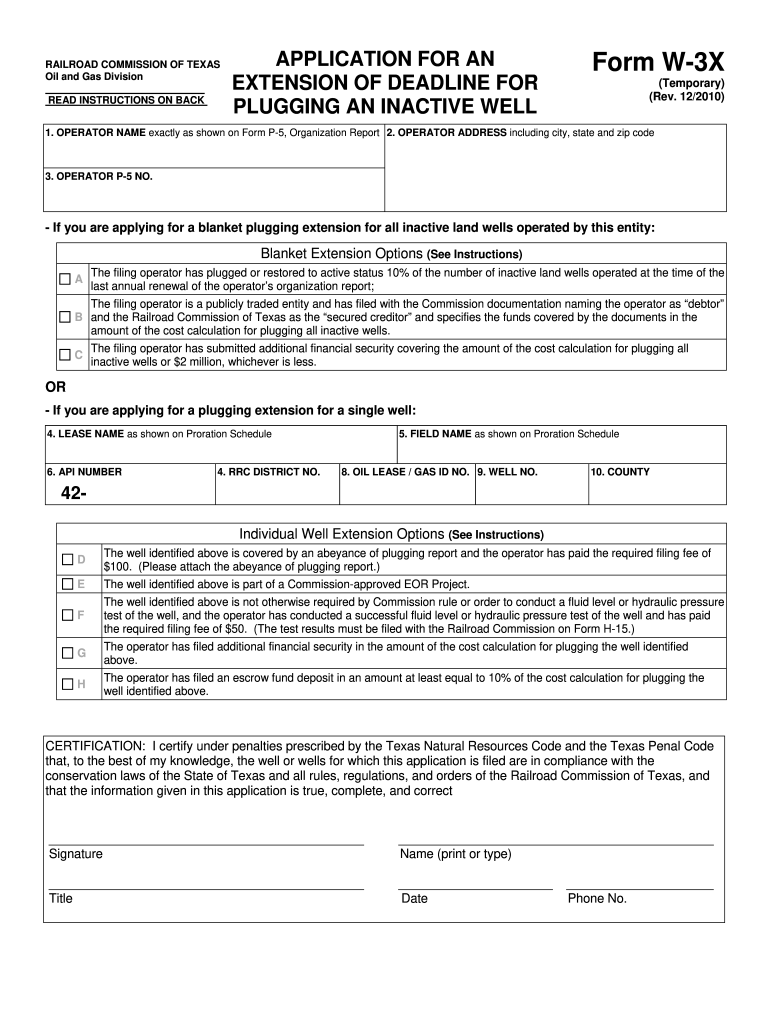
  2. Begin by entering the OPERATOR NAME exactly as shown on Form P-5, followed by the OPERATOR ADDRESS, including city, state, and zip code.
  3. Input your OPERATOR P-5 NUMBER. If applying for a blanket extension, select the appropriate option and provide any necessary supporting documentation.
  4. For individual well applications, complete items 4 through 10: include LEASE NAME, API NUMBER, RRC DISTRICT NO., FIELD NAME, OIL LEASE/GAS ID NO., WELL NO., and COUNTY.
  5. Choose the applicable individual well extension option and ensure all required fees are paid. Attach any necessary documents as specified in the instructions.
  6. Finally, certify your application by signing and dating the form before submitting it through our platform.

Start using our platform today to streamline your form completion process for free!

See more railroad commission of texas form p 5lc 2010 versions

We've got more versions of the railroad commission of texas form p 5lc 2010 form. Select the right railroad commission of texas form p 5lc 2010 version from the list and start editing it straight away!
Versions Form popularity Fillable & printable
2019 4.8 Satisfied (242 Votes)
2011 4.4 Satisfied (420 Votes)
2010 4.3 Satisfied (67 Votes)
be ready to get more

Complete this form in 5 minutes or less

Get form

Got questions?

We have answers to the most popular questions from our customers. If you can't find an answer to your question, please contact us.
Contact us
The P-5 bond is a license permit bond required by the Railroad Commission of Texas. P-5 surety bonds are required to ensure different aspects of operating and abandoning oil or gas wells are managed and/or completed in accordance with Texas laws and regulations.
The Railroad Commission of Texas (Commission) is the state agency with primary regulatory jurisdiction over the oil and natural gas industry, pipeline transporters, natural gas and hazardous liquid pipeline industry, natural gas utilities, the LP-gas industry, critical natural gas infrastructure, and coal and uranium
As of March 2022, the commission members are Wayne Christian (chairman), Christi Craddick, and Jim Wright. All three members are Republicans. Christian was elected in 2016 as a commissioner, and was selected as chairman in 2019.
What DOES NOT fall under the jurisdiction of the Railroad Commission? The Commission does not have jurisdiction over railroads, roads, traffic, noise, odors, oil and gas leases and agreements, pipeline easements or royalty payments.
Despite its name, it ceased regulating railroads in 2005, when the last of the rail functions were transferred to the Texas Department of Transportation. Established by the Texas Legislature in 1891, it is the states oldest regulatory agency, and it began as part of the Efficiency Movement of the Progressive Era.

Security and compliance

At DocHub, your data security is our priority. We follow HIPAA, SOC2, GDPR, and other standards, so you can work on your documents with confidence.

Learn more
ccpa2
pci-dss
gdpr-compliance
hipaa
soc-compliance
be ready to get more

Complete this form in 5 minutes or less

Get form

People also ask

The Railroad Commission of Texas hasnt had anything to do with railroads for almost two decades and, for advocates of government transparency, the agencys name is not just a harmless misnomer its a smoke screen that helps shield the Railroad Commission from public scrutiny and prevents voters from understanding

Related links

