Respondent ren incompatible 2026

Get Form
respondent ren incompatible Preview on Page 1

Here's how it works

01. Edit your form online
Type text, add images, blackout confidential details, add comments, highlights and more.
02. Sign it in a few clicks
Draw your signature, type it, upload its image, or use your mobile device as a signature pad.
03. Share your form with others
Send it via email, link, or fax. You can also download it, export it or print it out.

How to use or fill out respondent ren incompatible with our platform

Form edit decoration
9.5
Ease of Setup
DocHub User Ratings on G2
9.0
Ease of Use
DocHub User Ratings on G2
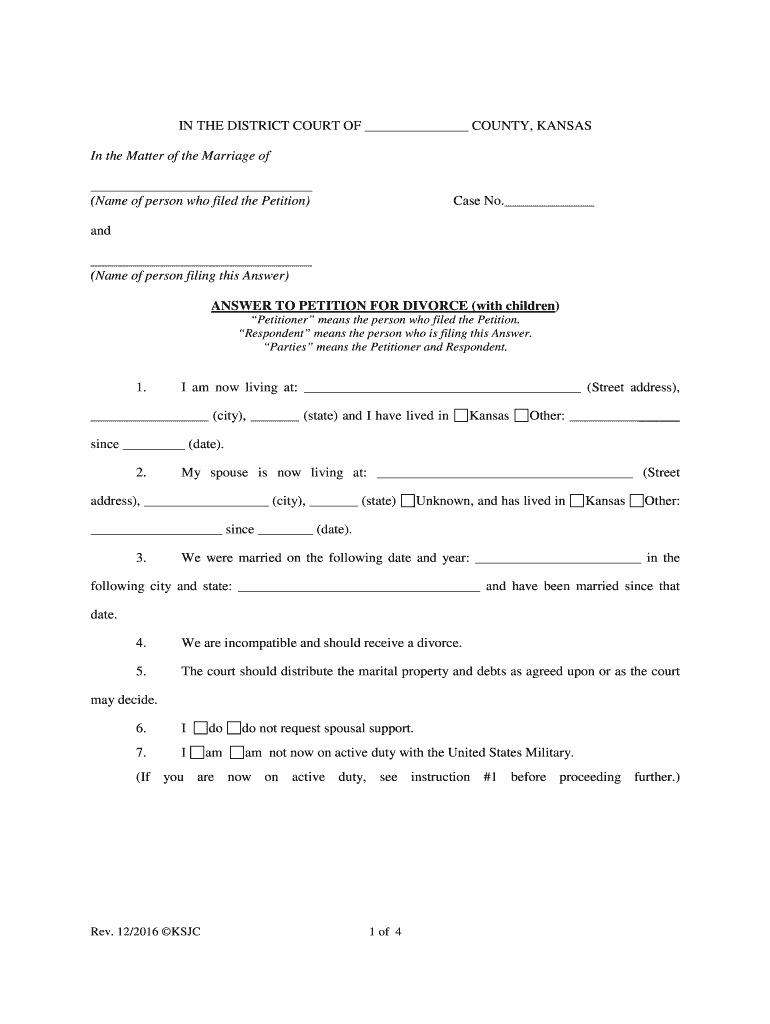
  1. Click ‘Get Form’ to open the respondent ren incompatible document in the editor.
  2. Begin by entering your current address in Section 1. Fill in the street address, city, state, and how long you have lived in Kansas.
  3. In Section 2, provide your spouse's current address and their duration of residence in Kansas. If unknown, indicate as such.
  4. Section 3 requires the date and location of your marriage. Ensure accuracy for legal purposes.
  5. In Section 4, confirm your incompatibility by checking the appropriate box.
  6. Section 5 allows you to outline how marital property and debts should be distributed. Be clear about your preferences.
  7. Indicate whether you request spousal support in Section 6 by checking 'do' or 'do not'.
  8. Complete Sections 7 through 14 as applicable, providing information about military service, children, and any previous court cases.
  9. Finally, sign the document at the bottom and ensure all required fields are filled before submitting.

Start using our platform today for free to streamline your document editing and signing process!

See more respondent ren incompatible versions

We've got more versions of the respondent ren incompatible form. Select the right respondent ren incompatible version from the list and start editing it straight away!
Versions Form popularity Fillable & printable
2016 4.8 Satisfied (290 Votes)
be ready to get more

Complete this form in 5 minutes or less

Get form

Got questions?

We have answers to the most popular questions from our customers. If you can't find an answer to your question, please contact us.
Contact us

Sure, and it’s really easy! DocHub is an online PDF editor with advanced document processing capabilities that allow you promptly adjust your forms, fill out empty fields and add new ones for others to fill out, and create electronic signatures in several ways. Import your respondent ren incompatible, provide information as requested, and decide how you want to eSign your document - by typing your name, drawing your signature, uploading its image, or utilizing a QR code.

If you are looking for a state-specific respondent ren incompatible sample, you can find it in our DocHub Forms & Templates catalog. Use the search field, key in your form’s name, and search through the results for your state. You may also filter out irrelevant results while exploring our catalog by groups.

The respondent is the party against whom a petition is filed, especially one on appeal. The respondent can be either the plaintiff or the defendant from the court below, as either party can appeal the decision thereby making themselves the petitioner and their adversary the respondent.
A respondent, also called a defendant, is the person who is named as the other party in the court action filed by the petitioner. This person can respond to the complaint by filing a cross application or written response with the court.
A respondent is a person who is called upon to issue a response to a communication made by another. The term is used in legal contexts, in survey methodology, and in psychological conditioning.

Security and compliance

At DocHub, your data security is our priority. We follow HIPAA, SOC2, GDPR, and other standards, so you can work on your documents with confidence.

Learn more
ccpa2
pci-dss
gdpr-compliance
hipaa
soc-compliance

People also ask

In legal matters, the respondent is essential to ensuring fairness, as they are given the opportunity to challenge the claims made by the petitioner or plaintiff. Their responses, whether in writing or in court, help the decision-making process by providing the necessary context, evidence, or legal arguments.

Related links