



Health care directive wisconsin 2026

Get Form
wisconsin living will form Preview on Page 1

Here's how it works

01. Edit your wisconsin living will form online
Type text, add images, blackout confidential details, add comments, highlights and more.

02. Sign it in a few clicks
Draw your signature, type it, upload its image, or use your mobile device as a signature pad.

03. Share your form with others
Send wisconsin power of attorney for health care via email, link, or fax. You can also download it, export it or print it out.

How to use or fill out health care directive wisconsin with our platform

Form edit decoration
9.5
Ease of Setup
DocHub User Ratings on G2
9.0
Ease of Use
DocHub User Ratings on G2
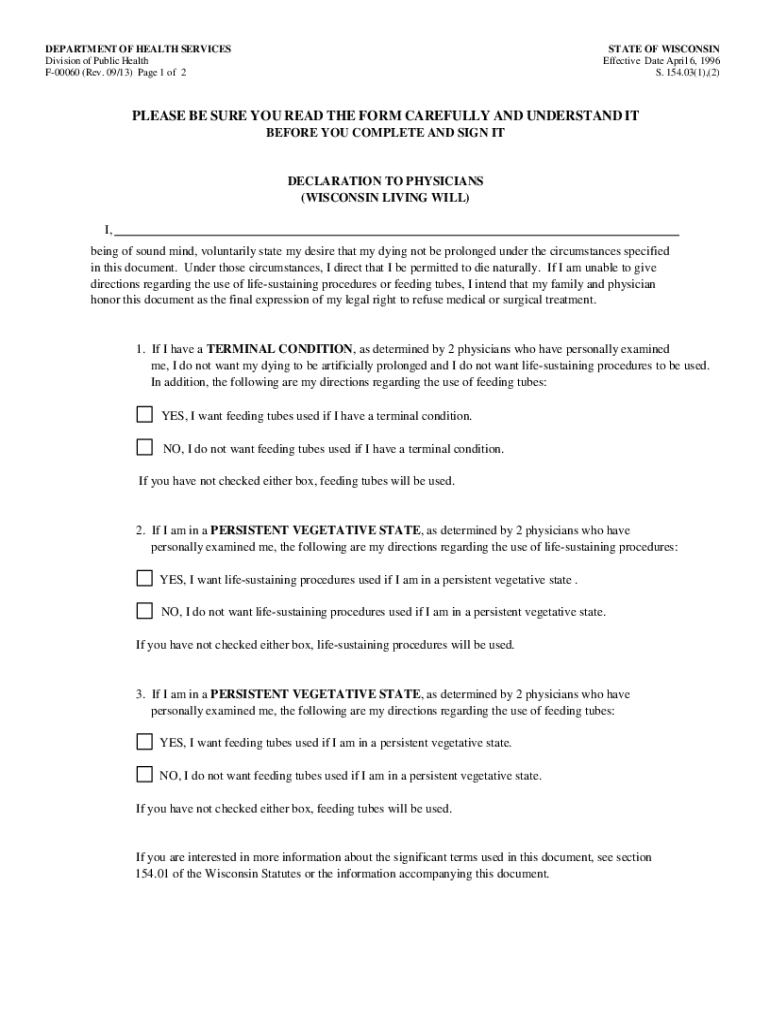
  1. Click ‘Get Form’ to open the health care directive Wisconsin in the editor.
  2. Begin by filling in your name and date of birth at the top of the form. This identifies you as the declarant.
  3. In Section 1, indicate your preferences regarding life-sustaining procedures if you have a terminal condition. Check 'YES' or 'NO' for feeding tubes.
  4. Proceed to Section 2 and specify your wishes for life-sustaining procedures if you are in a persistent vegetative state. Again, check 'YES' or 'NO'.
  5. In Section 3, make your choice about feeding tubes under the same conditions as above.
  6. Ensure that two witnesses sign the document simultaneously, confirming they meet the requirements outlined in the instructions.
  7. Once completed, save your document securely and inform your physician about its existence to ensure it is included in your medical records.

Start using our platform today to easily complete your health care directive Wisconsin for free!

See more health care directive wisconsin versions

We've got more versions of the health care directive wisconsin form. Select the right health care directive wisconsin version from the list and start editing it straight away!
Versions Form popularity Fillable & printable
2020 4.8 Satisfied (47 Votes)
2013 4.4 Satisfied (139 Votes)
2008 4 Satisfied (47 Votes)
be ready to get more

Complete this form in 5 minutes or less

Get form

Got questions?

We have answers to the most popular questions from our customers. If you can't find an answer to your question, please contact us.
Contact us
Types of Advance Directives Before you get started. The living will. Durable power of attorney for health care/Medical power of attorney. POLST (Physician Orders for Life-Sustaining Treatment) Do not resuscitate (DNR) orders. Organ and tissue donation.
An advance directive is a direction from the patient, not a medical order. In contrast, a POLST form consists of a set of medical orders that applies to a limited population of patients and addresses a limited number of critical medical decisions.
An Advance directive (also known as a living will) is a way to make sure that your wishes are known. You can make decisions in advance of care or name someone, known as a Medical Power of Attorney, to make those choices if you cannot.
An advance health care directive lets your physician, family, and friends know your health care preferences, including the types of special treatment you want or dont want at the end of life, your desire for diagnostic testing, surgical procedures, cardiopulmonary resuscitation and organ donation.
Advance Directive Mistakes to Avoid Mistake #1: Forgetting to Sign the Form. Mistake #2: Asking Medical Staff to Witness the Signature. Mistake #3: Using a Healthcare Agent as a Witness. Mistake #4: Listing Two Equal Healthcare Agents. Mistake #5: Not Choosing the Best Agent. Mistake #6: Not Documenting Your Wishes.

Security and compliance

At DocHub, your data security is our priority. We follow HIPAA, SOC2, GDPR, and other standards, so you can work on your documents with confidence.

Learn more

People also ask

In some states this directive may also be called a durable power of attorney for health care or a health care proxy.
Living Will, Power of Attorney forms, Authorization for Final Disposition.
It is important to have a Health Care Power of Attorney document. This allows you to formally choose a health care agent to make decisions for you in the event you are unable to make decisions for yourself. A lawyer or notary is not required to complete these forms.

Related links

