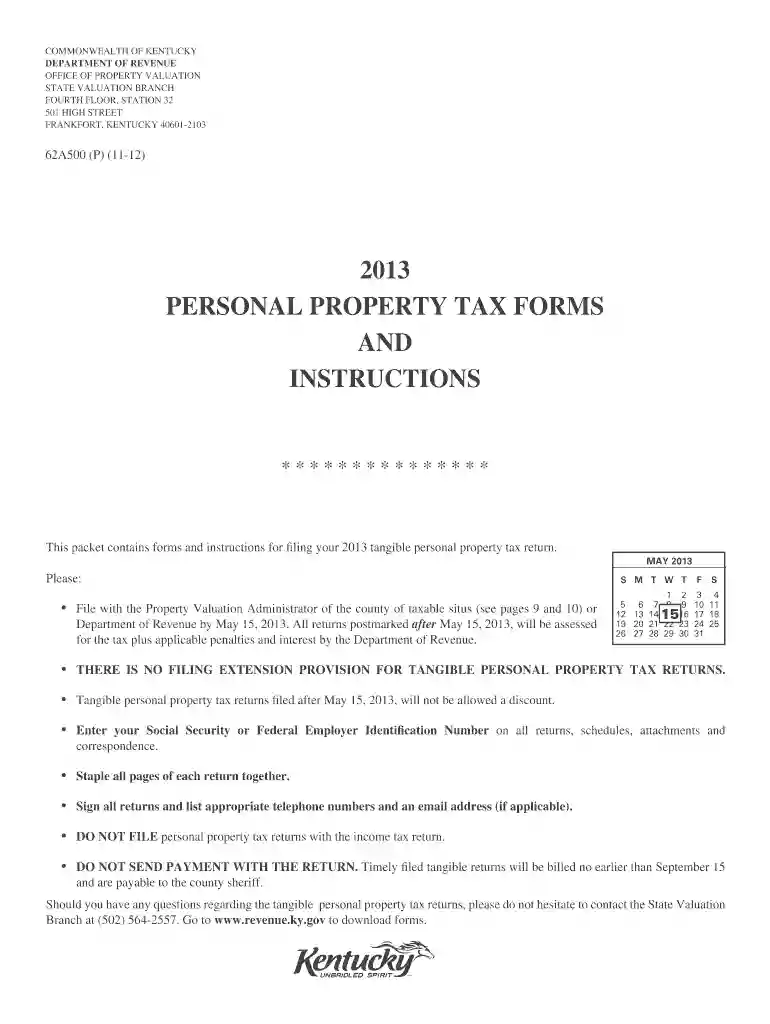
2013 personal property tax form-2026

Get Form
2013 personal property tax form Preview on Page 1

Here's how it works

01. Edit your form online
Type text, add images, blackout confidential details, add comments, highlights and more.

02. Sign it in a few clicks
Draw your signature, type it, upload its image, or use your mobile device as a signature pad.

03. Share your form with others
Send it via email, link, or fax. You can also download it, export it or print it out.

How to use or fill out 2013 personal property tax form with DocHub

Form edit decoration
9.5
Ease of Setup
DocHub User Ratings on G2
9.0
Ease of Use
DocHub User Ratings on G2
  1. Click ‘Get Form’ to open the 2013 personal property tax form in our editor.
  2. Begin by entering your name and business information in the designated fields. Ensure that you include your Social Security Number or Federal Employer Identification Number.
  3. Fill out the property location section accurately, providing the street address and county where the property is situated. Remember, a post office box is not acceptable.
  4. Complete Schedule A for depreciable assets, listing original costs and applying the appropriate factors to determine reported values based on economic life classifications.
  5. If applicable, complete Schedule C for other tangible personal property not listed elsewhere. Include details such as descriptions and values of items like precious metals or collectibles.
  6. Review all entries for accuracy, ensuring that all required signatures are included before submitting your completed form by May 15, 2013.

Start using our platform today to streamline your document editing and ensure a hassle-free filing experience!

See more 2013 personal property tax form versions

We've got more versions of the 2013 personal property tax form form. Select the right 2013 personal property tax form version from the list and start editing it straight away!
Versions Form popularity Fillable & printable
2023 4.2 Satisfied (29 Votes)
2022 4.8 Satisfied (212 Votes)
2021 4.4 Satisfied (197 Votes)
2020 4.3 Satisfied (247 Votes)
2019 4.4 Satisfied (91 Votes)
2018 4.3 Satisfied (119 Votes)
2016 4.3 Satisfied (192 Votes)
2015 4.3 Satisfied (70 Votes)
2014 4.4 Satisfied (37 Votes)
2013 4 Satisfied (48 Votes)
2012 4 Satisfied (49 Votes)
2011 4.2 Satisfied (53 Votes)
2002 4.3 Satisfied (181 Votes)
be ready to get more

Complete this form in 5 minutes or less

Get form

Got questions?

We have answers to the most popular questions from our customers. If you can't find an answer to your question, please contact us.
Contact us
Where to Report Personal Property on Your Taxes. Claim the itemized deduction on Schedule A State and local personal property taxes (Line 5c). Taxes you deduct elsewhere on your return like for a home office or rental dont qualify for this deduction.
Alabama law outlines four classes of property for Ad Valorem tax purposes, three of which apply to motor vehicles. The yearly Ad Valorem, or Property Tax, is based on the values assigned by the State of Alabama Department of Revenue.
If you are over 65 years of age, or permanent and totally disabled (regardless of age), or blind (regardless of age), you are exempt from the state portion of property tax. County taxes may still be due. Please contact your local taxing official to claim your homestead exemption.
State Individual Income Tax Rates and Brackets, as of January 1, 2025 StateSingle Filer (Rates)Married Filing Jointly (Rates) Alabama (a, b, c) 2.00% 2.00% Alabama 4.00% 4.00% Alabama 5.00% 5.00% Alaska none none21 more rows Feb 18, 2025
10 states with the highest property taxes States with the highest effective property tax ratesAverage amount paid (percentage of home value) 1. Illinois 1.83% 2. New Jersey 1.77% 3. Connecticut 1.48% 4. Nebraska 1.43%7 more rows Jul 22, 2025

Security and compliance

At DocHub, your data security is our priority. We follow HIPAA, SOC2, GDPR, and other standards, so you can work on your documents with confidence.

Learn more
ccpa2
pci-dss
gdpr-compliance
hipaa
soc-compliance
be ready to get more

Complete this form in 5 minutes or less

Get form

People also ask

Contact your County Assessors Office. For contact information, see the Missouri State Tax Commission website.
Personal property is considered Class II property and is taxed at 20 percent of market value. Market value multiplied by 20 percent equals the assessment value, which is then multiplied by the appropriate jurisdictions millage rates to determine the amount of tax due.
The type of business, type of equipment, acquisition year, and acquisition date are all used in calculating market values. For example, computer equipment depreciates more quickly than office furniture. Personal Property falls into Class II property and is assessed at 20% of its market value.

Related links