Massage Therapy Medical History Form 2026

Get Form
massage health history form Preview on Page 1

Here's how it works

01. Edit your massage health history form online
Type text, add images, blackout confidential details, add comments, highlights and more.

02. Sign it in a few clicks
Draw your signature, type it, upload its image, or use your mobile device as a signature pad.

03. Share your form with others
Send health history form massage therapy via email, link, or fax. You can also download it, export it or print it out.

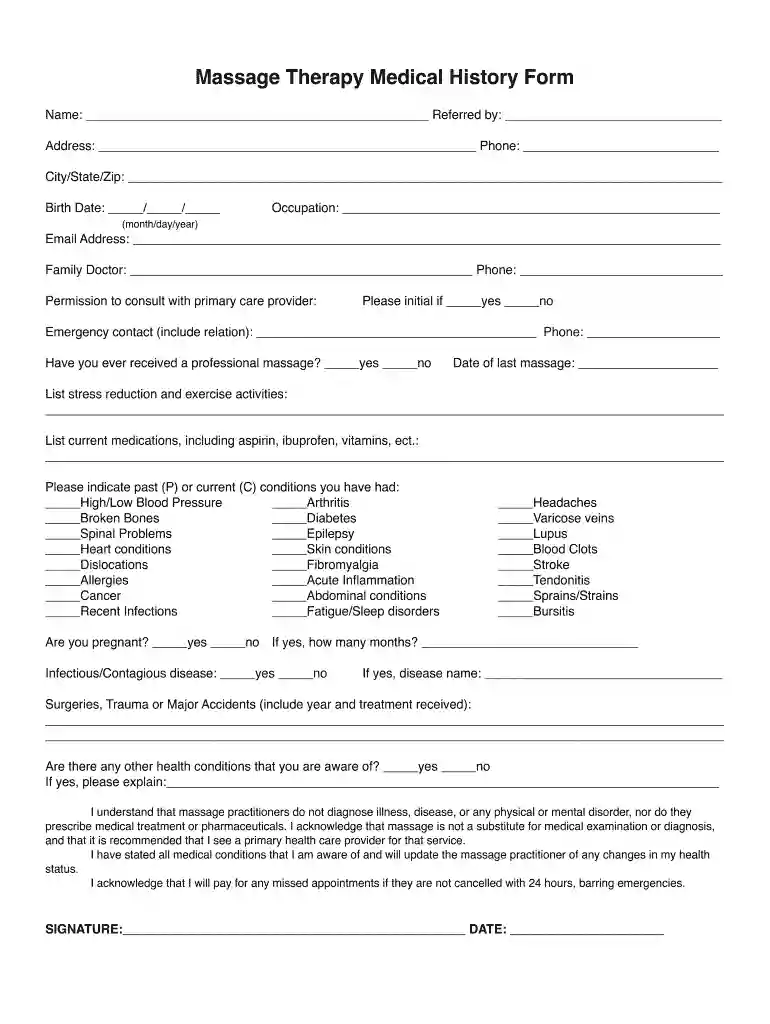
Key Components of a Massage Therapy Medical History Form

The Massage Therapy Medical History Form is a vital document for healthcare providers, specifically in the context of massage therapy. This form facilitates the collection of essential personal and medical information from clients. Understanding its components is crucial for both therapists and clients to ensure appropriate care and effective treatment plans.

Client Contact Information

Collecting accurate client contact information is the first step in the form. This section typically includes:

  • Full Name: Essential for identification and record keeping.
  • Address: Necessary for billing, correspondence, and verifying client identity.
  • Phone Number & Email: Critical for appointment reminders and follow-up communications.

Incomplete or inaccurate contact information can lead to missed appointments and disruption in communication about treatment plans or changes to services.

Medical History Disclosure

An exhaustive medical history section is fundamental for assessing a client's health needs. It encompasses:

  • Current Health Conditions: Clients should detail any ongoing medical issues, such as diabetes or hypertension, which may affect their treatment.
  • Past Health Conditions: Important for understanding previous health challenges.
  • Previous Injuries: Knowledge of past injuries helps therapists tailor their approach to prevent re-injury or exacerbation.
  • Surgeries: Information on past surgeries provides critical insight into possible complications or areas requiring special attention.

Clients should be encouraged to provide thorough disclosures, as incomplete information can compromise the quality of care.

Current Medications

This section requires clients to list all medications they are currently taking, including over-the-counter and herbal supplements. Accurate documentation of current medications is essential due to:

  • Potential Drug Interactions: Some medications may increase sensitivity to massage or blood circulation issues.
  • Specific Care Needs: Certain medications indicate the need for specific massage techniques or adjustments in treatment intensity.

Clients should also report any recent changes to medication or dosage to maintain an accurate and updated medical record.

Consent for Treatment

This is a critical section ensuring clients are informed and consenting to the services provided. Key components include:

  • Acknowledge Risks and Benefits: Clients must be aware of the potential benefits of massage therapy alongside any risks.
  • Right to Withdraw Consent: Clients should know they can withdraw consent at any time.
  • Confidentiality Assurance: This informs clients that their personal and medical information will be kept confidential, fostering trust in the therapeutic relationship.

Clarifying these points can prevent misunderstandings and establish an informed consent process.

Communication with Primary Care Provider

The form often includes a section allowing clients to grant permission for the therapist to communicate with their primary care providers. This feature enhances the continuity of care by:

  • Collaborative Treatment Plans: Sharing information with other healthcare providers ensures an integrated approach to the client's health.
  • Emergency Information Access: In emergencies, having access to clients' complete medical histories can be crucial for appropriate treatment.

Clients should carefully consider whom they authorize for information sharing, and they should have the option to revoke this consent at any time.

Limitations of Massage Therapy Practice

It is essential for clients to understand the limitations of massage therapy. This section might include explanations such as:

  • Not a Substitute for Medical Treatment: Clients must be informed that massage therapy does not replace medical diagnoses or treatments.
  • Scope of Practice: Therapists should clarify what conditions they are trained to treat and which require referral to a physician.

This understanding helps set realistic expectations for clients and fosters a collaborative healthcare environment.

Emergency Contact Information

Including an emergency contact section ensures that therapists can reach someone on behalf of the client if needed. This should contain:

  • Emergency Contact Name and Relationship: The designated contact person.
  • Phone Number: How to reach them quickly in an emergency.

Having this information readily available can provide peace of mind for both clients and therapists during sessions.

Additional Notes

Any additional notes or specific requests from the client can be captured in this section. This may include preferences for pressure during massage, sensitivity to particular areas, or concerns about specific techniques. Encouraging clients to share preferences fosters an individualized treatment approach that can improve their overall experience.

Thoroughly understanding the sections within the Massage Therapy Medical History Form helps ensure accuracy, comprehensive care, and optimized therapeutic outcomes.

See more Massage Therapy Medical History Form versions

We've got more versions of the Massage Therapy Medical History Form form. Select the right Massage Therapy Medical History Form version from the list and start editing it straight away!
Versions Form popularity Fillable & printable
2017 4.1 Satisfied (53 Votes)
be ready to get more

Complete this form in 5 minutes or less

Get form

Got questions?

We have answers to the most popular questions from our customers. If you can't find an answer to your question, please contact us.
Contact us
Verify Coverage with Your Insurance Company When you contact your insurance, ask about codes 97124 (Massage Therapy), 97140 (Manual Therapy), 97112 (Neuromuscular Re-Education), and 97010 (Hot/Cold Pack Therapy). Ask if your policy covers these treatments.
Although medical massage may use some of the same techniques as other types of massage, the main difference between medical massage and other massage types is that medical massage has a focused approach to specifically address a physician-diagnosed issue.
SOAP notes are a standard way of documenting massage therapy sessions. They allow you to track the progress of your clients, as well as provide information to insurance companies and other professionals. In this blog post, we will discuss how to write massage therapy SOAP notes, as well as provide some examples.
A comprehensive history intake includes the patients medical history, past surgical history, family medical history, social history, allergies, and medications.
One of the most effective ways to secure insurance coverage for massage therapy is to obtain a physician referral. Since massage therapists are not licensed to diagnose medical conditions, a physician referral with an ICD-10 diagnostic code increases the likelihood of insurance reimbursement.

People also ask

Coverage for medical massage therapy depends on how the treatment is classified by the insurance company. If it is deemed medically necessary or falls under habilitative or habilitation treatment, it may be covered as an essential health benefit.
How to Create a Massage Client Intake Form Step 1: Create a new Google Form. Step 2: Include questions for personal information. Step 3: Add a field to describe health history. Step 4: Add a field to mention areas of concern. Step 5: Include necessary consent agreements. Step 6: Create an intake document automatically.
The only way you can get them to pay for a massage is if you get a referral from your primary care doctor to a physical therapist and the physical therapist decides that you need it, AND that physical therapist even offers it.

health history form for massage therapy