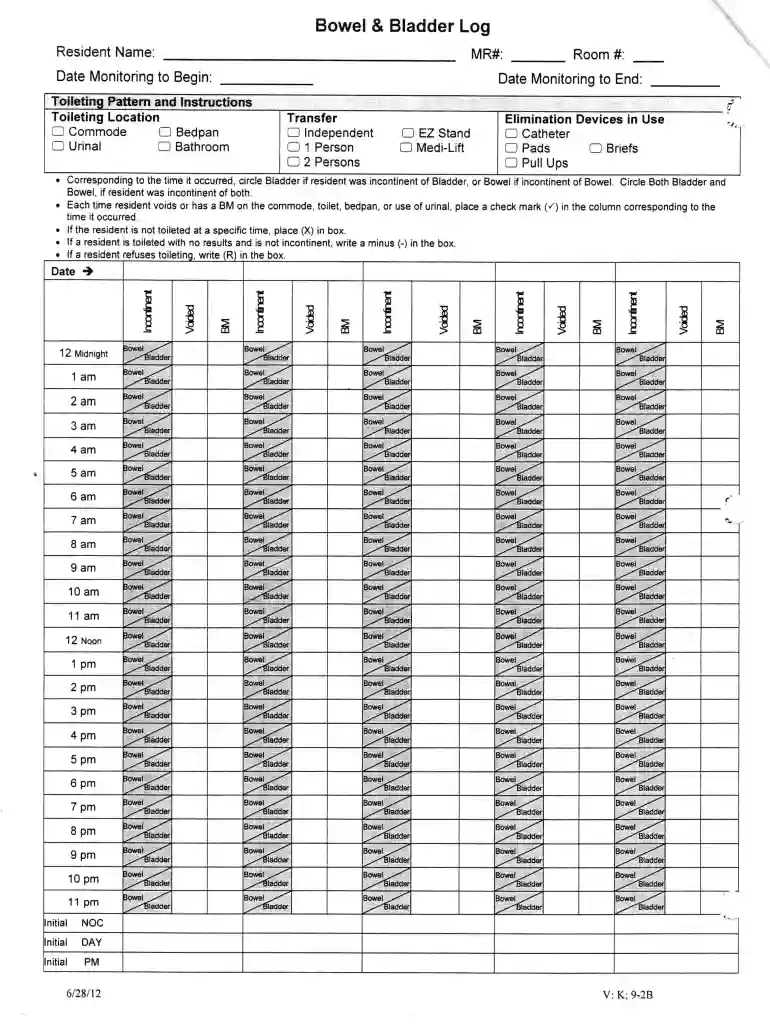
Bowel & Bladder Log 2026

Get Form
bowel and bladder tracking forms Preview on Page 1

Here's how it works

01. Edit your bowel and bladder tracking forms online
Type text, add images, blackout confidential details, add comments, highlights and more.

02. Sign it in a few clicks
Draw your signature, type it, upload its image, or use your mobile device as a signature pad.

03. Share your form with others
Send it via email, link, or fax. You can also download it, export it or print it out.

How to use or fill out Bowel & Bladder Log with our platform

Form edit decoration
9.5
Ease of Setup
DocHub User Ratings on G2
9.0
Ease of Use
DocHub User Ratings on G2
  1. Click ‘Get Form’ to open the Bowel & Bladder Log in the editor.
  2. Begin by entering the Resident Name and MR# at the top of the form. This information is crucial for accurate record-keeping.
  3. Specify the Date Monitoring to Begin and Date Monitoring to End. This helps track the duration of monitoring effectively.
  4. In the Toileting Pattern and Instructions section, indicate the Toileting Location by selecting from options like Commode, Urinal, Bedpan, or Bathroom.
  5. For Transfer assistance, choose between Independent, 1 Person, or 2 Persons based on the resident's needs.
  6. List any Elimination Devices in Use such as Catheter or Pads in the designated area.
  7. As you monitor, record each instance of voiding or bowel movement by placing a check mark in the corresponding time column. Use symbols like (X) for no toileting and (-) for no results.

Start using our platform today to easily manage your Bowel & Bladder Log online for free!

be ready to get more

Complete this form in 5 minutes or less

Get form

Got questions?

We have answers to the most popular questions from our customers. If you can't find an answer to your question, please contact us.
Contact us
The baseline bladder and chart is designed to help families who are working on the skills for potty or toilet training their child. It will give you information about when your child is passing (having a wee) or opening their (doing a poo). This can be used to help plan a toileting programme.
There are three major categories of bladder and dysfunction: Incontinence is the loss of control over the bladder or . Frequent urination is the need to urinate more than seven times in a 24 hour period. Constipation is difficulty passing stools and/or having infrequent movements.
A bladder diary helps show your bladder pattern of urinating. It is very important that you complete it accurately, so that the health professional can assist you manage any symptoms. Three days in a row is best, however, one fully completed 24 hour diary is a suitable minimum. On the chart you need to record:
The assessment should include questions about any other bladder or symptoms you or your child have noticed. There are also likely to be questions about your childs general health and development and about any treatments / medications they may be taking or have had in the past.
Recognize overactive bladder symptoms including incontinence, urinary urgency, and holding manoeuvres (i.e., crossing of legs) (1). Requesting and reviewing voiding and diaries (48 to 72 hours duration), a Bristol Stool Scale, and fluid/dietary intake can help to objectively identify patterns of BBD symptoms (1).

Security and compliance

At DocHub, your data security is our priority. We follow HIPAA, SOC2, GDPR, and other standards, so you can work on your documents with confidence.

Learn more
ccpa2
pci-dss
gdpr-compliance
hipaa
soc-compliance
be ready to get more

Complete this form in 5 minutes or less

Get form

People also ask

Write down every drink, every wee, and every poo. Write by the nearest hour or half hour you dont have to record the exact time. Please measure drinks/feeds in mls. In the Stool Type column, write down the number from the Bristol Stool Chart that best describes the poo see image below.
The Bristol Stool Chart is widely used as a research tool to evaluate the effectiveness of treatments for various diseases of the . The chart is used to describe the shapes and types of stools.

Related links