Ct au 524 2026

Get Form
au 524 Preview on Page 1

Here's how it works

01. Edit your au 524 online
Type text, add images, blackout confidential details, add comments, highlights and more.

02. Sign it in a few clicks
Draw your signature, type it, upload its image, or use your mobile device as a signature pad.

03. Share your form with others
Send it via email, link, or fax. You can also download it, export it or print it out.

How to use or fill out ct au 524 with our platform

Form edit decoration
9.5
Ease of Setup
DocHub User Ratings on G2
9.0
Ease of Use
DocHub User Ratings on G2
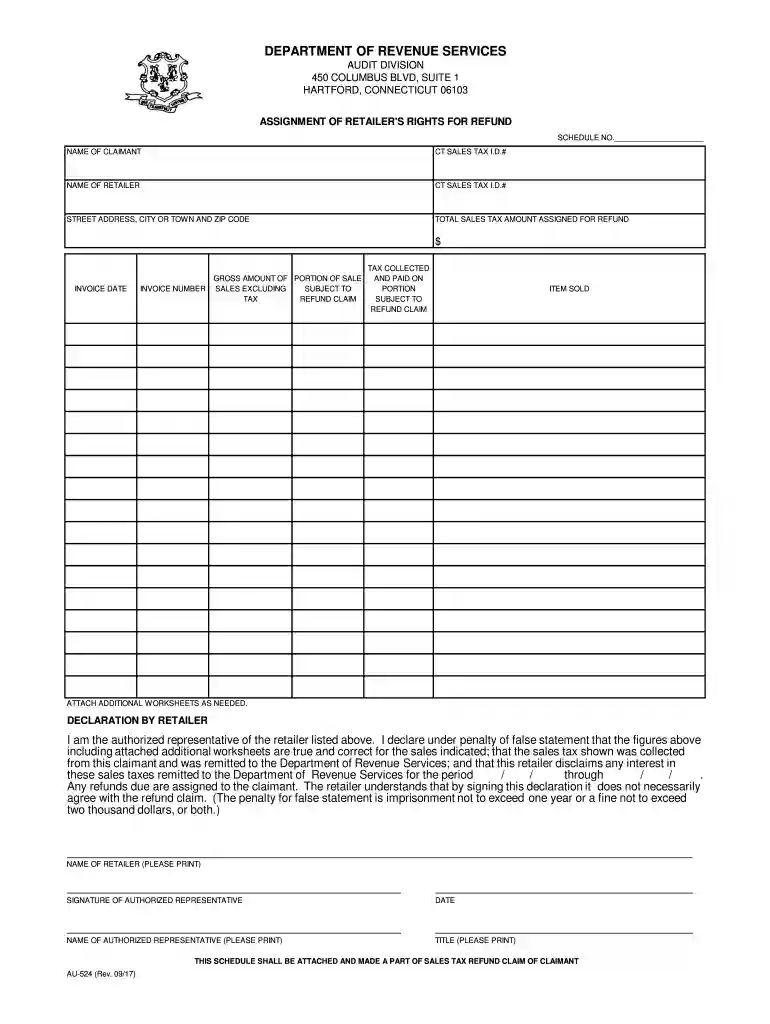
  1. Click ‘Get Form’ to open the ct au 524 in the editor.
  2. Begin by entering the 'Name of Claimant' and their CT Sales Tax I.D. number in the designated fields.
  3. Next, fill in the 'Name of Retailer' along with their CT Sales Tax I.D. number.
  4. Provide the complete street address, city or town, and ZIP code for both the claimant and retailer.
  5. Indicate the 'Total Sales Tax Amount Assigned for Refund' clearly in the specified field.
  6. Complete the invoice details by entering the 'Invoice Date' and 'Invoice Number'.
  7. Fill out the gross amount of sales excluding tax, tax collected, and paid on portions subject to refund claim.
  8. If necessary, attach additional worksheets for further details regarding items sold.
  9. Finally, ensure that an authorized representative signs and dates the declaration section at the bottom of the form.

Start using our platform today to easily fill out your ct au 524 form for free!

See more ct au 524 versions

We've got more versions of the ct au 524 form. Select the right ct au 524 version from the list and start editing it straight away!
Versions Form popularity Fillable & printable
2017 4.8 Satisfied (47 Votes)
2015 4.3 Satisfied (119 Votes)
1999 4.4 Satisfied (310 Votes)
be ready to get more

Complete this form in 5 minutes or less

Get form

Got questions?

We have answers to the most popular questions from our customers. If you can't find an answer to your question, please contact us.
Contact us
Effective for tax years beginning in 2024, CT Pass-Through Entity Tax will now be optional for all pass-through entities (Partnerships, S Corps, and when applicable LLCs). There will be an annual election that is due on the date the return is filed, including extensions.
There are four Refund Statuses that may be displayed: Status. Description. PROCESSED Your return has been processed and the refund has been issued. UNDER REVIEW Your return has been received and is being processed.
You must begin withholding at the highest marginal rate of 6.99%, from each employee who claimed exempt status from Connecticut income tax withholding in the prior year and who did not provide a new Form CT-W4 on or before February 15 of the current year.
The CT business entity tax is a tax required of all limited liability companies that operate in the state of Connecticut. The business entity tax costs $250 and is due every two years.
Stat. 12-425 sets out the specific procedures and requirements for refunds of sales and use taxes. No refund or credit will be allowed unless a claim is filed with the Commissioner within three years from the last day of the month next succeeding the period for which the overpayment was made.

Security and compliance

At DocHub, your data security is our priority. We follow HIPAA, SOC2, GDPR, and other standards, so you can work on your documents with confidence.

Learn more
ccpa2
pci-dss
gdpr-compliance
hipaa
soc-compliance
be ready to get more

Complete this form in 5 minutes or less

Get form

People also ask

As of July 9, 2024, 36 states (and one locality) had enacted a PTET intended to meet the requirements of Notice 2020-75. In addition, three states had PTET bills proposed during 2024 legislative sessions: Maine Legislative Document 1891 was a PTET bill carried over from the 2023 session.
What is a pass-through entity? Pass-through entities are businesses that pass their income directly to their owners, shareholders, or investors. Revenues are taxed only on individuals, not on the entity itself. Common types of pass-through entities include. Sole proprietorships.
For Distributive Share Percentage, see the instructions for Part 4 - Member Information, in the Form CT-PET instructions. Legislation makes the pass-through entity tax optional.

Related links