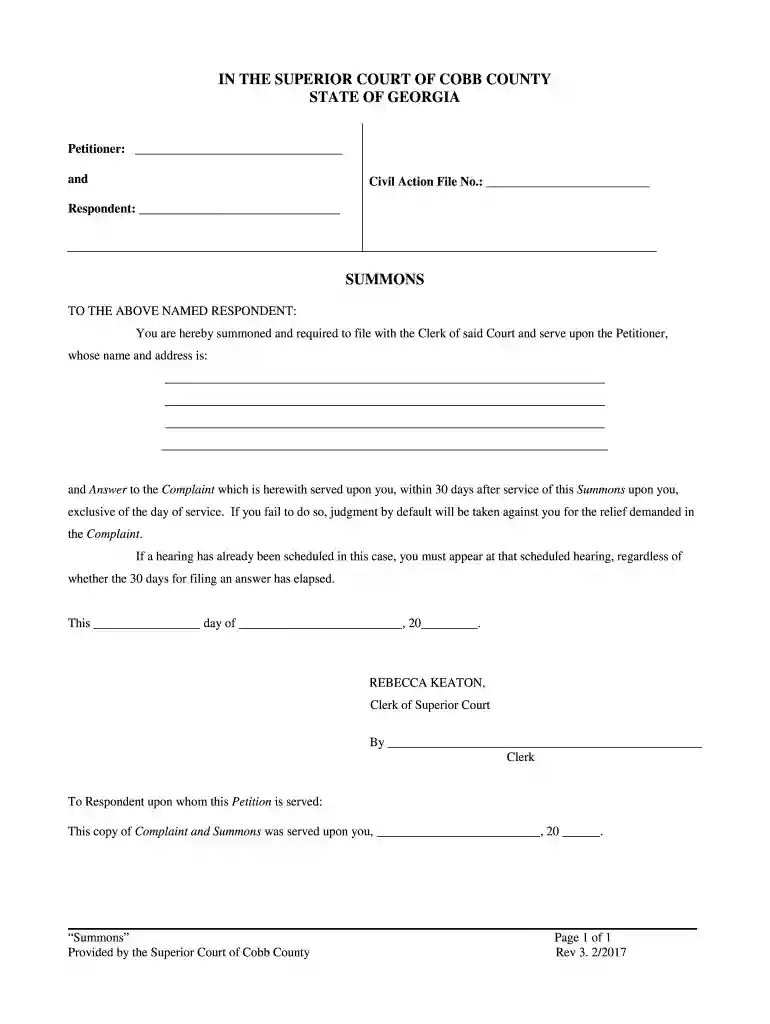
Georgia summons county superior court 2026

Get Form
cobb county superior court forms Preview on Page 1

Here's how it works

01. Edit your cobb county superior court forms online
Type text, add images, blackout confidential details, add comments, highlights and more.

02. Sign it in a few clicks
Draw your signature, type it, upload its image, or use your mobile device as a signature pad.

03. Share your form with others
Send cobb county court forms via email, link, or fax. You can also download it, export it or print it out.

How to use or fill out Georgia Summons County Superior Court with our platform

Form edit decoration
9.5
Ease of Setup
DocHub User Ratings on G2
9.0
Ease of Use
DocHub User Ratings on G2
  1. Click ‘Get Form’ to open the Georgia Summons in the editor.
  2. Begin by filling in the 'Petitioner' section with your name. This identifies who is initiating the action.
  3. Next, enter the 'Civil Action File No.' if available. This number helps track your case within the court system.
  4. In the 'Respondent' section, input the name of the individual or entity being summoned.
  5. Provide your address in the designated area for serving upon the Petitioner. Ensure this is accurate for proper communication.
  6. Review all entries for accuracy and completeness before finalizing your document.
  7. Once completed, save your document and utilize our platform’s features to print or share it as needed.

Start using our platform today to streamline your document editing and ensure a smooth filing process!

See more georgia summons county superior court versions

We've got more versions of the georgia summons county superior court form. Select the right georgia summons county superior court version from the list and start editing it straight away!
Versions Form popularity Fillable & printable
2017 4.8 Satisfied (157 Votes)
2002 4 Satisfied (58 Votes)
be ready to get more

Complete this form in 5 minutes or less

Get form

Got questions?

We have answers to the most popular questions from our customers. If you can't find an answer to your question, please contact us.
Contact us
The Superior Court is Georgias general jurisdiction trial court. It has exclusive, constitutional authority over felony, divorce, and equity cases, and cases regarding title to land.
A Judicial Hold is a temporary closure of a criminal case due to the defendant not being available for trial. Examples include the defendant failing to appear for court (bail jumping), the defendant being under medical care, and the defendant being on loan out to another jurisdiction.
Superior Court is responsible for handling cases involving serious crimes (felonies), civil disputes, real estate matters and family and domestic relations issues. State Court handles civil law actions not otherwise within the jurisdiction of Superior Court, dispossessions, misdemeanors, and certain traffic offenses.
Superior Court Judges preside over cases involving misdemeanors, contract disputes, premises liability, and various other actions. In addition, the Superior Court has exclusive equity jurisdiction over all cases of divorce, title to land, and felonies involving jury trials, including death penalty cases.
You must serve your opponent with a copy of your Answer and Counterclaim. Mail a copy of your Answer to the attorney representing your opponent, or directly to your opponent if s/he has no attorney. Mail your answer to the address which was stated on the Summons which you received.

Security and compliance

At DocHub, your data security is our priority. We follow HIPAA, SOC2, GDPR, and other standards, so you can work on your documents with confidence.

Learn more
ccpa2
pci-dss
gdpr-compliance
hipaa
soc-compliance
be ready to get more

Complete this form in 5 minutes or less

Get form

People also ask

It involves physically delivering the summons and complaint to the defendant. In Georgia, this is often done by a sheriffs deputy or a licensed process server. Service by Certified Mail: In some cases, Georgia law allows for service of a summons via certified mail.
a hold typically refers to a directive issued by a law enforcement agency or a court to detain or keep an individual in custody.

Related links