




01. Edit your dfas form sf 1174 online
Type text, add images, blackout confidential details, add comments, highlights and more.

Type text, add images, blackout confidential details, add comments, highlights and more.

Draw your signature, type it, upload its image, or use your mobile device as a signature pad.

Send sf 1174 via email, link, or fax. You can also download it, export it or print it out.
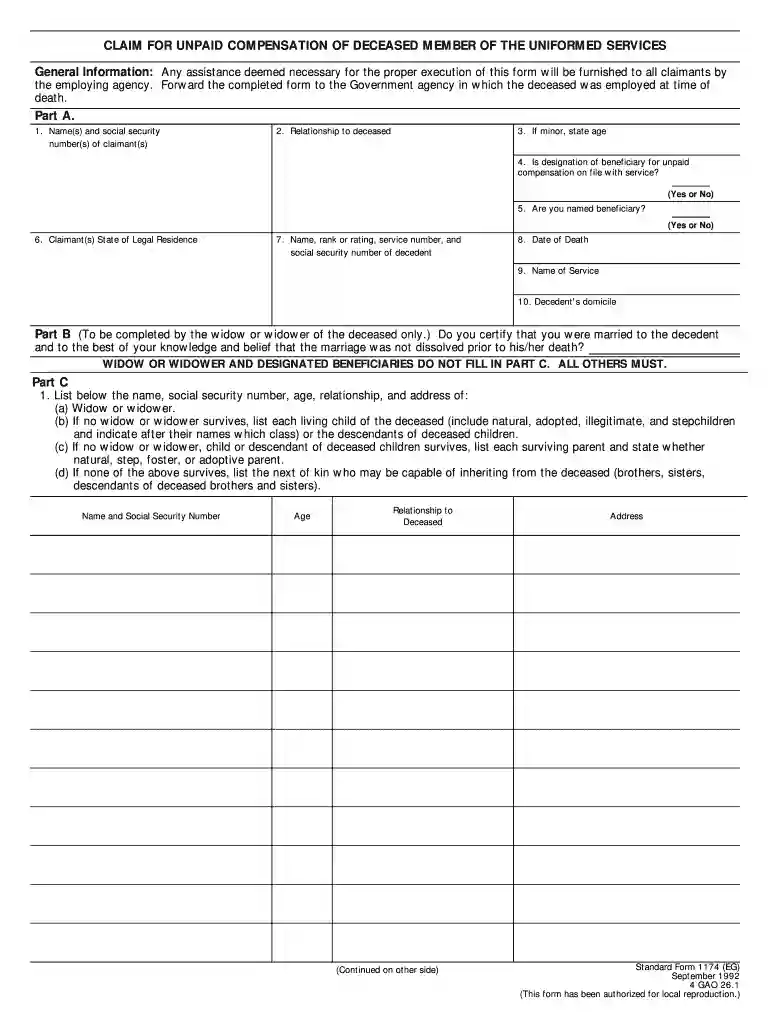
Form 1174, commonly used in the context of unpaid compensation for deceased members of the uniformed services, is essential for claimants seeking to collect these funds. This document gathers comprehensive details about the deceased's military service, the relationship between the claimant and the deceased, and information about any surviving family members. By accurately completing this form, claimants ensure they adhere to legal requirements while positioning themselves to receive any compensation due. The form serves not only as a claim document but also as a formal record, pivotal for legal and financial purposes.
Form 1174 requires details on the type and amount of unpaid compensation being claimed. This includes salary, allowances, or other entitlements the deceased was due at the time of their passing. Clear documentation of these amounts is essential in processing the claim efficiently. Claimants must ensure that all figures are accurate and substantiated with appropriate documentation. This step ensures that claims are processed smoothly and without delays, which might otherwise occur due to discrepancies or missing information.
The form mandates claimants to provide detailed information about their relationship with the deceased. Whether as a widow, widower, executor, or another potential beneficiary, delineating these connections is crucial. Claimants must also relay their contact information and potentially present official documents to prove their relationship. This process ensures that the claim aligns with the deceased's intended wishes and legal requirements.
To accurately complete Form 1174, claimants must follow a structured approach, ensuring all sections are done comprehensively. The form typically contains various sections, each requiring specific data. Starting from personal information, progressing through service details and specific claims, this sequential completion ensures no section is overlooked.
Primarily, this form is utilized by individuals entitled to unpaid compensations from the deceased’s service. These users include widows, widowers, children, or other legal beneficiaries. Legal representatives, such as executors or administrators of the deceased's estate, also frequently handle these forms, ensuring that the descendants receive rightful compensations.


The legal implications of submitting Form 1174 can be significant. Filing inaccurate or fraudulent claims can result in penalties, both financially and legally. Claimants should endeavor to provide truthful, precise information, using legal guidance when necessary, to navigate complex situations. Ensuring compliance with legal frameworks protects claimants and upholds integrity.
Understanding specific terminology within Form 1174 is crucial for accurately completing and submitting the form. Terms like "deceased member," "claimant," and "unpaid compensation" hold specific legal connotations and need careful attention.
Deadlines associated with Form 1174 submissions are critical. Missing these can impact the processing speed or eligibility for receiving compensation. Claimants should remain vigilant about specific timelines to ensure successful filing and processing.
Form 1174 submissions can occur via multiple channels, ensuring accessibility for all claimants. These include online portals, traditional mail, or in-person submissions at relevant offices. Understanding these methods equips claimants to choose the most efficient avenue to suit their situations.
By focusing on these detailed aspects of Form 1174, claimants can accurately and efficiently navigate the process of claiming unpaid compensation, honoring the service and legacy of their deceased loved ones.
We've got more versions of the dfas form sf 1174 form. Select the right dfas form sf 1174 version from the list and start editing it straight away!
| Versions | Form popularity | Fillable & printable |
|---|---|---|
| 1992 | 4.9 Satisfied (390 Votes) |
At DocHub, your data security is our priority. We follow HIPAA, SOC2, GDPR, and other standards, so you can work on your documents with confidence.


ABSTRACT. For each optical short identified in the diagnostic exposures, the NIRSpec instrument model can be used to infer their positions to within +/-1
Sep 1, 2023 To make a claim for money due to a retiree after their death, complete and submit an SF 1174 with a copy of the death certificate listing the cause of death.Read more
Aug 23, 2013 In light of the foregoing analysis, we hold that a cash basis borrower is not entitled to an interest deduction where the funds used to satisfyRead more


