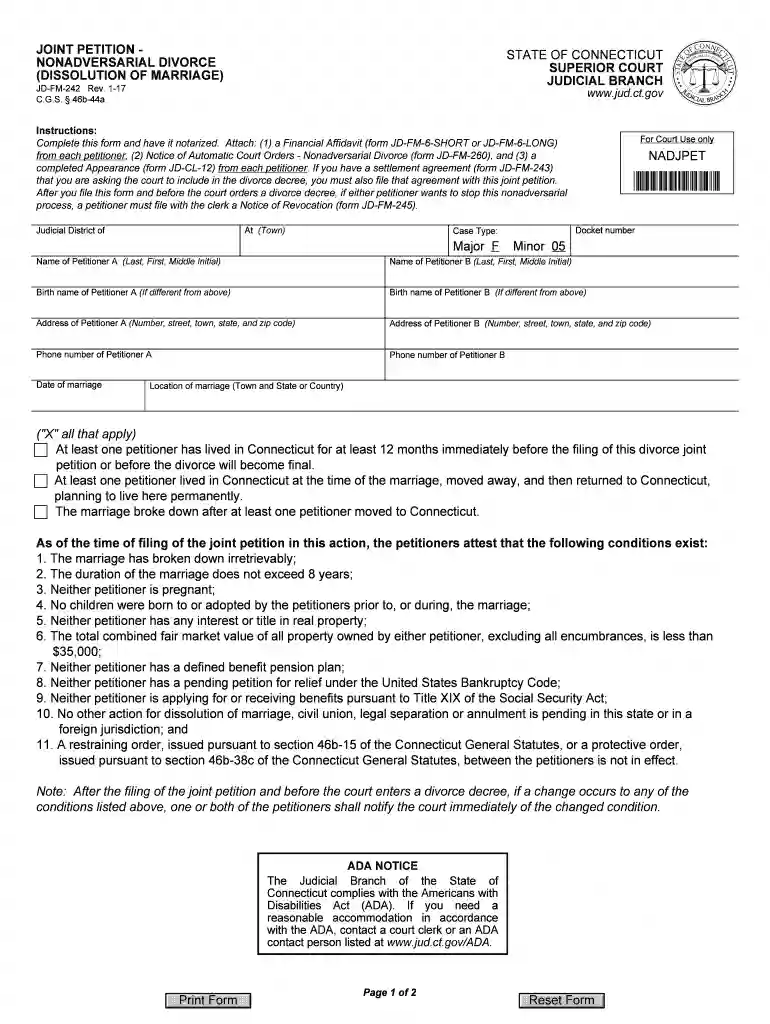
Connecticut joint divorce form 2026

Get Form
divorce in ct Preview on Page 1

Here's how it works

01. Edit your divorce in ct online
Type text, add images, blackout confidential details, add comments, highlights and more.

02. Sign it in a few clicks
Draw your signature, type it, upload its image, or use your mobile device as a signature pad.

03. Share your form with others
Send divorce papers ct via email, link, or fax. You can also download it, export it or print it out.

Definition and Meaning of the Connecticut Joint Divorce Form

The Connecticut Joint Divorce Form, formally referred to as the Joint Petition for Nonadversarial Divorce, is designed for married couples seeking an amicable dissolution of their marriage. This form is significant for couples who agree on the terms of their divorce, including asset division, child custody, and any financial obligations. It emphasizes a nonadversarial approach, reducing the need for extensive court intervention.

Key Elements of the Connecticut Joint Divorce Form

  • Mutual agreement: Both parties must agree on the divorce terms, such as property division and child support arrangements.
  • Attachment requirements: The submission should include necessary documents like financial affidavits or custody agreements.
  • Notarization: The form must be notarized to verify the authenticity of signatures and affirm the agreement between both parties.

Understanding these elements is crucial for ensuring a smooth filing process and clarity in future obligations.

Steps to Complete the Connecticut Joint Divorce Form

Completing the Connecticut Joint Divorce Form involves several steps to ensure accuracy and compliance with state regulations.

  1. Read the Instructions: Before starting, carefully read the instructions provided with the form to understand the necessary information required.
  2. Provide Personal Information: Include full names, addresses, dates of birth, and information about minor children if applicable.
  3. Detail Marital Assets and Liabilities: Accurately list all marital property, debts, and financial responsibilities.
  4. Sign and Notarize: Once completed, both parties must sign the form in front of a notary public, ensuring the signatures are legally recognized.
  5. Submit the Form: Choose a submission method (online, mail, or in-person) as outlined in the filing guidelines.

Completing these steps diligently will help avoid delays or potential rejections due to incomplete information.

Important Terms Related to the Connecticut Joint Divorce Form

Understanding key legal terms associated with the Connecticut Joint Divorce Form is essential for clarity during the process.

  • Nonadversarial divorce: A divorce proceeding where both parties work collaboratively without contentious disputes.
  • Financial affidavit: A document detailing each party’s income, expenses, assets, and liabilities required for financial transparency.
  • Custody agreement: A clear outline of custody arrangements for children, including visitation rights and parenting responsibilities.

Familiarity with these terms aids in effectively navigating the divorce process.

Legal Use of the Connecticut Joint Divorce Form

The Connecticut Joint Divorce Form is legally binding once filed and approved by the court.

  • Jurisdiction: It is specifically designed for couples residing in Connecticut and must comply with Connecticut state divorce laws.
  • Enforcement: Once the form is approved, custody arrangements and financial obligations noted within the form can be enforced legally.
  • Modification: If circumstances change, the agreements made in the joint petition can be modified through the court, provided both parties agree.

This legal framework supports the amicable resolution of disputes and protects the rights of both parties involved.

Required Documents for Filing the Connecticut Joint Divorce Form

Filing the Connecticut Joint Divorce Form involves submitting several supporting documents to ensure the court has all necessary information.

  • Financial affidavits: Must be provided to show income, expenses, and assets.
  • Parenting plan: If children are involved, a detailed parenting plan must accompany the petition outlining custody arrangements.
  • Certificate of dissolution: A form confirming that both parties adhere to all legal requirements for filing for divorce in Connecticut.

Gathering all required documents ahead of time can streamline the filing process and minimize the chances of delays.

Examples of Using the Connecticut Joint Divorce Form

Real-world examples can clarify how the Connecticut Joint Divorce Form is utilized in various scenarios.

  • Couples without children: A couple that owns jointly acquired property and wants to maintain amicability files the joint petition, outlining how to divide assets without court intervention.
  • Couples with children: A couple agrees on shared parenting responsibilities and financial support for their child, implementing these terms in the petition to avoid future conflicts.
  • Asset division: For couples with significant assets, they may detail an equitable division of property in the form, reducing the need for legal mediation.

These examples illustrate the form's versatility in various divorce situations and highlight its emphasis on collaboration.

Filing Deadlines and Important Dates for the Connecticut Joint Divorce Form

Understanding filing deadlines is crucial for completing the Connecticut Joint Divorce Form efficiently.

  • Filing with the court: The form must be submitted within the set state deadlines, which typically allow for filing after any mandated waiting period.
  • Response time: Once filed, the other party usually has a specified time to respond, generally within twenty days, to ensure the divorce process moves forward smoothly.
  • Court appearance: Depending on the form's contents and local court rules, both parties may need to appear before a judge to finalize the divorce.

Awareness of these deadlines helps ensure compliance with court procedures and furthers efficient processing of the divorce.

See more connecticut joint divorce form versions

We've got more versions of the connecticut joint divorce form form. Select the right connecticut joint divorce form version from the list and start editing it straight away!
Versions Form popularity Fillable & printable
2017 4.9 Satisfied (275 Votes)
be ready to get more

Complete this form in 5 minutes or less

Get form

Got questions?

We have answers to the most popular questions from our customers. If you can't find an answer to your question, please contact us.
Contact us
Attendance in Court May Not Be Required You and your spouse may get a divorce at any time. You may either request a hearing, or, if you and your spouse fill out the forms to be divorced without a hearing, most people do not need to come to court at all.
Under the new law, the person filing for the divorce can now ask the court to waive the 90-day period, provided *specific criteria are met. If the judge agrees that all of the criteria are met, then he or she may waive the waiting period and grant the divorce, in some cases, without a hearing.
You may need original documentation, including: your marriage certificate; birth certificates of any children; prenuptial agreements; mortgages; and. outstanding loans taken out during the marriage.
A joint petition for divorce is a procedure where both parties file for divorce together instead of doing it separately. This process saves divorcees time by choosing to come to an agreement together before going to court. Both parties also must agree to the full terms of divorce before filing.

Security and compliance

At DocHub, your data security is our priority. We follow HIPAA, SOC2, GDPR, and other standards, so you can work on your documents with confidence.

Learn more
ccpa2
pci-dss
gdpr-compliance
hipaa
soc-compliance
be ready to get more

Complete this form in 5 minutes or less

Get form