Definition & Meaning of Affidavit Diligent
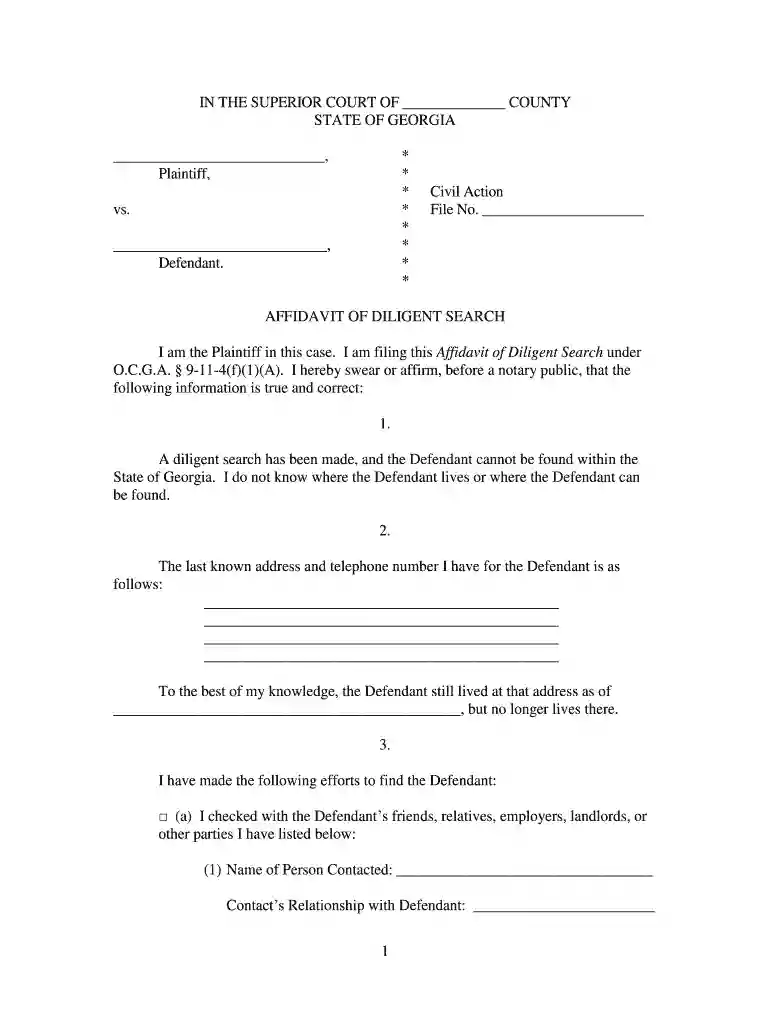
An affidavit diligent is a legal document used primarily in civil and family law cases to affirm that a party has made significant efforts to locate another party who is elusive or unreachable. This document is typically filed with a court to provide proof that reasonable investigative actions were taken when a defendant or respondent cannot be found.
The affidavit serves two main purposes:
- Proves Due Diligence: It officially documents the steps that were taken to locate the party, thereby fulfilling legal obligations before proceeding with service or legal actions.
- Facilitates Legal Proceedings: By establishing that attempts to inform the other party were made, it allows the court to consider alternative methods of service, such as publication or notice by mail, depending on jurisdictional requirements.
Key Components of an Affidavit Diligent
- Affiant Information: The details of the individual submitting the affidavit, including their relationship to the parties involved.
- Description of Efforts: A thorough account of all efforts made to locate the missing party, such as checking public records, contacting known associates, and utilizing online search tools.
- Sworn Statement: The document must be notarized or sworn in front of an authorized official, affirming that the information presented is true to the best of the affiant’s knowledge.
Steps to Complete the Affidavit Diligent
Completing an affidavit diligent requires careful attention to detail and adherence to specific legal standards. Here is a practical step-by-step guide on how to prepare this form correctly.
-
Gather Relevant Information:
- Collect all pertinent details about the missing party, including past addresses, known associates, and any available telephone numbers.
-
Document Search Efforts:
- Create a list of all attempts made to locate the individual, specifying dates, times, and methods used, such as:
- Contacting friends and relatives
- Searching social media profiles
- Reviewing public records such as property or vehicle registrations
- Create a list of all attempts made to locate the individual, specifying dates, times, and methods used, such as:
-
Draft the Affidavit:
- Use a clear and concise format, starting with the title "Affidavit of Diligent Search."
- Clearly identify the affiant, their relationship to the missing party, and the purpose of the affidavit.
- Include a detailed account of search efforts in chronological order.
-
Notary Public:
- After completing the affidavit, sign it in front of a notary public. This step is crucial to validate the document legally.
-
File with the Court:
- Submit the signed affidavit to the relevant court. Ensure you adhere to deadlines and any specific filing instructions provided by the court.
Important Considerations While Completing the Affidavit
- Accuracy: Ensure all information is truthful and verifiable. Providing false information can result in legal penalties.
- State-Specific Requirements: Each state may have different procedural rules or required formats for affidavits. Be sure to comply with local regulations.
Legal Use of the Affidavit Diligent
Affidavits of diligent search are significant in various legal contexts, particularly in civil lawsuits. They uphold the principles of fairness and legal due process and are often utilized in the following scenarios:
- Civil Litigation: When a defendant is impossible to locate, an affidavit diligent serves to justify alternative service methods. Courts can allow notification via publication if the affidavit demonstrates comprehensive search efforts.
- Family Law Cases: In child custody cases, if a parent cannot be found, an affidavit can provide proof of attempts to locate them before terminating parental rights or changing custody arrangements.
- Estate Matters: In probating estates, an affidavit diligent may be required to demonstrate attempts to notify potential heirs or beneficiaries who are untraceable.
Examples of Legal Situations Requiring an Affidavit Diligent
- An individual contesting claims in a personal injury lawsuit where the defendant’s whereabouts are unknown.
- A plaintiff trying to obtain a default judgment in a lawsuit where the defendant has failed to respond and cannot be located.
- Family law attorneys filing for divorce on behalf of a client when the spouse has disappeared.
State-Specific Rules for the Affidavit Diligent
Different states may have specific regulations regarding the use and submission of an affidavit diligent. Familiarizing oneself with these local rules is essential to ensure compliance and avoid delays in legal proceedings.
General Variations to Note:
- Filing Location: In some states, affidavits may need to be filed in the court where the case is being heard, while others may allow filing in a different jurisdiction depending on parties' locations.
- Content Requirements: Some jurisdictions may require more detailed accounts of search efforts or specific supporting documentation, such as emails or messages sent to potential contacts.
- Notarization Rules: Certain states may mandate notarization by a particular type of official, such as a local government official, rather than just any notary public.
Examples of State-Specific Differences
- In California, the affidavit must include an explicit declaration stating that the affiant has conducted reasonable efforts.
- New York may require additional forms to be completed alongside the affidavit when serving papers through publication.
Important Terms Related to Affidavit Diligent
Understanding key terminology associated with the affidavit diligent can enhance comprehension and effectiveness in legal scenarios. Here are several important terms:
- Due Diligence: The comprehensive effort to locate an individual or entity that has been provided in good faith and follows legal standards.
- Service of Process: The method by which a party is formally notified of a legal action against them, which may involve personal delivery, mail, or publication.
- Affiant: The individual who swears to the validity of information contained within the affidavit and is responsible for its accuracy.
- Notary Public: A legally authorized individual who witnesses signatures and helps verify the authenticity of legal documents.
In various legal settings, having a solid grasp on these terms can facilitate smoother processes and clearer communication among all involved parties.