Interrogatories to Defendant for Motor Vehicle Accident - Maryland 2026

Get Form
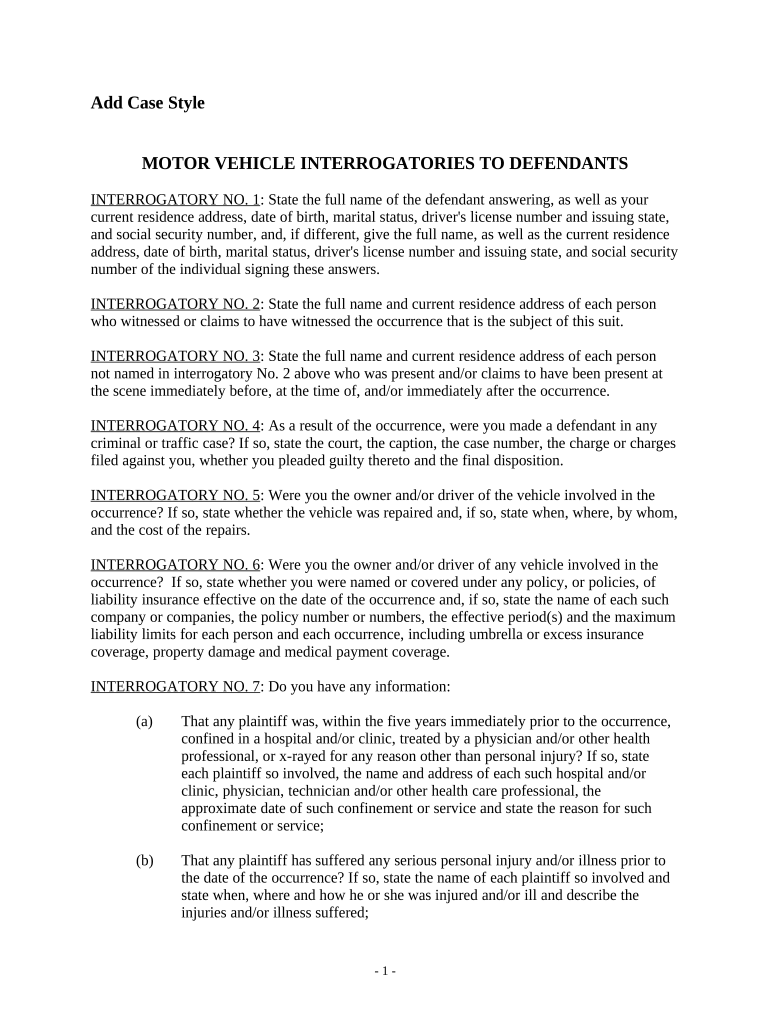
Interrogatories to Defendant for Motor Vehicle Accident - Maryland Preview on Page 1

Here's how it works

01. Edit your form online
Type text, add images, blackout confidential details, add comments, highlights and more.
02. Sign it in a few clicks
Draw your signature, type it, upload its image, or use your mobile device as a signature pad.
03. Share your form with others
Send it via email, link, or fax. You can also download it, export it or print it out.

How to use or fill out Interrogatories to Defendant for Motor Vehicle Accident - Maryland

Form edit decoration
9.5
Ease of Setup
DocHub User Ratings on G2
9.0
Ease of Use
DocHub User Ratings on G2
  1. Click ‘Get Form’ to open it in the editor.
  2. Begin with INTERROGATORY NO. 1, providing your full name, current residence address, date of birth, marital status, driver's license number and issuing state, and social security number. If someone else is signing the answers, include their details as well.
  3. Proceed to INTERROGATORY NO. 2 by listing the names and addresses of all witnesses who saw the incident.
  4. For INTERROGATORY NO. 3, identify any additional individuals present at the scene before, during, or after the accident.
  5. Continue through each interrogatory systematically, ensuring you provide accurate information regarding any criminal cases (INTERROGATORY NO. 4), vehicle ownership (INTERROGATORY NO. 5), insurance policies (INTERROGATORY NO. 6), and medical history related to the incident (INTERROGATORY NO. 7).
  6. Complete all remaining interrogatories by detailing conversations about the incident (INTERROGATORY NO. 9) and any relevant statements made by others (INTERROGATORY NO. 10).
  7. Finally, review your responses for accuracy before saving or exporting your completed form.

Start using our platform today to fill out your Interrogatories for free!

be ready to get more

Complete this form in 5 minutes or less

Get form

Got questions?

We have answers to the most popular questions from our customers. If you can't find an answer to your question, please contact us.
Contact us
Interrogatories. Interrogatories is a list of questions sent to the other party. You cannot send more than 30 questions to another party in a circuit court case. The Maryland Rules have form interrogatories that you can use as an example.
Usually, lawyers use interrogatories to obtain detailed information about persons, corporations, facts, witnesses, and identity and locations of records and documents. Court rules usually limit the number of questions included in an interrogatory.
Rule 33 (b), Federal Rules of Civil Procedure , requires the respondent to answer an interrogatory separately and fully in writing and under oath, unless the respondent objects, in which event the party objecting shall state with specificity the reasons for objection and shall answer to the extent the interrogatory is
Clear and Succinct Language: Writing in an easy-to-understand way without using complex legal terms. Leading Questions: Questions that suggest the desired answer and can be seen as an attempt to influence the partys response. Motion to Compel: A legal request to force the opposing party to answer the interrogatories.
Interrogatories are written questions sent by one party in a lawsuit to another party in that same suit, which the responding party must answer under penalty of perjury. Interrogatories allow the parties to ask who, what, when, where and why questions, making them a good method for obtaining new information.

Security and compliance

At DocHub, your data security is our priority. We follow HIPAA, SOC2, GDPR, and other standards, so you can work on your documents with confidence.

Learn more
ccpa2
pci-dss
gdpr-compliance
hipaa
soc-compliance

People also ask

Common objections include: The request is impermissibly compound. The request is vague, ambiguous or unintelligible. The request is not reasonably calculated to lead to the discovery of relevant, admissible evidence. Introduction to Discovery Part 5: Responding to Form Interrogatories.

Related links