Type text, add images, blackout confidential details, add comments, highlights and more.
02. Sign it in a few clicks
Draw your signature, type it, upload its image, or use your mobile device as a signature pad.
03. Share your form with others
Send it via email, link, or fax. You can also download it, export it or print it out.
How to use or fill out j - suggested joint custody plan - 14th Judicial District Court - 14jdc with DocHub
Ease of Setup
DocHub User Ratings on G2
Ease of Use
DocHub User Ratings on G2
Click ‘Get Form’ to open it in the editor.
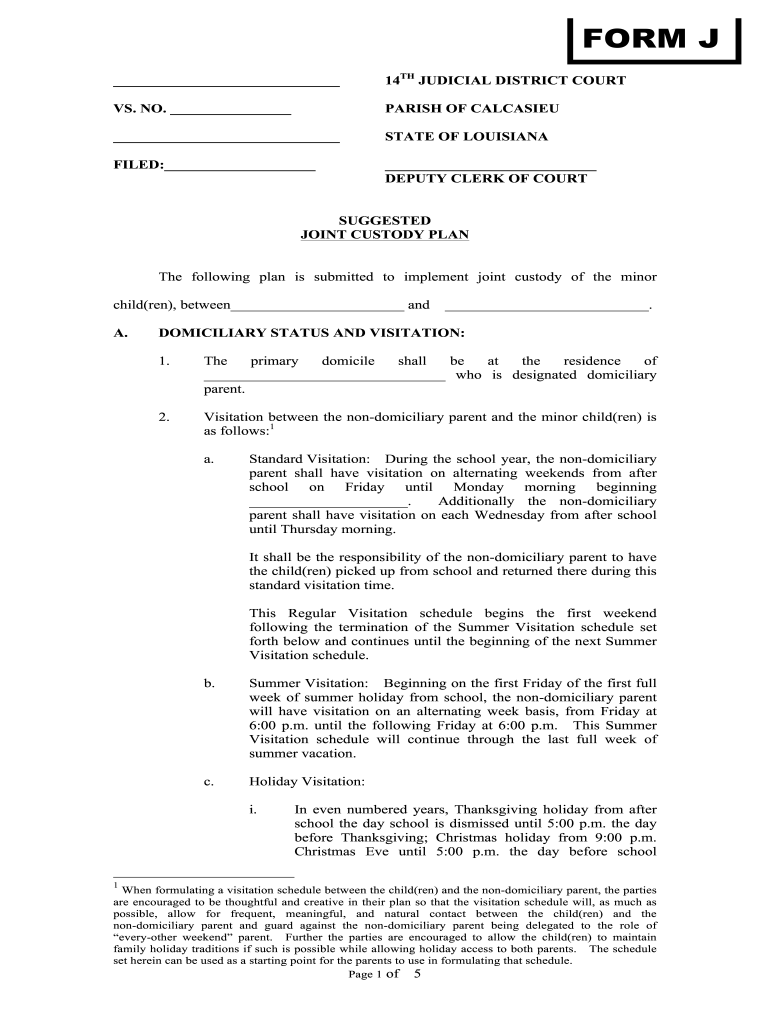
Begin by filling in the names of both parents at the top of the form, ensuring accuracy for legal purposes.
In the Domiciliary Status and Visitation section, designate the primary domicile parent and outline visitation schedules clearly, including standard, summer, and holiday visitation.
Complete the Child Support section by entering details regarding monthly support payments as per court judgment.
Review sections on communication and medical decisions to ensure both parents understand their responsibilities and rights.
Once all fields are filled out, utilize our platform’s signing feature to securely sign the document electronically.
Start using our platform today to easily complete your joint custody plan for free!
Fill out j - suggested joint custody plan - 14th Judicial District Court - 14jdc online It's free
See more j - suggested joint custody plan - 14th Judicial District Court - 14jdc versions
We've got more versions of the j - suggested joint custody plan - 14th Judicial District Court - 14jdc form. Select the right j - suggested joint custody plan - 14th Judicial District Court - 14jdc version from the list and start editing it straight away!
14th Judicial District Court Parish of Calcasieu case search14th Judicial District Court ticket payment14th JDC local Rules14th jdc judges14th jdc Clerk of Court phone number14th Judicial District Court Lake CharlesFamily Court AFFIDAVIT form nJoint custody Implementation plan Louisiana
Security and compliance
At DocHub, your data security is our priority. We follow HIPAA, SOC2, GDPR, and other standards, so you can work on your documents with confidence.
by IM Gottlieb 1954 Cited by 11 The law applicable to suits under the Federal Tort Claims Act is that of the place where the act or omission occurred. Accordingly, the Act provides forRead more
Cookie consent notice
This site uses cookies to enhance site navigation and personalize your experience.
By using this site you agree to our use of cookies as described in our Privacy Notice.
You can modify your selections by visiting our Cookie and Advertising Notice.