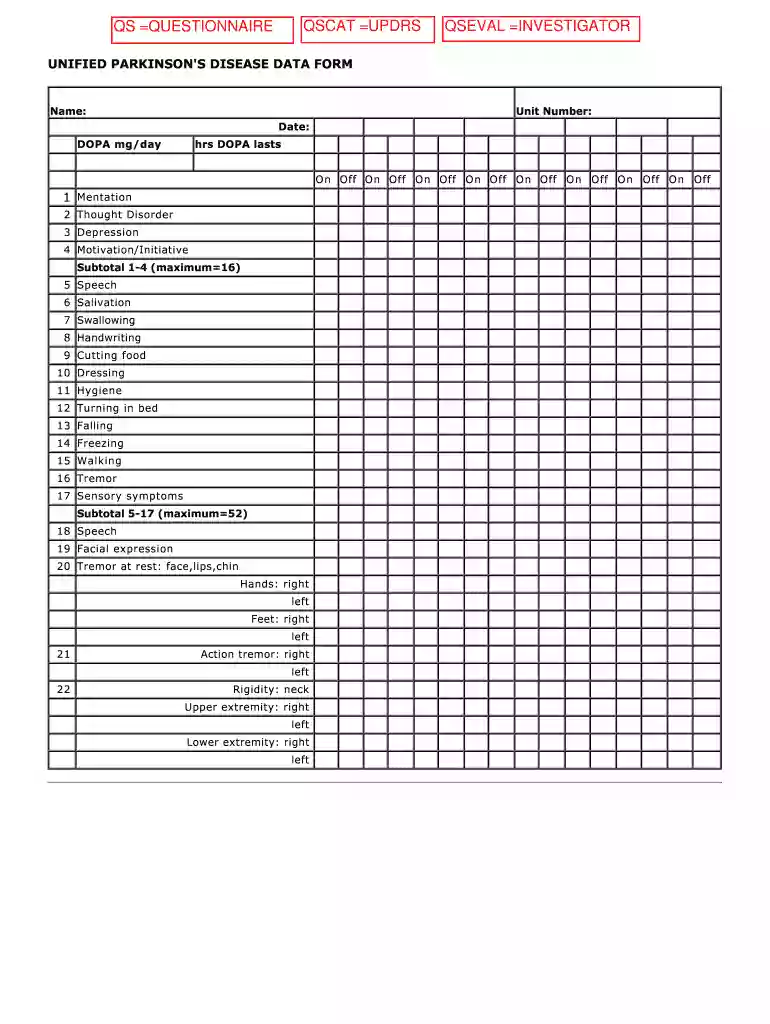
UNIFIED PARKINSONS DISEASE DATA FORM 2026

Get Form
updrs Preview on Page 1

Here's how it works

01. Edit your updrs online
Type text, add images, blackout confidential details, add comments, highlights and more.

02. Sign it in a few clicks
Draw your signature, type it, upload its image, or use your mobile device as a signature pad.

03. Share your form with others
Send updrs score calculator via email, link, or fax. You can also download it, export it or print it out.

Definition & Meaning of the Unified Parkinson's Disease Data Form

The Unified Parkinson's Disease Data Form serves as a critical instrument in the assessment and documentation of Parkinson's disease. This form is designed to collect relevant patient data that pertain to the symptoms, progression, and treatment of Parkinson's disease, offering healthcare providers a structured framework for evaluating individual cases. Key components often covered in this form include the medical history of the patient, current medications, as well as neurological and physical examination results.

Components of the Form

  • Patient Demographics: Basic information such as age, gender, and contact details.
  • Medical History: Detailed account of Parkinson's disease onset, duration, and symptom progression.
  • Medication History: Records of current and past treatments, including medications and therapies utilized.
  • Assessment Metrics: Standardized scales, like the UPDRS, to determine the severity of symptoms and monitor changes over time.

How to Use the Unified Parkinson's Disease Data Form

Utilizing the Unified Parkinson's Disease Data Form effectively requires a systematic approach to gather and input the pertinent data. This enables healthcare professionals to track the progression of the disease and make necessary interventions based on the gathered data.

Step-by-Step Guide

  1. Patient Interaction: Collect information through interviews or surveys during patient visits, ensuring the patient understands each section of the form.
  2. Input Patient Demographics: Start with the patient's basic information to ensure proper identification in the healthcare system.
  3. Record Medical and Medication History: Gather comprehensive details regarding the patient's previous medical conditions and current medications.
  4. Score Assessment Metrics: Use standardized tools, such as the UPDRS score calculator, to evaluate and score the patient's symptoms.
  5. Review & Update: Regularly revisit the form to update the data as the patient's condition evolves.

Key Elements of the Unified Parkinson's Disease Data Form

Understanding the essential elements of the Unified Parkinson's Disease Data Form is crucial for accurate assessment and documentation. These elements facilitate the collection of baseline and ongoing data necessary for monitoring patient outcomes.

Essential Elements

  • Symptom Evaluation: Sections for documenting specific motor and non-motor symptoms prevalent in Parkinson's disease.
  • Activity Indexes: Instruments like the Schwab and England Activities of Daily Living Scale provide insights into the patient's functional abilities.
  • Complications of Therapy: Evaluation of side effects related to various treatment modalities.
  • Staging of Disease: Modified Hoehn and Yahr staging helps classify the severity of Parkinson's disease based on clinical presentations.

Importance of Accurate Data Collection

Accurate data collection through the Unified Parkinson's Disease Data Form is vital for creating effective treatment plans and improving patient care outcomes. Incorrect or incomplete information can lead to misdiagnosis, inappropriate treatments, and further complications.

Benefits of Accurate Data

  • Informed Treatment Decisions: A complete understanding of the patient's condition aids clinicians in selecting the most appropriate therapies.
  • Progress Monitoring: Regular updates ensure that changes in the patient’s symptoms can be effectively monitored over time.
  • Research and Statistical Analysis: Comprehensive data sets contribute to broader neurological research and may lead to advancements in treatments.

Compliance and Legal Considerations

The collection and management of data through the Unified Parkinson's Disease Data Form must adhere to legal and ethical standards to protect patient confidentiality and privacy. Understanding these principles is essential for healthcare providers using the form.

Key Compliance Guidelines

  • HIPAA Regulations: Ensure all patient data is kept confidential according to the Health Insurance Portability and Accountability Act guidelines.
  • Informed Consent: Obtain explicit consent from patients before collecting or sharing their data.
  • Data Security: Implement secure systems for storing and transmitting patient information to prevent unauthorized access.

Who Typically Uses the Unified Parkinson's Disease Data Form?

Various healthcare professionals utilize the Unified Parkinson's Disease Data Form to ensure comprehensive assessment and care for patients with Parkinson's disease. This includes a range of specialists and interdisciplinary teams focused on patient management.


decoration image ratings of Dochub

Primary Users

  • Neurologists: Specialists in diagnosing and treating neurological disorders, including Parkinson's disease.
  • Geriatricians: Physicians who focus on the care of older adults, often managing Parkinson's disease among other age-related conditions.
  • Nurses and Allied Health Professionals: Essential members of the care team who assist with patient interactions and data collection.
  • Researchers: Individuals conducting studies related to Parkinson's disease who rely on detailed data for analysis.

Examples of Using the Unified Parkinson's Disease Data Form

Real-world applications of the Unified Parkinson's Disease Data Form demonstrate its significance in clinical settings. These examples illustrate how the form contributes to patient care and research.

Practical Examples

  • Routine Evaluations: Regularly scheduled assessments using the form to monitor symptom changes during patient visits.
  • Clinical Trials: Leveraging the standardized data collection process to gather information on new treatments or interventions.
  • Interdisciplinary Team Meetings: Sharing collected data among team members to ensure coordinated patient care plans.

By understanding and employing the Unified Parkinson's Disease Data Form effectively, healthcare professionals can enhance their assessment capabilities and ultimately improve the quality of care provided to patients with Parkinson's disease.

See more UNIFIED PARKINSONS DISEASE DATA FORM versions

We've got more versions of the UNIFIED PARKINSONS DISEASE DATA FORM form. Select the right UNIFIED PARKINSONS DISEASE DATA FORM version from the list and start editing it straight away!
Versions Form popularity Fillable & printable
2003 4 Satisfied (58 Votes)
be ready to get more

Complete this form in 5 minutes or less

Get form

Got questions?

We have answers to the most popular questions from our customers. If you can't find an answer to your question, please contact us.
Contact us
Based on motor function and independence, the Hoehn and Yahr scale divides Parkinsons into stages, offering a straightforward but useful paradigm for clinical evaluation. On the other hand, the UPDRS scale provides a more thorough assessment as it covers both motor and non-motor symptoms in several domains.
A involves injection of a small amount of a radioactive drug that is then measured by a single-photon emission computed tomography scanner (SPECT scanner). The SPECT scanner measures the levels and location of the drug in the brain. A negative suggests that a person does not have Parkinsons.
Patients meeting the 52-1 screening criteria had one or more of the three clinical indicators of APD: (i) 5 doses of oral levodopa/day, OR (ii) off symptoms for 2 h of waking day, OR (iii) 1 h of troublesome dyskinesia. Clinician assessment of PD stage was used as the reference in this study.
The International Parkinson and Movement Disorder Society sponsored revision of the Unified Parkinsons Disease Rating Scale (MDS-UPDRS) is a comprehensive 50 question assessment of both motor and non-motor symptoms associated with Parkinsons.
The MDS-UPDRS was developed to evaluate various aspects of Parkinsons disease including non-motor and motor experiences of daily living and motor complications. It includes a motor evaluation and characterizes the extent and burden of disease across various populations.

Security and compliance

At DocHub, your data security is our priority. We follow HIPAA, SOC2, GDPR, and other standards, so you can work on your documents with confidence.

Learn more
ccpa2
pci-dss
gdpr-compliance
hipaa
soc-compliance

People also ask

The UPDRS scale consists of the following six segments: 1) Mentation, Behavior, and Mood, 2) ADL, 3) Motor sections, 4) Complications of Therapy (in the past week) 5) Modified Hoehn and Yahr Scale, and 6) Schwab and England ADL scale. The first four segments are made up of 42 items grouped into four subscales.

updrs 3 pdf