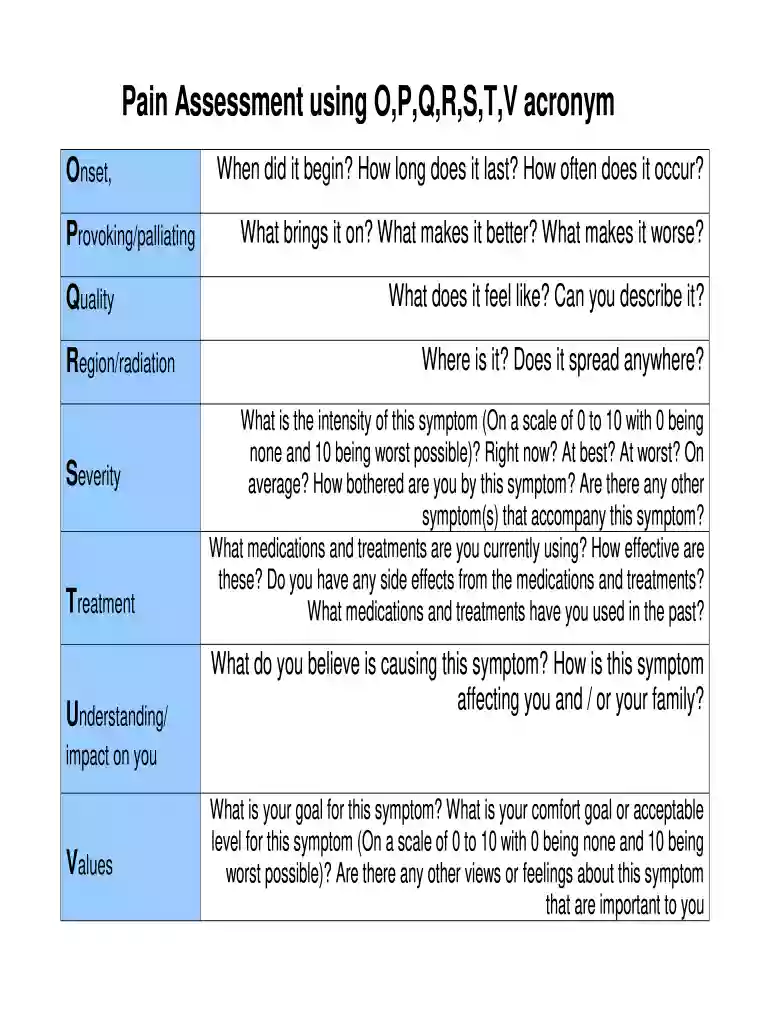
Oldcarts 2026

Get Form
oldcart Preview on Page 1

Here's how it works

01. Edit your oldcart online
Type text, add images, blackout confidential details, add comments, highlights and more.

02. Sign it in a few clicks
Draw your signature, type it, upload its image, or use your mobile device as a signature pad.

03. Share your form with others
Send oldcarts acronym via email, link, or fax. You can also download it, export it or print it out.

Definition and Meaning of Oldcarts

The oldcarts acronym, which stands for Onset, Location, Duration, Characteristics, Aggravating/Alleviating factors, Radiating, and Treatment, is a widely recognized mnemonic used in pain assessment and history taking in clinical settings. It helps healthcare professionals gather comprehensive information about a patient's pain experience, facilitating accurate diagnosis and effective treatment plans.

  • Onset: Refers to the time and circumstances when the pain first occurred. Understanding this can help identify underlying conditions or trigger factors.
  • Location: Specifies the exact area where the patient feels pain. This information is crucial for diagnosing conditions related to specific anatomical regions.
  • Duration: Describes how long the pain lasts, whether it is constant, intermittent, or episodic. This can provide insights into the nature of the pain.
  • Characteristics: Involves the quality of the pain, such as sharp, dull, throbbing, or burning. This helps differentiate between types of pain and their potential causes.

These components of oldcarts ensure that healthcare providers can create a detailed profile of the patient's pain, which is essential for effective treatment.

How to Use the Oldcarts Mnemonic Effectively

Implementing the oldcarts mnemonic involves a structured approach within clinical interviews or assessments. Healthcare professionals can utilize this tool during patient interactions to elicit detailed information about pain.

  1. Start with Open-Ended Questions: Prompt the patient to describe their pain in their own words. For example, "Can you tell me about the pain you're experiencing?"
  2. Apply Each Element of Oldcarts: Progressively guide the conversation through the mnemonic, ensuring that each aspect is addressed.
    • Ask about onset, "When did the pain start?"
    • Inquire about location, "Where exactly do you feel the pain?"
    • Discuss duration, "How long does the pain last?"
    • Explore characteristics, "How would you describe the pain?"
    • Delve into aggravating and alleviating factors, "What makes the pain worse or better?"
    • Assess radiation, "Does the pain spread to other areas?"
    • Review any previous treatment received and its effectiveness.

This systematic approach ensures that no critical information is overlooked, improving the quality of patient assessments and treatment protocols.

Key Elements of the Oldcarts Acronym Explained

The key elements of the oldcarts acronym provide a framework for thorough patient evaluations related to pain. Each component serves a distinct purpose:

  • Onset: Knowing when the pain started can help identify acute versus chronic conditions.
  • Location: Specific localization of pain can indicate certain conditions; for instance, abdominal pain may suggest gastrointestinal issues, while chest pain might be cardiovascular in nature.
  • Duration: Understanding how long the pain lasts is essential; persistent pain may suggest a serious issue, while brief, intermittent pain may point to less immediate concerns.
  • Characteristics: The type of pain can also guide differential diagnosis; for instance, sharp pain may indicate nerve involvement, while dull pain might be associated with musculoskeletal problems.
  • Aggravating/Alleviating Factors: Knowing what makes the pain better or worse can help develop a treatment plan tailored to the patient's needs.
  • Radiating: Pain that radiates can signify nerve issues or referred pain from other organs.
  • Treatment: Previous treatments and their effectiveness provide insight into what approaches may help the patient in future management.

Understanding these key elements facilitates informed decision-making in clinical settings.

Examples of Using Oldcarts in Clinical Practice

In practice, the oldcarts mnemonic can be applied across various clinical scenarios to enhance patient history taking and pain assessment.

  • Example 1: Acute Abdominal Pain

    • Onset: "The pain started suddenly last night."
    • Location: "It’s in the lower right side of my abdomen."
    • Duration: "It has been constant since it started."
    • Characteristics: "The pain feels sharp and intense."
    • Aggravating/Alleviating Factors: "It gets worse when I move or cough."
    • Radiating: "It doesn’t radiate anywhere."
    • Treatment: "I took some over-the-counter painkillers, but they didn’t help."
  • Example 2: Chronic Back Pain

    • Onset: "I have had this pain for several years, but it has worsened recently."
    • Location: "The pain is mostly in the lower back."
    • Duration: "It’s almost always there, but sometimes it flares up."
    • Characteristics: "The pain is dull, but it can be sharp when I move."
    • Aggravating/Alleviating Factors: "It’s worse in the morning and feels better with heat."
    • Radiating: "Sometimes, I feel a tingling sensation down my leg."
    • Treatment: "I have tried physical therapy and medications, but they only help a little."

These examples illustrate how the oldcarts framework allows clinicians to gather specific information effectively, leading to a better understanding of the patient's condition.

Legal Use of Oldcarts in Pain Assessment

The application of the oldcarts mnemonic in pain assessment has legal implications, particularly in documentation for patient care. Accurate recording of a patient's pain history using oldcarts is essential for:

  • Providing Quality Care: Thorough assessments can lead to correct diagnoses and effective treatments. This, in turn, can reduce legal liability for clinicians.
  • Documenting Medical Necessity: Clear documentation of pain assessment is crucial for insurance claims and reimbursement. Insurers often require comprehensive medical records that show the rationale for treatment plans.
  • Defending Against Claims: In cases of malpractice or liability disputes, clear and detailed patient histories using oldcarts can serve as evidence of due diligence and appropriate care standards.

Healthcare professionals should ensure that their documentation reflects all relevant components from the oldcarts framework to protect both their practice and their patients.

be ready to get more

Complete this form in 5 minutes or less

Get form

Got questions?

We have answers to the most popular questions from our customers. If you can't find an answer to your question, please contact us.
Contact us
A helpful acronym to remember the specific questions to ask patients when taking a skin history is OLD CARTS, which gives a systematic approach to questioning in a skin assessment, this includes onset, location, duration, character, aggravating factors, relieving factors, timing and severity.
Some of the most commonly used abbreviations are COLDERAS and OLDCARTS. Both of these acronyms summarize the character, onset, location, duration, exacerbating symptoms, relieving symptoms, radiation of pain, associated symptoms, and severity of illness.
OLDCARTS stands for Onset, Location, Duration, Character, Aggravating factors, Relieving factors, Timing, and Severity.
For those who favor mnemonics, the 8 dimensions of a medical problem can be easily recalled using OLD CARTS (Onset, Location/radiation, Duration, Character, Aggravating factors, Relieving factors, Timing and Severity).
One mnemonic is OLD CARTS, (Onset, Location, Duration, Characteristics, Associating factors, Relieving factors/radiation, Treatment/temporal factors, Severity/intensity) (ODonovan, 2011).

Security and compliance

At DocHub, your data security is our priority. We follow HIPAA, SOC2, GDPR, and other standards, so you can work on your documents with confidence.

Learn more
ccpa2
pci-dss
gdpr-compliance
hipaa
soc-compliance
be ready to get more

Complete this form in 5 minutes or less

Get form

People also ask

The letters stand for onset; location; duration; characteristic; alleviating and aggravating factors; radiation or relieving factors; timing; and severity.
OLD CARTS is a mnemonic device used by providers to guide their interview of a patient while documenting a history of present illness. The letters stand for onset; location; duration; characteristic; alleviating and aggravating factors; radiation or relieving factors; timing; and severity.

oldcarts