




Here's how it works

01. Edit your naemt login online
Type text, add images, blackout confidential details, add comments, highlights and more.

02. Sign it in a few clicks
Draw your signature, type it, upload its image, or use your mobile device as a signature pad.

03. Share your form with others
Send naemt instructor login via email, link, or fax. You can also download it, export it or print it out.
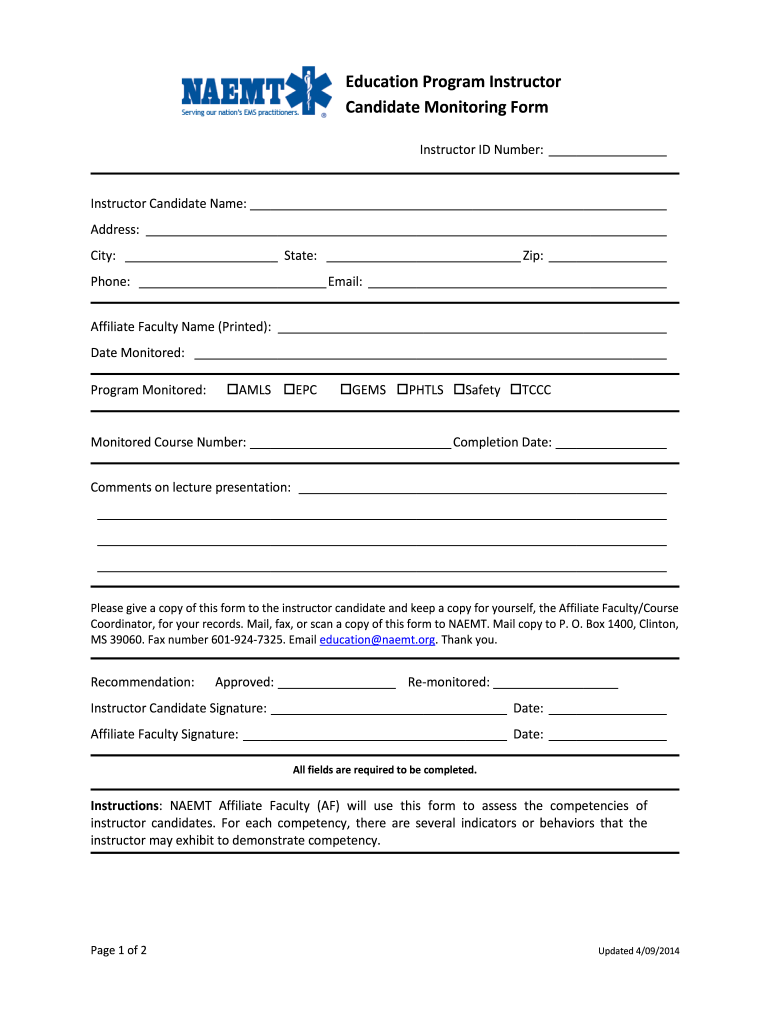
How to use or fill out naemt instructor monitoring form with our platform

- Click ‘Get Form’ to open the naemt instructor monitoring form in the editor.
- Begin by entering the Instructor ID Number at the top of the form. This unique identifier is essential for tracking and record-keeping.
- Fill in the Instructor Candidate Name, Address, City, State, Zip, Phone, and Email. Ensure all contact information is accurate for effective communication.
- Select the Program Monitored by checking the appropriate box (AMLS, EPC, GEMS, PHTLS, Safety, TCCC) to indicate which course is being assessed.
- Complete the Monitored Course Number and Completion Date fields to document when the course was monitored.
- Provide detailed comments on lecture presentation in the designated area. This feedback is crucial for evaluating teaching effectiveness.
- Ensure all required fields are filled out before signing. Both the Instructor Candidate and Affiliate Faculty must sign and date at the bottom of the form.
- Once completed, save your changes and share a copy with both the instructor candidate and yourself for records. Use our platform's sharing options to easily distribute via email or print.
Start using our platform today to streamline your document editing and form completion process for free!
Fill out naemt instructor monitoring form online
It's free
Got questions?
We have answers to the most popular questions from our customers. If you can't find an answer to your question, please contact us.
Contact us
How to become NAEMT affiliate faculty?
Successfully complete the full NAEMT provider course for the program for which you wish to serve as an instructor. (Refresher courses do not qualify.) Be affiliated with at least one Authorized NAEMT Training Center, either as a current member of their faculty, or as an instructor candidate.
Which organization accredits the NAEMT instructor course hours for participant recertification?
Accredited by the Commission on Accreditation for Pre-Hospital Continuing Education (CAPCE) Outlined in the National Registry Accepted Education and Documentation, Academic Credit, and Alternative Recertification Credits policies.
What is the role of the EMS staff?
Basic Function: Responds to and provides care for patients in the prehospital setting. Interacts with other EMS personnel as well as other institutions (Nursing Homes, Hospitals, Physicians Offices, Business, Industries) and agencies (Fire Departments, Law Enforcement) in order to assure quality care for the patient.
What is the role of the NAEMT education committee?
Recommending the development of new courses or course content, as needed; Developing tools and resources to support NAEMT instructors; and. Overseeing applications or renewals of education program accreditation, including CAPCE.
What are the roles and responsibilities of NAEMT headquarters?
NAEMT maintains administrative oversight for the development of new training centers and faculty (sometimes referred to as promulgation), and for the ongoing activities of all approved NAEMT training centers and faculty in all countries in which NAEMT courses are conducted.
Security and compliance
At DocHub, your data security is our priority. We follow HIPAA, SOC2, GDPR, and other standards, so you can work on your documents with confidence.
Learn more


People also ask
What are the roles and responsibilities of the EMT?
EMTs and paramedics assess a patients condition and administer emergency medical care. Emergency medical technicians (EMTs) and paramedics assess injuries and illnesses, provide emergency medical care, and may transport patients to medical facilities.
How to be an NAEMT instructor?
Completion of the NAEMT Instructor Preparation Course, Second Edition along with successful completion of the provider course and a monitored teach-back for the NAEMT program that you wish to teach, is required to be recognized as an NAEMT instructor.
What are the responsibilities of state EMS agencies?
The EMS Agency is responsible for planning, implementing, monitoring and evaluating the local EMS system. This includes establishing policies, addressing the financial aspects of system operation, and making provisions for collection, analysis, and dissemination of EMS related data.