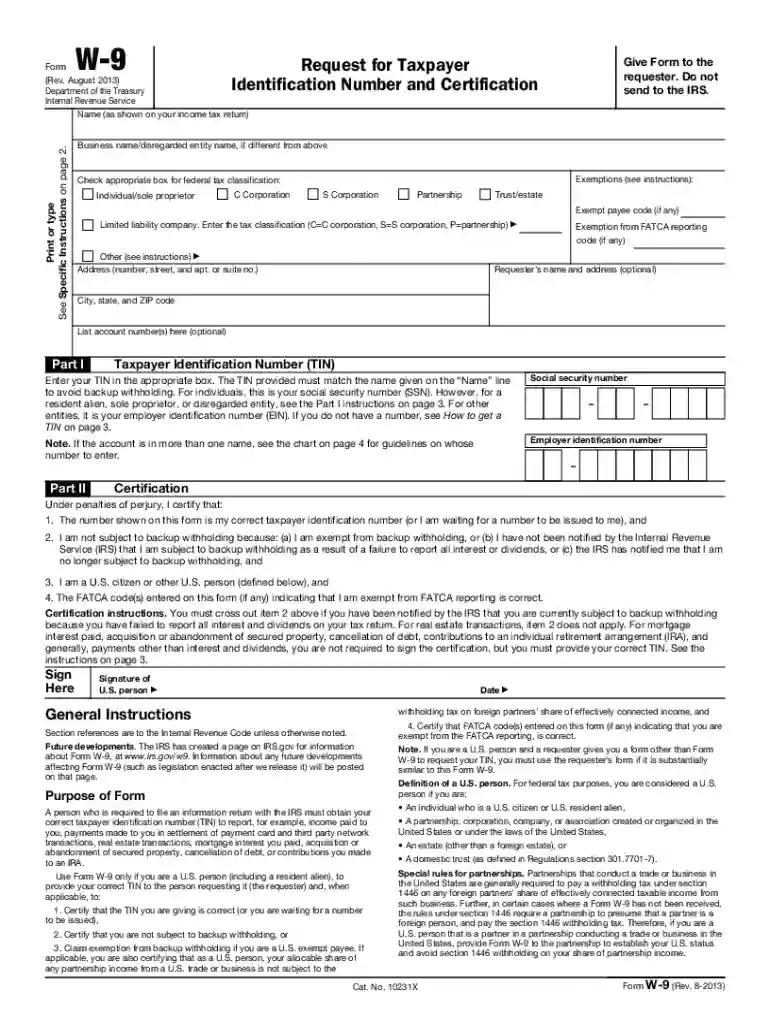
Landlord w9 form california 2026

Get Form
landlord w9 form Preview on Page 1

Here's how it works

01. Edit your landlord w9 form online
Type text, add images, blackout confidential details, add comments, highlights and more.

02. Sign it in a few clicks
Draw your signature, type it, upload its image, or use your mobile device as a signature pad.

03. Share your form with others
Send landlord w9 via email, link, or fax. You can also download it, export it or print it out.

Definition and Importance of the Landlord W-9 Form in California

The landlord W-9 form, also known as the IRS Form W-9, is a tax document that landlords in California must complete. This form is a request for taxpayer identification number (TIN) and certification, which is essential for tax reporting purposes. By providing accurate information on this form, landlords help ensure compliance with federal tax regulations and avoid unnecessary issues such as backup withholding, where the IRS requires withholding a certain percentage of payments due to insufficient tax information.

Key Information Included in the W-9 Form

The landlord W-9 form typically includes the following important information:

  • Name: The full name of the landlord or business entity.
  • Business Name: If applicable, the legal business name of the landlord.
  • Tax Classification: Identification of the entity type such as individual, LLC, corporation, or partnership.
  • Address: A complete mailing address to ensure accurate communication and reporting.
  • Tax Identification Number (TIN): Either a Social Security Number (SSN) or Employer Identification Number (EIN), which is necessary for tax purposes.

Providing accurate information is critical as any errors or omissions can lead to complications during tax filing.

Steps to Complete the Landlord W-9 Form in California

Filling out the landlord W-9 form properly is essential to meet IRS requirements. Here’s a step-by-step guide on how to complete the form:

  1. Obtain the Form:

    • Download the form directly from the IRS website or obtain a copy through tax software that supports the form.
  2. Fill in Your Name:

    • In the first line, enter your name exactly as it appears on your tax return. If you are a business entity, enter the business name in the "Business name/disregarded entity name" field.
  3. Select Your Tax Classification:

    • Check the appropriate box that indicates your tax classification. This could range from individual/sole proprietor to a corporation or partnership.
  4. Provide Your Address:

    • Complete the address section with your street address, city, state, and zip code.
  5. Enter Your TIN:

    • Provide your SSN or EIN in the specified fields. Ensure that the number is accurate to avoid any issues with the IRS.
  6. Certification:

    • Complete the certification section by signing and dating the form. This certifies that the information provided is accurate.
  7. Submit the Form:

    • Send the completed W-9 form to the requester (commonly a tenant or a business) and not to the IRS.

Ensure to keep a copy of the W-9 for your records in case of any future inquiries.

Reasons Why the Landlord W-9 Form is Necessary

Utilizing the landlord W-9 form serves several essential purposes in the rental process:

  • Tax Compliance: It ensures that landlords provide the necessary information to comply with IRS regulations for reporting income from rental properties.
  • Avoiding Backup Withholding: By providing accurate TINs, landlords avoid the risk of backup withholding, which is a percentage of payments withheld for tax purposes.
  • Clear Documentation: The W-9 form establishes clear documentation of the landlord's tax status, which can be beneficial if disputes arise concerning rental agreements or payments.
  • Ease of Record-Keeping: For tenants, collecting this information upfront simplifies the record-keeping process for tax deductions related to rental expenses.

Understanding the importance of the form helps landlords maintain compliance and establish a transparent reporting process for all parties involved.

Who Typically Uses the Landlord W-9 Form in California

The landlord W-9 form is widely used by various entities in California, including:

  • Individual Landlords: Sole property owners renting out residential space to tenants.
  • Real Estate Companies: Businesses managing multiple properties that require tenant information for tax purposes.
  • Partnerships and LLCs: Businesses structured as partnerships or limited liability companies that rent out property.
  • Corporate Landlords: Corporations that hold multiple rental properties, needing to report income to the IRS.

Understanding who uses the form highlights its relevance in the rental market and the need for compliance among diverse property owners.


decoration image ratings of Dochub

State-Specific Rules for the Landlord W-9 Form in California

While the W-9 form is a federal document, there are specific considerations for landlords in California:

  • State Law Compliance: California may impose additional regulations regarding tenant information collection, such as privacy laws that protect personal information.
  • Property Type Considerations: Different types of rental properties (e.g., residential vs. commercial) may have varied requirements for information disclosure, though the W-9 will generally remain the same.
  • Environmental Disclosures: California also has strict environmental disclosure laws that landlords should be aware of when managing properties, ensuring compliance in addition to completing the W-9.

Being aware of these state-specific rules allows landlords to operate within legal guidelines while also fulfilling federal requirements, creating a comprehensive framework for managing rental properties.

be ready to get more

Complete this form in 5 minutes or less

Get form

Got questions?

We have answers to the most popular questions from our customers. If you can't find an answer to your question, please contact us.
Contact us
Step-by-step guide to filling out W-9 forms Choose the correct entity type. The first step is to determine the correct entity type for your situation. Provide your full legal name or business name. Enter your mailing address. Provide your TIN. Sign and date the form. Submitting W-9 forms to tenants or third parties.
How to fill out a W9 form. Line 1. The payees name. Line 2. Business name (if different from line 1). Line 3. The payees federal tax classification. Line 4. Exception codes. Lines 56. The payees mailing address. Part I. The payees taxpayer identification number (TIN). Part II.
Use Form W-9 to provide your correct Taxpayer Identification Number (TIN) to the person who is required to file an information return with the IRS to report, for example: Income paid to you. Real estate transactions. Mortgage interest you paid.
Why would a customer ask for a W9? A W9 is generally requested by someone whose business needs to make a payment and needs to know exactly what legal entity they are making a payment to. Without a W9, they may need to withhold 24% of the amount theyre paying you and give it to the IRS.
Who needs to fill out a W-9 form? Employers who work with independent contractors must provide them with a W-9 form to fill out before starting work. There are specific criteria for who is classified as an independent contractor and will need to fill it out.

People also ask

The landlord and the tenants name should be on the account where the escrow deposit is the tenant should get the interest yearly from the landlord on the day the account was open. The W9 is for the bank to verify the tenant Social Security number.

w9 for rental property