Form family spending template 2026

Get Form
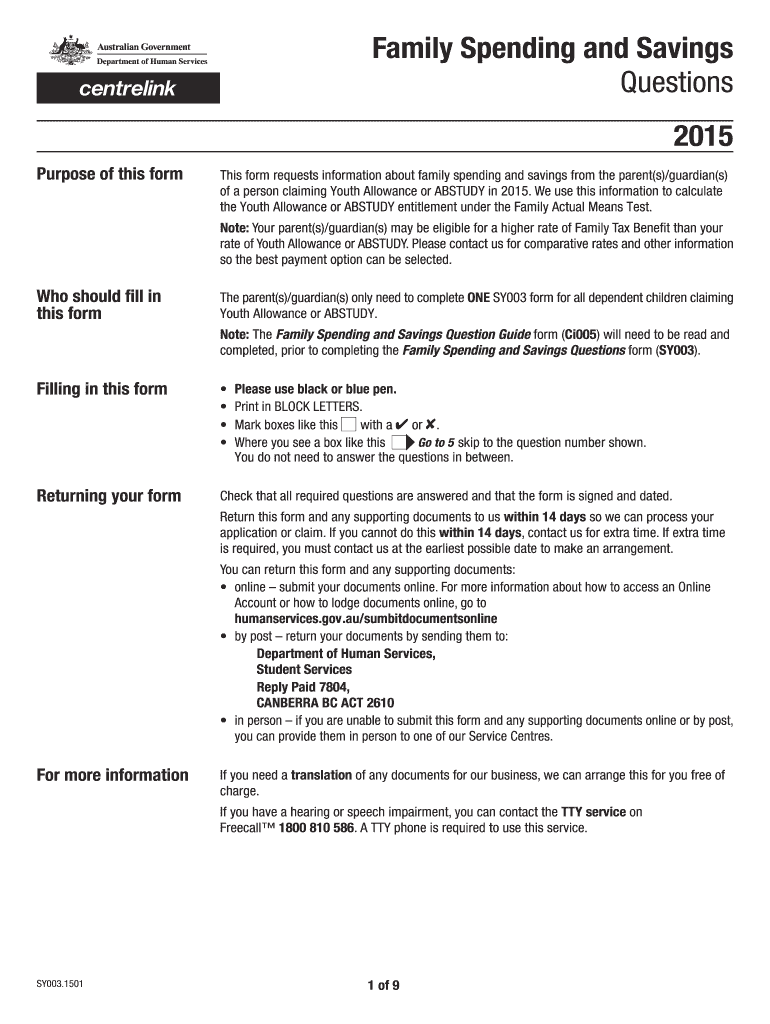
family budget template excel Preview on Page 1

Here's how it works

01. Edit your family budget template excel online
Type text, add images, blackout confidential details, add comments, highlights and more.
02. Sign it in a few clicks
Draw your signature, type it, upload its image, or use your mobile device as a signature pad.
03. Share your form with others
Send household budget worksheet excel via email, link, or fax. You can also download it, export it or print it out.

How to use or fill out form family spending template with our platform

Form edit decoration
9.5
Ease of Setup
DocHub User Ratings on G2
9.0
Ease of Use
DocHub User Ratings on G2
  1. Click ‘Get Form’ to open the Family Spending and Savings template in the editor.
  2. Begin by filling in the personal details of the Youth Allowance or ABSTUDY customer, including their name, date of birth, and Centrelink Reference Number if known.
  3. Next, provide information about the parent(s)/guardian(s). Indicate your relationship status and complete all relevant fields regarding your contact details.
  4. Proceed to the financial sections where you will detail family spending for specified financial years. Ensure you calculate totals accurately as instructed in the accompanying Question Guide form (Ci005).
  5. Review all entries for completeness. Make sure all required questions are answered, and sign and date the form before submission.
  6. Submit your completed form online through our platform, by post, or in person at a Service Centre within 14 days.

Start using our platform today to easily fill out your Family Spending template for free!

See more form family spending template versions

We've got more versions of the form family spending template form. Select the right form family spending template version from the list and start editing it straight away!
Versions Form popularity Fillable & printable
2015 4.8 Satisfied (228 Votes)
be ready to get more

Complete this form in 5 minutes or less

Get form

Got questions?

We have answers to the most popular questions from our customers. If you can't find an answer to your question, please contact us.
Contact us
Add up your family income and make a spending plan One option is the 50/30/20 budget. It splits your income three ways: 50% toward needs, such as groceries, housing, basic utilities, transportation, insurance, child care and minimum loan payments. 30% toward wants, such as travel, gifts and meals out.
What does this look like? If you make $3000 a month after taxes, then 50% ($1500) would go toward needs, the next 30% ($900) goes toward your wants or discretionary spending, and the remaining 20% ($600) goes toward your savings.
Those will become part of your budget. The 50-30-20 rule recommends putting 50% of your money toward needs, 30% toward wants, and 20% toward savings. The savings category also includes money you will need to realize your future goals. Lets take a closer look at each category.
How to create a budget spreadsheet Choose a spreadsheet program or template. Create categories for income and expense items. Set your budget period (weekly, monthly, etc.). Enter your numbers and use simple formulas to streamline calculations. Consider visual aids and other features.
Designate 50% of your income to needs (mortgage/rent, utilities, car payments), 30% to wants (travel, concerts, fashion splurges) and 20% goes directly to your savings account(s) and debts.

Security and compliance

At DocHub, your data security is our priority. We follow HIPAA, SOC2, GDPR, and other standards, so you can work on your documents with confidence.

Learn more
ccpa2
pci-dss
gdpr-compliance
hipaa
soc-compliance
be ready to get more

Complete this form in 5 minutes or less

Get form

People also ask

Monthly 50/30/20 budget worksheet. Keep your monthly budget and savings on track and on target with the 50/30/20 approach. Designate 50% of your income to needs (mortgage/rent, utilities, car payments), 30% to wants (travel, concerts, fashion splurges) and 20% goes directly to your savings account(s) and debts.

Related links