




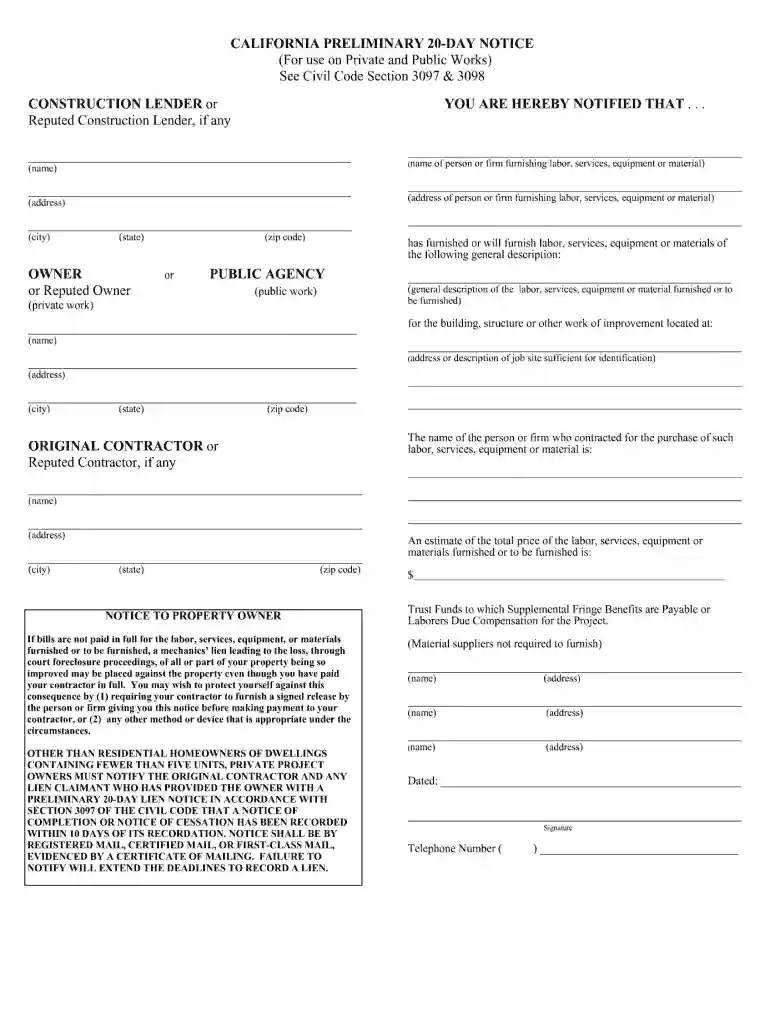
01. Edit your california preliminary notice pdf online
Type text, add images, blackout confidential details, add comments, highlights and more.

Type text, add images, blackout confidential details, add comments, highlights and more.

Draw your signature, type it, upload its image, or use your mobile device as a signature pad.

Send free california 20 day preliminary via email, link, or fax. You can also download it, export it or print it out.
The California Preliminary Notice is a critical document in the construction industry within California, serving as an official communication to notify parties about the right to file a mechanics lien in the event of non-payment. Known commonly as the "Preliminary 20-Day Notice," it is mandated by California Civil Code Sections 3097 and 3098. This notice primarily acts as a protective measure for subcontractors, suppliers, and other construction professionals, ensuring that the property owner, direct contractor, and lender are aware of the potential for a lien should payment disputes arise. Understanding the definition and significance of this notice is fundamental for professionals engaged in California's construction sector, as it establishes legal grounds to secure payment claims.
Using the California Preliminary Notice effectively requires adherence to several key steps and considerations. Initially, stakeholders must determine whether sending the notice is applicable to their role in the project. Generally, all parties providing labor, materials, or services on a project should issue this notice, except for direct contractors and those who have a direct contractual relationship with the property owner.
Identify the Stakeholders: Clearly identify the property owner, the direct contractor, and any construction lenders involved in the project. Ensure you collect accurate and full details about these parties.
Timing is Crucial: Send the preliminary notice within 20 days of first furnishing labor or materials. Late notices only protect lien rights for work or materials provided in the 20 days preceding the notice date.
Method of Delivery: Ensure delivery of the preliminary notice via certified mail with return receipt requested or any other documented measure that confirms receipt by the owner, contractor, and lender.
Following these steps helps facilitate legal lien rights, thereby safeguarding against non-payment scenarios.
Accessing and utilizing the correct version of the California Preliminary Notice form is paramount for compliance. While there is no "official" government-issued template, various organizations provide templates that adhere to legal requirements. Here's how to obtain one:
Online Resources: Many legal and construction-oriented websites offer downloadable templates. Verify that the templates conform to California Civil Code requirements.
Trade Associations: Contact local construction and contractor trade associations that often provide resources and advice, including form templates that meet statutory obligations.
Legal Counsel: Consulting with an attorney specializing in construction law can provide both the form and the assurance that it’s filled out correctly and comprehensively.
By leveraging these resources, those involved can efficiently obtain and issue the notice, keeping legal considerations in check.
Filling out the California Preliminary Notice requires attention to detail to ensure accuracy and legal validity. Below is a breakdown of the steps involved:
Header Information: Identify the type of notice and cite the relevant California Civil Code sections detailing its usage.
Property Details: Clearly outline the property address where the work or materials are provided.
Participant Information:
Project Description: Provide a brief description of work or material supplied.
Service Date: Specify the date when work or supplies commenced and the notice issuance date.
Verification and Signature: Ensure the form is signed and dated, confirming the provided information's accuracy and serving as an official acknowledgment of intent to pursue legal rights if necessary.
Completing these steps thoroughly establishes a solid claim to future payment protection.
Issuing the California Preliminary Notice is essential for several reasons. It creates transparency, informing all relevant parties of your involvement in a project and reaffirming your security interest. This proactive approach:
Understanding these pragmatic benefits highlights why utilizing the California Preliminary Notice is a best practice in construction projects.
Various parties in the construction industry rely on the California Preliminary Notice. These typically include:
These groups depend on the notice to establish legal grounds for lien rights and ensure payment security across varying project scopes.
Issuing a California Preliminary Notice has significant legal implications. Committing to this practice aligns with compliance under state law, reinforcing the following:
Understand these legal dimensions to ensure adherence and leverage the California Preliminary Notice accurately.
Familiarizing yourself with the terminology surrounding the California Preliminary Notice fosters a clearer understanding:
Mastering these terms enhances the actionable knowledge needed for navigating this fundamental component of construction law.
Understanding and implementing these elements equips those involved in California's construction industry with the knowledge needed to leverage the Preliminary Notice efficiently, securing their work and financial interests.
We've got more versions of the california preliminary notice pdf form. Select the right california preliminary notice pdf version from the list and start editing it straight away!
| Versions | Form popularity | Fillable & printable |
|---|---|---|
| 2004 | 4.9 Satisfied (504 Votes) |
At DocHub, your data security is our priority. We follow HIPAA, SOC2, GDPR, and other standards, so you can work on your documents with confidence.




by EH Gibbs 2014 preliminary relief; (iii) the balance of hardships and equities favors consumers; (iv) an injunction is in the public interest. Meyer vRead more
If you record a notice of cessation or completion of your construction project, you must within 10 days after recording, send a copy of the notice of completionRead more
A preliminary notice can be sent by a variety of different individuals including: General Contractors; Subcontractors; Material men; Equipment Lessors; Etc.Read more


