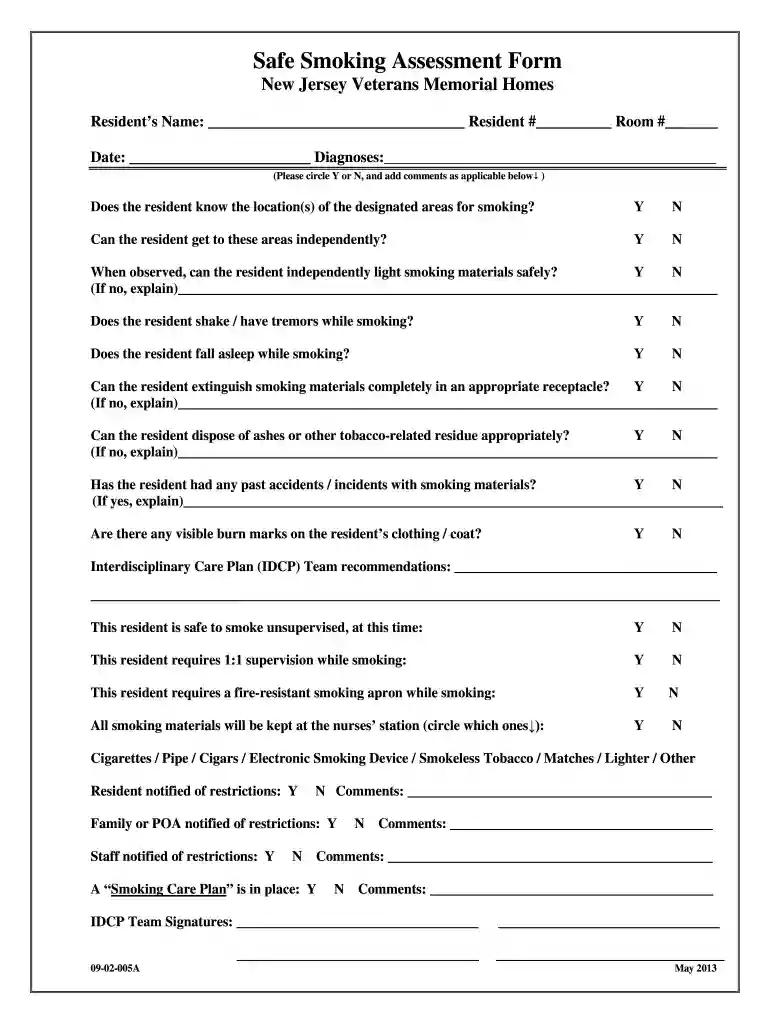
Risk assessment smoking 2026

Get Form
smoking risk assessment example Preview on Page 1

Here's how it works

01. Edit your smoking risk assessment example online
Type text, add images, blackout confidential details, add comments, highlights and more.

02. Sign it in a few clicks
Draw your signature, type it, upload its image, or use your mobile device as a signature pad.

03. Share your form with others
Send smoking risk assessment template via email, link, or fax. You can also download it, export it or print it out.

Definition and Meaning of Smoking Risk Assessment

A smoking risk assessment evaluates the potential dangers associated with smoking, particularly in environments where individuals' health and safety may be at risk. This type of assessment is critical for developing strategies to minimize smoking-related hazards, especially in care facilities, workplaces, and living communities. It helps identify individuals’ smoking habits, knowledge of safety practices, and their overall ability to manage smoking-related materials.

  • Purpose of the Assessment

    • To assess an individual's smoking behavior and environment.
    • To evaluate the understanding of the risks associated with smoking.
    • To implement safety measures based on identified risks.
  • Key Considerations

    • Past incidents involving smoking.
    • Knowledge of designated smoking areas.
    • Ability to safely handle smoking materials like lighters and cigarettes.

How to Use the Smoking Risk Assessment

The smoking risk assessment should be employed in settings where smoking is permitted or where individuals may have a smoking history. It is designed to facilitate a thorough understanding of both the individual and environmental factors associated with smoking behaviors. The following guidelines illustrate its practical application:

  • Initial Evaluation

    • Conduct a preliminary evaluation of the individual's smoking habits.
    • Assess the individual's understanding of smoking-related hazards.
  • Form Structure

    • Include sections to facilitate the flow of information, such as:
      • General information (name, age, and smoking history).
      • Behavioral questions about smoking habits and safety practices.
      • Areas for notes on supervision and necessary interventions.
  • Implementation

    • Use the assessment data to create a care plan that considers the individual's needs, ensuring that any interventions align with their smoking habits and risks.

Steps to Complete the Smoking Risk Assessment

Completing a risk assessment involves a systematic approach to gather relevant information about a smoker's habits and their environment. Here are the steps to ensure a thorough assessment:

  1. Gather Necessary Materials

    • Obtain the risk assessment form.
    • Ensure all stakeholders (e.g., healthcare providers, caregivers) are involved in the assessment process.
  2. Collect Personal Information

    • Record the individual's basic details.
    • Note any medical history related to smoking or respiratory issues.
  3. Assess Smoking Habits

    • Ask specific questions regarding frequency, duration, and contexts of smoking.
    • Include inquiries about past incidents or accidents related to smoking.
  4. Evaluate Environmental Factors

    • Review smoking policies and designated smoking areas in the facility.
    • Assess materials available for the smoker (e.g., lighters, ashes disposal).
  5. Compile Findings

    • Aggregate data collected from the individual and the environment.
    • Identify risks and determine necessary recommendations for safety.

Why Conduct a Smoking Risk Assessment

Conducting a smoking risk assessment is essential for numerous reasons:

  • Health and Safety

    • The assessment helps identify risks that could lead to health hazards, both for the individual who smokes and those around them.
  • Compliance with Regulations

    • Many organizations must adhere to federal and state regulations regarding smoking. Assessments ensure compliance while promoting a safe environment.
  • Development of Care Plans

    • The results guide the creation of tailored care plans for individuals requiring supervision or modifications to their smoking habits.
  • Education and Awareness

    • It serves as an educational tool, enlightening smokers about safe practices and the consequences of their habits.

Important Terms Related to Smoking Risk Assessment

Understanding the key terminology associated with smoking risk assessments is crucial for accurate implementation and communication of results:

  • Safety Protocols: Procedures established to reduce smoking-related risks in shared environments.
  • Designated Smoking Areas: Specific locations where smoking is permitted, often managed with safety measures.
  • Hazard Assessment: The process of evaluating the likelihood and impact of incidents related to smoking.
  • Care Plan: A structured plan developed based on the findings of the assessment, outlining safety measures and interventions.

Examples of Using the Smoking Risk Assessment

Practical examples accentuate the importance of the smoking risk assessment. This can be observed in various scenarios:

  • Long-Term Care Facilities

    • Residents are assessed upon admission to determine their smoking risks and create individualized plans that ensure their safety and that of others.
  • Workplaces

    • Employers conduct assessments to ensure that employee smoking habits do not pose a risk to health and safety protocols, particularly in industrial environments.
  • Community Health Initiatives

    • Public health organizations leverage assessments to tailor smoking cessation programs and educational workshops aimed at reducing smoking rates within communities.

By systematically approaching the smoking risk assessment, stakeholders can significantly improve safety, health outcomes, and compliance with regulatory requirements.

See more risk assessment smoking versions

We've got more versions of the risk assessment smoking form. Select the right risk assessment smoking version from the list and start editing it straight away!
Versions Form popularity Fillable & printable
2013 4 Satisfied (46 Votes)
be ready to get more

Complete this form in 5 minutes or less

Get form

Got questions?

We have answers to the most popular questions from our customers. If you can't find an answer to your question, please contact us.
Contact us
Smokers Risk Assessment examines the following: Health of the lungs: Your lungs are the direct recipients of the harmful tobacco when you smoke and are therefore more likely to get affected by smoking than other organs.
2. Steps needed to manage risk Identify hazards. Assess the risks. Control the risks. Record your findings. Review the controls.
Outside of cancer, smoking greatly increases the risk of heart disease, diabetes, stroke, osteoporosis, emphysema, and chronic bronchitis.
Cigarette smoking causes:1 Cancer. Heart disease and stroke. Lung diseases such as chronic obstructive pulmonary disease (COPD) Type 2 Diabetes. Harmful reproductive health effects. Other diseases, including certain eye diseases and problems of the immune system, including rheumatoid arthritis.
An assessment may help you determine how you can help a patient who smokes. Variables worth assessing include: Amount smoked. Degree of dependence (e.g., cigarettes per day, time to first cigarette) Patterns of smoking.
be ready to get more

Complete this form in 5 minutes or less

Get form