




Here's how it works

01. Edit your jdf 1418 online
Type text, add images, blackout confidential details, add comments, highlights and more.

02. Sign it in a few clicks
Draw your signature, type it, upload its image, or use your mobile device as a signature pad.

03. Share your form with others
Send it4u maybank via email, link, or fax. You can also download it, export it or print it out.
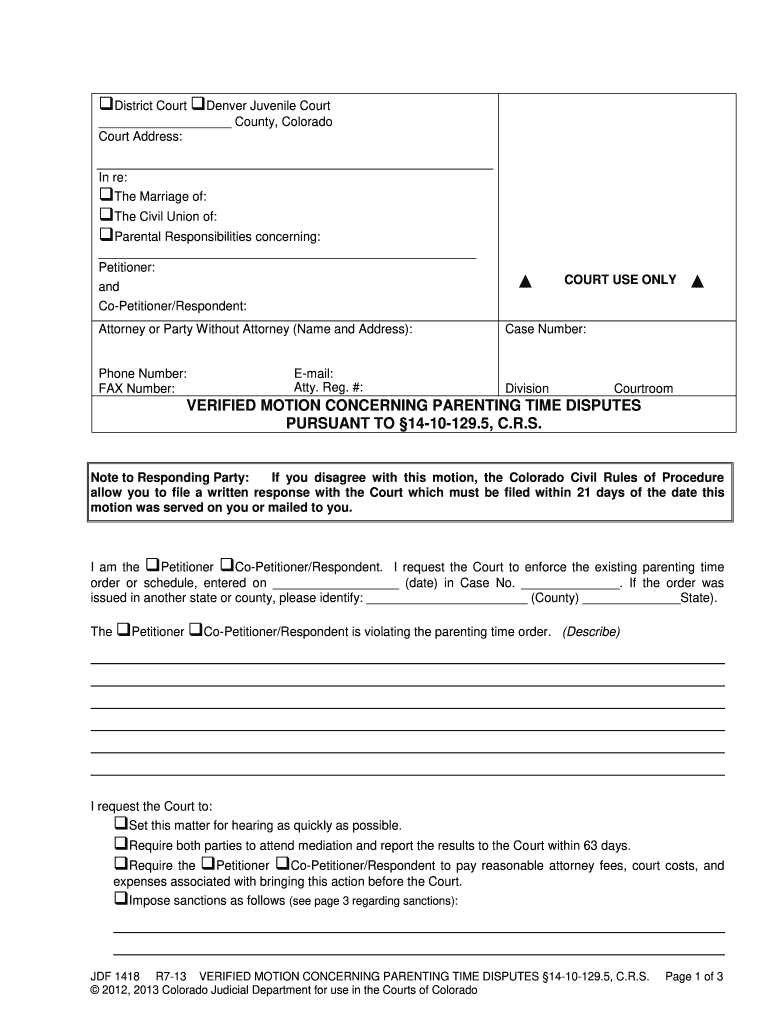
How to use or fill out co jdf1418 with our platform

- Click ‘Get Form’ to open the co jdf1418 in the editor.
- Begin by filling in the court address and case details at the top of the form. Ensure you accurately enter your county and case number.
- Indicate whether you are the Petitioner or Co-Petitioner/Respondent by checking the appropriate box.
- In the section regarding parenting time disputes, clearly describe any violations of existing orders, including dates and specifics.
- Select your requests to the court by checking relevant boxes, such as setting a hearing or requiring mediation.
- Complete the verification section by signing and dating where indicated. If applicable, include your attorney's signature.
- Fill out the Certificate of Service section to confirm how you served copies of this motion to other parties involved.
Start using our platform today for free to streamline your document editing and completion process!
Fill out co jdf1418 online
It's free
It's free
See more co jdf1418 versions
We've got more versions of the co jdf1418 form. Select the right co jdf1418 version from the list and start editing it straight away!
| Versions | Form popularity | Fillable & printable |
|---|---|---|
| 2013 | 4.8 Satisfied (189 Votes) |
Got questions?
We have answers to the most popular questions from our customers. If you can't find an answer to your question, please contact us.
Contact us
How does joint custody work in Colorado?
In Colorado, legal custody is called decision-making responsibility. Joint physical custody: The childs time is divided between both parents households, with a specific parenting schedule outlining when the child will reside with each parent. Colorado courts use the term parenting time for this custody type.
What is a motion to enforce an order in Colorado?
In Colorado, a motion to enforce is a legal tool that can be used to ensure that an existing court order or agreement is followed. When one party fails to comply with the terms of a court order or agreement, the other party may file a motion to enforce to seek enforcement of the terms.
How to enforce a parenting plan in Colorado?
How is a Parenting Plan Enforced in Colorado? File A Contempt Motion. If the other parent violates the parenting plan, you can file a contempt motion in court. Call The Police. If the other parent is denying you access to the children, you can call the police to accompany you. File A Motion With The Court.
Can police enforce custody orders in Colorado?
For example, if one parent refuses to return a child after their visitation period has ended, the other parent can seek assistance from law enforcement under Colorado Revised Statutes Section 14-10-129. This statute allows for the enforcement of custody orders by any law enforcement officer in the state.
How do you enforce parenting time in Colorado?
File A Motion With The Court The court will give priority to motions for enforcement of the parenting plan and may order mediation, require the other parent to comply, or impose sanctions and attorney fees.
Security and compliance
At DocHub, your data security is our priority. We follow HIPAA, SOC2, GDPR, and other standards, so you can work on your documents with confidence.
Learn more


People also ask
Can a parent withhold parenting time?
California generally prohibits parents from withholding visitation unless there is a legitimate reason. Legitimate reasons can mean more than just disliking the other parent. Typically, a court needs to agree to withhold visitation if there is concrete concern that a child is unsafe when with the other parent.
At what age does a parenting plan end in Colorado?
Under Colorado statute, custody orders expire when a child reaches 18 years of age. Child support ends at 19 years of age, with some exceptions either related to high school or disability. If by parental rights taken away you mean those rights are terminated, then, yes, there should be no child support to be paid.
What are the factors for child custody in Colorado?
Many factors are taken into consideration when determining an initial award, such as the history of involvement by each parent, the mental and physical health of the parties, and the ability of the custodial parent to encourage the relationship between the children and the non-custodial parent.


