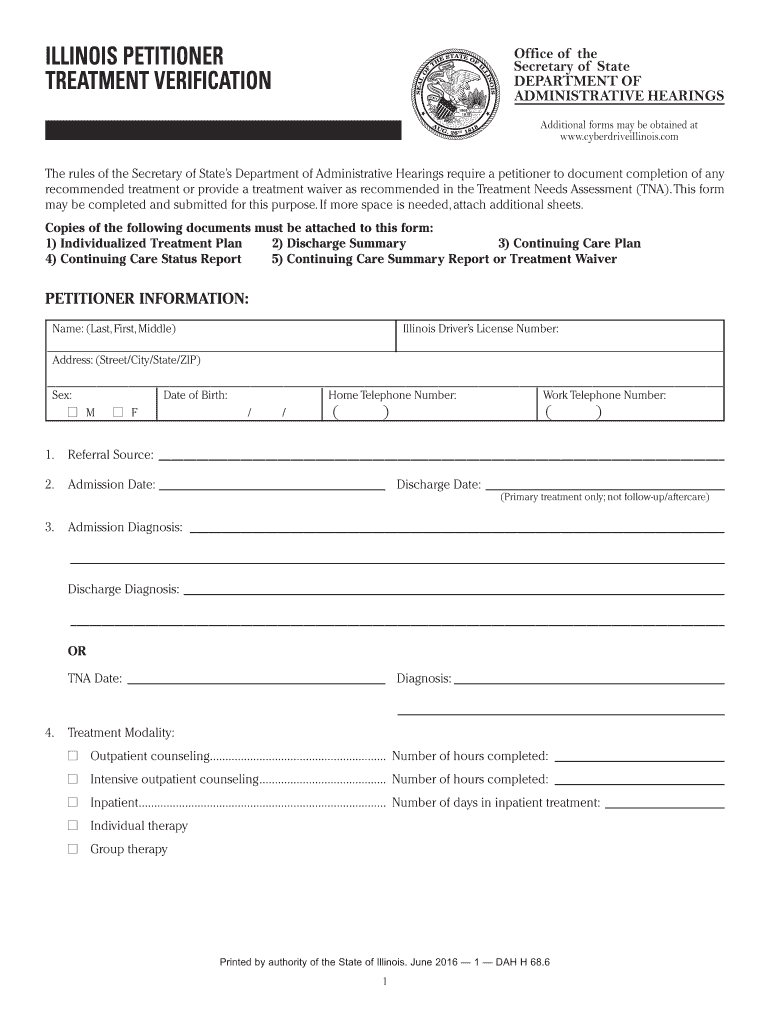
Treatment verification 2026

Get Form
illinois verification of Preview on Page 1

Here's how it works

01. Edit your illinois verification of online
Type text, add images, blackout confidential details, add comments, highlights and more.
02. Sign it in a few clicks
Draw your signature, type it, upload its image, or use your mobile device as a signature pad.
03. Share your form with others
Send illinois verification form via email, link, or fax. You can also download it, export it or print it out.

How to use or fill out treatment verification with our platform

Form edit decoration
9.5
Ease of Setup
DocHub User Ratings on G2
9.0
Ease of Use
DocHub User Ratings on G2
  1. Click ‘Get Form’ to open the treatment verification document in the editor.
  2. Begin by filling out the Petitioner Information section. Enter your name, Illinois Driver’s License Number, address, sex, date of birth, and contact numbers.
  3. In the Referral Source field, provide details about who referred you for treatment. Then, input your Admission and Discharge Dates for primary treatment.
  4. Complete the Admission and Discharge Diagnosis sections with relevant information regarding your treatment history.
  5. Select the Treatment Modality that applies to you and indicate the number of hours or days completed as required.
  6. Provide a prognosis after completing treatment, discussing gains made and potential future risks.
  7. Indicate your Continuing Care Status by selecting the appropriate option and providing any necessary reports.
  8. Finally, fill in the Rationale section if applicable, ensuring all modifications or waivers are clearly explained.

Start using our platform today to easily complete your treatment verification form online for free!

See more treatment verification versions

We've got more versions of the treatment verification form. Select the right treatment verification version from the list and start editing it straight away!
Versions Form popularity Fillable & printable
2016 4.8 Satisfied (102 Votes)
be ready to get more

Complete this form in 5 minutes or less

Get form

Got questions?

We have answers to the most popular questions from our customers. If you can't find an answer to your question, please contact us.
Contact us
[Abstract] It has been realized that the 4Rs (repair, repopulation, redistribution, and reoxygenation) would affect the result of cell irradiation, and thus radiation treatment. The 4Rs each occurs at different dose rates, usually very low dose rates.
Next, your radiation therapy team will mark the place on your body that will get the radiation. This might be done with a marker or with small permanent tattoos. It all depends on your situation. Planning scans.
To date, the determinant factors of response to radiation have been presented as 6 terms that start with the letter R, including Regeneration (proliferation rate), Repair (DNA damage repair efficacy), Reoxygenation (rate of oxygen pressure in tumor tissue), Redistribution (cell cycle stage), Radiosensitivity (intrinsic
Radiation therapy usually does not have an immediate effect, and it could take days, weeks or months to see any change in the cancer. The cancer cells may keep dying for weeks or months after the end of treatment.
Record and verify systems (RVSs) were developed to reduce the risk of treatment errors in radiation oncology. These have recently evolved into complete radiotherapy information management systems that interface with imaging systems, treatment planning computers and treatment delivery systems.

Security and compliance

At DocHub, your data security is our priority. We follow HIPAA, SOC2, GDPR, and other standards, so you can work on your documents with confidence.

Learn more
ccpa2
pci-dss
gdpr-compliance
hipaa
soc-compliance
be ready to get more

Complete this form in 5 minutes or less

Get form

People also ask

In general, success or failure of standard clinical radiation treatment is determined by the 4 Rs of radiobiology: repair of DNA damage, redistribution of cells in the cell cycle, repopulation, and reoxygenation of hypoxic tumor areas.

Related links