
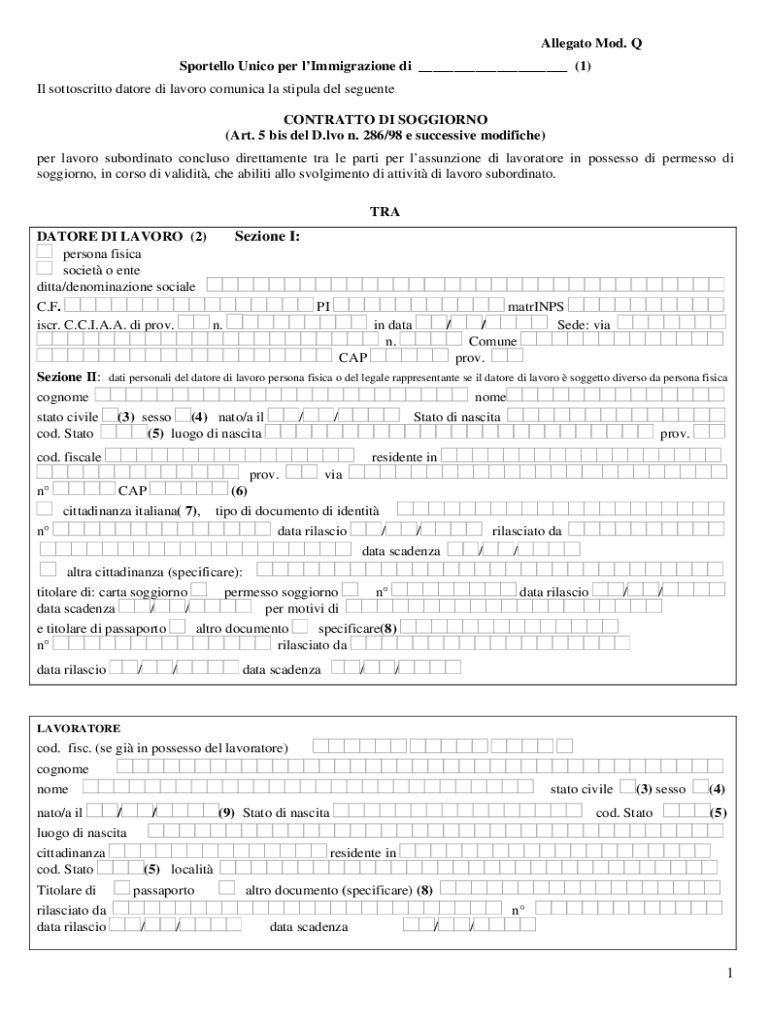







Definition & Meaning
The "Italian Work Contract for Non-EU Workers" is a formal agreement that sets the terms of employment for non-EU citizens planning to work in Italy. This contract is essential for legally ensuring work permission under Italian law, covering aspects such as job role, salary, working hours, and the duration of employment. It is governed by the Italian Immigration Law, ensuring compliance with national employment standards.
How to Obtain the Italian Work Contract for Non-EU Workers
To secure an Italian work contract, a non-EU worker generally needs a job offer from an employer in Italy who is willing to sponsor their visa. The employer must apply for a Nulla Osta, which is a work permit, through the local immigration office. Key steps include:
-
Employer Application: The employer submits an application for a work permit on behalf of the employee to Immigration (Sportello Unico per l'Immigrazione).
-
Approval of Nulla Osta: Once approved, the Nulla Osta is sent electronically to the Italian consulate in the employee's country of residence.
-
Visa Application: The employee applies for a work visa at the consulate, submitting their passport, contract, and an application fee.
-
Residence Permit: Upon arrival in Italy, the worker applies for a residence permit (Permesso di Soggiorno) at the local police station within eight days.
Steps to Complete the Italian Work Contract for Non-EU Workers
Completing this contract involves collaboration between the employer and employee. Here are detailed steps to complete the contract:
-
Review Job Offer: Ensure that the terms offered align with Italian employment standards and personal expectations.
-
Gather Required Documents: Collect documents like identification certificates, proof of education, and professional credentials.
-
Complete Necessary Forms: Fill out forms such as the Allegato Mod. Q provided by the Italian immigration office.
-
Legal Review: Consider consulting with an immigration lawyer to ensure all terms are legally compliant and understood by both parties.
-
Submit Contract for Approval: Once all documentation is complete, submit the contract to the relevant Italian authorities for final approval.
Key Elements of the Italian Work Contract for Non-EU Workers
An Italian work contract must include several critical components to be valid:
-
Employer Information: Details such as name, address, and business registration number.
-
Employee Details: Full name, nationality, passport information.
-
Job Description: Role and responsibilities the employee will undertake.
-
Salary and Benefits: Detailed outline of compensation, including base salary, bonuses, and additional benefits.
-
Work Hours: Expected working hours per week, including provisions for overtime or shift work.
-
Contract Duration: Length of employment, whether it's temporary or permanent.
-
Termination Clause: Conditions under which the contract may be terminated by either party.
Important Terms Related to Italian Work Contract for Non-EU Workers
Understanding key legal and employment terms is crucial for anyone signing this contract:
-
Nulla Osta: A clearance certificate required before a non-EU citizen can apply for an Italian work visa.
-
Permesso di Soggiorno: The residence permit needed to stay in Italy after arrival.
-
D.lvo n. 286/98: The legislative decree that governs immigration and employment of non-EU workers in Italy.
Legal Use of the Italian Work Contract for Non-EU Workers
This contract is pivotal in legitimizing employment under Italian and EU laws. It protects against unauthorized employment, which could lead to severe penalties, including deportation or fines for the employer. Legal compliance with labor standards, such as fair wages and working conditions, is essential to uphold workers' rights.
Who Typically Uses the Italian Work Contract for Non-EU Workers
This form is commonly used by:
-
International Corporations: Hiring talent from outside the EU to fill specialized positions.
-
Italian SMEs: Small to medium enterprises needing specific skills not available in the local market.
-
Individual Employers: Families or individuals looking to hire domestic help or personal assistants from abroad.


Penalties for Non-Compliance
Failure to comply with the requirements of the Italian Work Contract for Non-EU Workers can result in:
-
Fines: Significant penalties imposed on the employer for unauthorized employment.
-
Deportation: Involves the repatriation of the employee if found to be working unlawfully.
-
Legal Action: Potential criminal charges against employers for serious breaches of immigration laws.
Employers and employees must ensure they adhere strictly to every aspect of the contract to avoid such consequences.




