




01. Edit your form online
Type text, add images, blackout confidential details, add comments, highlights and more.

Type text, add images, blackout confidential details, add comments, highlights and more.

Draw your signature, type it, upload its image, or use your mobile device as a signature pad.

Send it via email, link, or fax. You can also download it, export it or print it out.
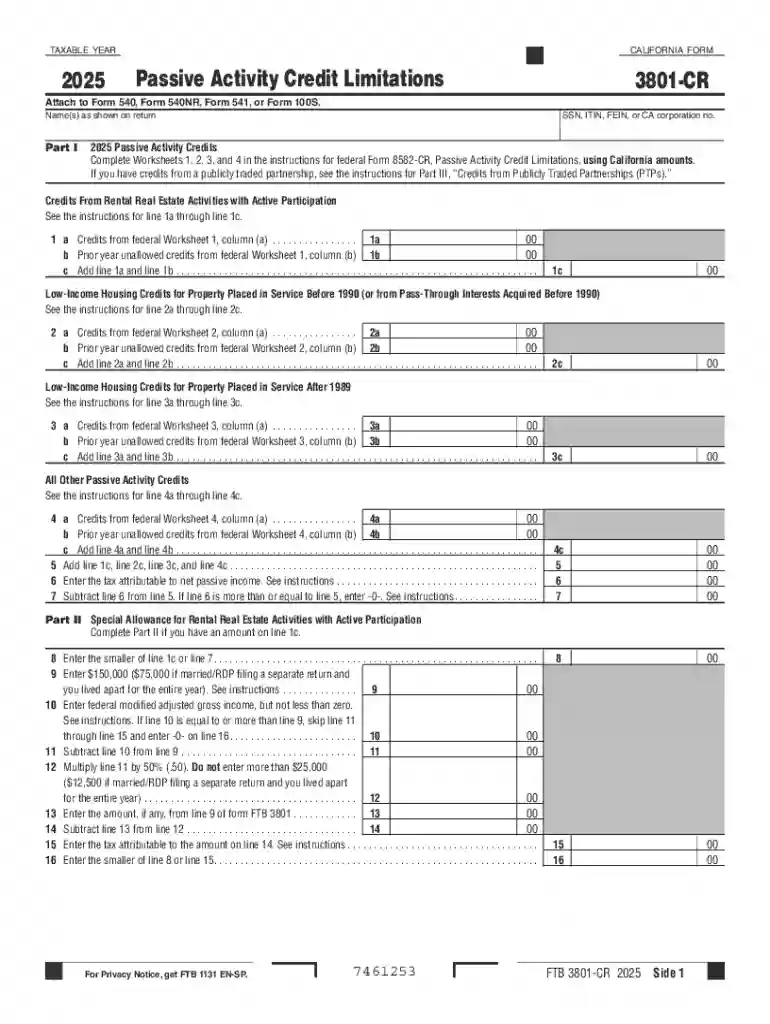
The California Form 3801-CR 2025 Passive Activity Credit Limitations is a tax document used by individuals, estates, trusts, and certain types of businesses to determine the amount of passive activity credit that can be claimed in a given tax year. This form is unique to California tax filings and aligns with both federal and state tax regulations. It limits the use of passive activity credits, ensuring compliance with the specific legal standards set by the state. Passive activities typically include rental activities and businesses in which the taxpayer does not materially participate, thus restricting the use of credits from these activities to offset only the taxes generated from similar passive income.
The process of using California Form 3801-CR involves detailed calculations and the integration of various income sources. Here’s a step-by-step guide:
Gather Financial Information: Collect all relevant records, including income reports, prior tax returns, and documentation of passive activities.
Complete Part I: This section requires information about your income from passive activities. It serves as the primary basis for calculating how much of the passive activity credit can be applied to the current year.
Compute Carryover Credits: Identify any carryover credits from previous years that can be used in the current tax filing.
Determine Current Year Credit: Calculate the allowable credit based on limitations imposed by your passive income.
Attach to Tax Return: Once completed, attach the form to your California individual, trust, or business tax return forms (such as Form 540, Form 540NR, Form 541, or Form 100S).
Rental Property Owners: If you own a rental property and have passive losses or credits, Form 3801-CR will help you apply appropriate credits within the permissible limits.
Business Partnerships: Partners who are not actively participating in the business but still earning income may find this form essential in aligning their credit claims.
Completing this form accurately is crucial for compliance and the correct application of passive activity credits. Here’s a detailed guide:
Start with Personal Information: Fill in your name, SSN, or business identification number at the top as per your tax documents.
Identify Passive Activities: Write down details about each passive activity, including type and income or losses generated.
Complete Credit Calculation: Use the formulas provided within the form instructions to compute the exact credit for the taxable year.
Carryover Credits: Include credits that are carried over from previous years due to exceeding limitations in those years.
Final Review and Attach: Make a comprehensive assessment of all calculations and ensure the form is signed and attached to the appropriate tax document.
Several elements make up the form, each having distinct importance:
Passive Activity Identification: Listing specific activities and categorizing income or losses ensures clarity and accuracy in credit calculations.
Credits and Carryovers: Clearly segregate current year credits from carryover credits to maintain compliance with state mandates.
Adjustments: The section that allows for adjustments related to any federal/state differences, clarifying the specific California-only credit application.
The legal framework behind the use of Form 3801-CR involves its adherence to the federal and California-specific tax codes. Proper use ensures taxpayers aren't unlawfully reducing taxable income through the misapplication of passive activity credits. It also provides the legal backing to any credits applied, offering protection during audits.
Understanding filing deadlines is crucial:
Annual Filing Date: The California state return due date typically matches the federal tax deadline of April 15.
Extensions: Automatic six-month extensions are available by submitting the appropriate request forms.
To correctly file Form 3801-CR, gather:
Previous Year Return: Ensures carryovers are correctly applied.
Income Statements: For all passive activities, accuracy in income or loss reporting is essential.
Partnership or Trust Documents: For those who are part of these entities, additional documentation may be required to determine the extent of participation and credit usage.
California imposes unique rules distinct from federal limitations:
Non-Resident and Part-Year Residents: Special rules apply for these categories, with credits applied proportionally based on California source income.
Adjustment Factors: California may require adjustments for differences between federal and state recognition of passive activities, necessitating adherence to state-specific guidelines listed in the instructions.
We've got more versions of the California Form 3801-CR 2025 Passive Activity Credit Limitations form. Select the right California Form 3801-CR 2025 Passive Activity Credit Limitations version from the list and start editing it straight away!
At DocHub, your data security is our priority. We follow HIPAA, SOC2, GDPR, and other standards, so you can work on your documents with confidence.
Jun 12, 2025 No changes have been made to the proposed amendments since the committee reviewed them at the May 2025 meeting. BACKGROUND INFORMATION. Board ofRead more
Complete form FTB 3801, Side 2, California Passive Activity Worksheet, in order to figure your current year California passive activity income (loss) amounts.Read more


