
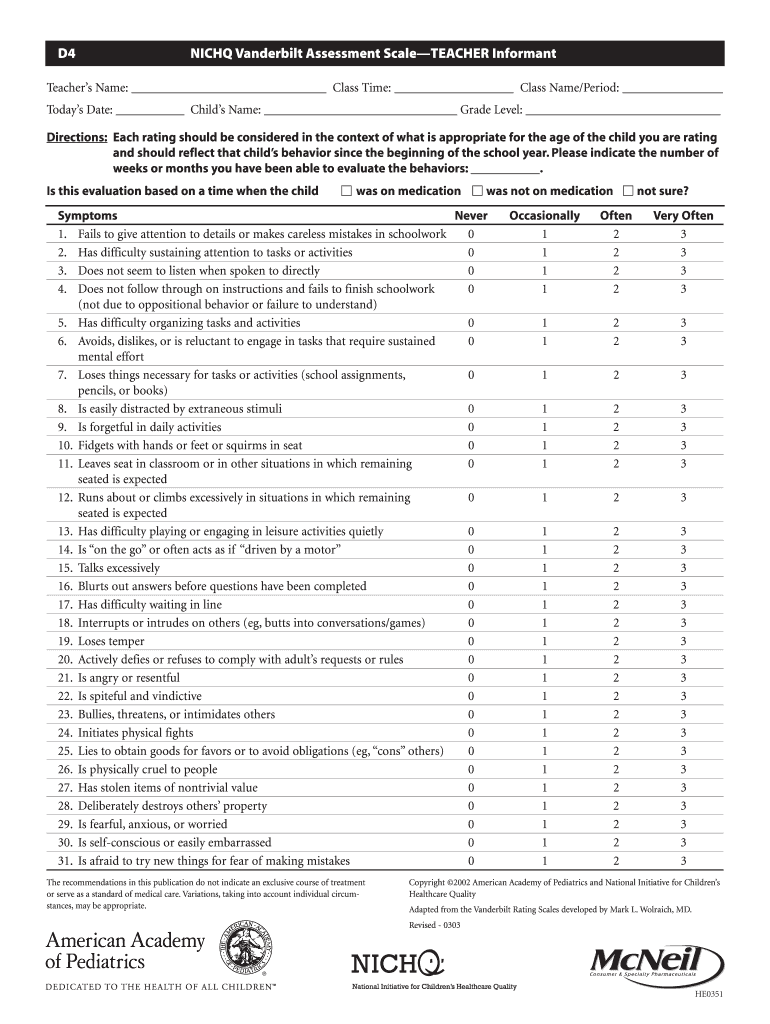







Definition and Meaning
The NICHQ Vanderbilt Assessment Scale Teacher Informant is a standardized tool used to evaluate behavioral patterns in children and adolescents, particularly those suspected of having ADHD (Attention-Deficit/Hyperactivity Disorder). Teachers fill out this form to provide insights into a child's behavior in academic and social settings, offering essential data for clinicians to make informed diagnoses. It assesses various parameters, including attention span, hyperactivity, academic performance, and social interactions.
How to Use the NICHQ Vanderbilt Assessment Scale Teacher Informant
Teachers use this form by observing the child's behavior over a period of time and rating specific behavioral criteria as described in the questionnaire. Each behavioral item is scored on a scale, often from 0 (never) to 3 (very often), allowing educators to quantify behaviors that may affect a child's performance and interactions. The scores are then calculated to provide an overall picture of the child's behavioral health, guiding further clinical evaluation and intervention strategies.
Steps to Complete the NICHQ Vanderbilt Assessment Scale Teacher Informant
- Familiarize with the Form: Review all sections and understand the criteria for each behavioral rating.
- Observe the Student: Ensure consistent and objective observation of the student’s behavior over a specific period, typically during regular classroom activities and interactions.
- Rate Each Behavior: Assign a score from 0 to 3 for each item based on observed frequency and intensity of behaviors.
- Calculate the Scores: Sum the scores for each section to determine specific behavior patterns.
- Submit the Completed Form: Provide the completed assessment to the relevant medical professional for further evaluation and intervention.
Key Elements of the NICHQ Vanderbilt Assessment Scale Teacher Informant
- Behavioral Criteria: Specific items focused on attention, hyperactivity, and impulsivity.
- Rating Scale: Numerical scales for quantifying behavioral frequency and severity.
- Scoring Sections: Divided into components that assess different aspects of behavior.
- Additional Comments: Space for anecdotal notes or observations that fall outside of predefined criteria.
Important Terms Related to the NICHQ Vanderbilt Assessment Scale Teacher Informant
- ADHD: Attention-Deficit/Hyperactivity Disorder, a common neurodevelopmental disorder in children.
- Inattention: Difficulty with focus and sustaining mental effort.
- Hyperactivity: Excessive movement or activity beyond what is considered normal.
- Impulsivity: Hasty actions that occur in the moment without thought to the consequences.
Who Typically Uses the NICHQ Vanderbilt Assessment Scale Teacher Informant
This form is primarily used by educators, including teachers and school counselors, to document behavioral observations in school settings. It is a critical tool for healthcare providers, such as pediatricians and child psychologists, to gather third-party data supporting clinical diagnoses and creating tailored intervention plans.


How to Obtain the NICHQ Vanderbilt Assessment Scale Teacher Informant
The form is typically provided by healthcare providers or specialist clinics as part of the ADHD evaluation process. It may also be accessible through educational resources or directly from the National Institute for Children's Health Quality (NICHQ) for schools and educational institutions.
Legal Use of the NICHQ Vanderbilt Assessment Scale Teacher Informant
Completion and submission of this assessment are compliant with HIPAA regulations if done in a clinical context, protecting the confidentiality of the child's mental health information. Consistent with U.S. regulations, consent from guardians may be required to administer the assessment and share results with health professionals.
Digital vs. Paper Version
Educators and healthcare providers can choose between traditional paper versions and digital formats of the NICHQ Vanderbilt Assessment Scale Teacher Informant. Digital versions are often integrated with clinic management software, allowing for quicker data entry, analysis, and storage.
Examples of Using the NICHQ Vanderbilt Assessment Scale Teacher Informant
Schools might utilize this form to establish behavioral baselines for students showing early signs of ADHD to determine the need for further assessment. Additionally, it can be included in individualized educational plan (IEP) meetings to document progress and tailor support strategies for students with behavioral challenges.




