Definition & Meaning
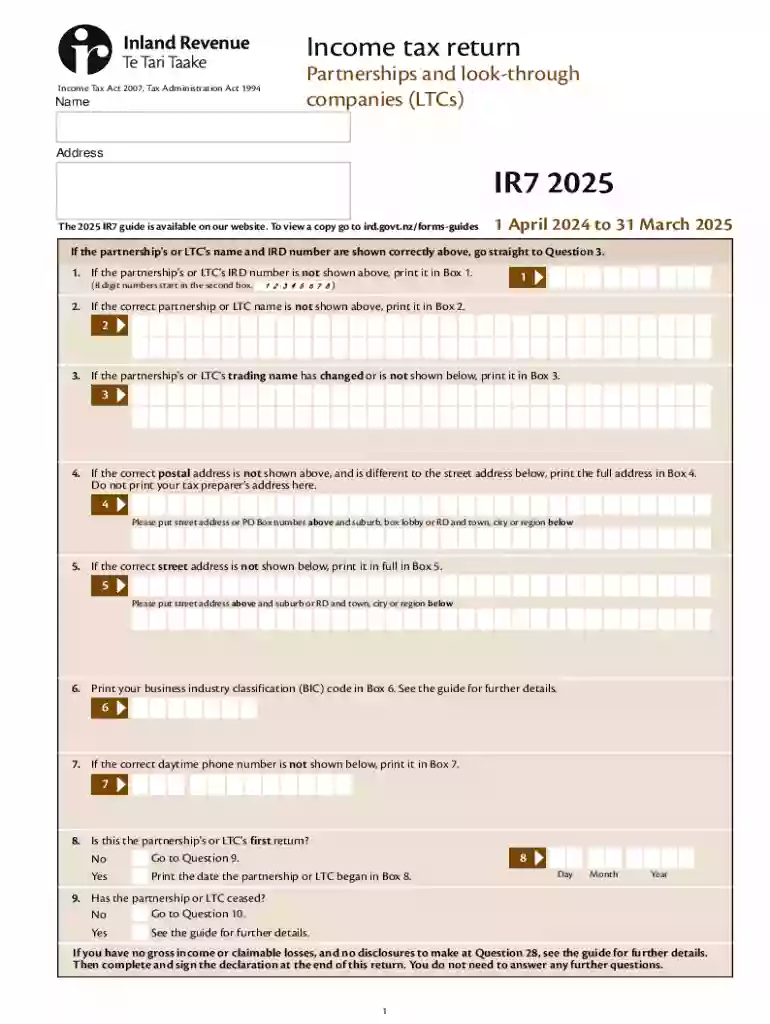
The New Zealand Partnership Income Tax Return IR7 2025 is a tax form specifically designed for partnerships and look-through companies (LTCs) in New Zealand. The form is integral for reporting partnership income, deductions, and credits for the year 2025, ultimately determining the tax that each partner or shareholder must pay. It is vital for business entities to accurately complete the IR7 to ensure compliance with tax regulations as outlined in the Income Tax Act 2007 and Tax Administration Act 1994.
Contextual Explanation
- Purpose: The IR7 form facilitates the collection of tax-related information from partnerships, ensuring that income is correctly allocated and taxed.
- Scope: This form specifically applies to partnerships and LTCs, which are pass-through entities in New Zealand, meaning taxes are paid individually by partners or shareholders, not the business itself.
- Legal Framework: Governed by New Zealand's Income Tax Act and Tax Administration Act, the IR7 form mandates necessary disclosures to prevent evasion and ensure proper tax allocation.
Steps to Complete the New Zealand Partnership Income Tax Return IR7 2025
Completing the IR7 form requires careful attention to detail to ensure accuracy and compliance with tax laws. Here is a step-by-step guide to completing the New Zealand Partnership Income Tax Return IR7 2025:
- Gather Required Information: Collect all financial records for the business, including income, expenses, deductions, and distributions to partners or shareholders.
- Determine Income: Calculate total income from all sources, distinguishing between types of income such as sales, interest, and dividends.
- Report Deductions: Accurately list all allowable deductions following New Zealand tax regulations, including operating expenses and specific business-related costs.
- Allocate Profits and Losses: Distribute the partnership’s profit or loss among partners according to their ownership interest, ensuring correct reporting for individual tax purposes.
- Complete the IR7 Form: Fill in all relevant sections of the IR7 2025 form accurately, confirming that income and expense figures align with provided documentation.
- Review and Submit: Double-check all entries for accuracy and completeness before submitting the form through the preferred method: online via New Zealand Inland Revenue's website, postal mail, or in person.
Key Points
- Ensure all partners' taxpayer information is correctly listed on the form.
- Consider using accounting software for accuracy.
- Check for any updates or changes in tax legislation that might affect the reporting requirements for 2025.
Required Documents
Accurate completion of the IR7 form necessitates several supporting documents, ensuring compliance and accurate tax assessments:
- Financial Statements: Comprehensive income statement, balance sheet, and cash flow statement.
- Bank Statements: To verify income and expenses reported.
- Expense Receipts: Documentation of all deductible expenses claimed.
- Partnership Agreement: Copy outlining the profit distribution and roles.
- Previous Year’s Tax Return: Reference to ensure continuity and reporting accuracy.
Practical Tips
- Maintain an organized filing system throughout the year to streamline document retrieval during tax season.
- Regularly review documents to ensure they are up-to-date and reflect the latest fiscal policies.
Important Terms Related to the New Zealand Partnership Income Tax Return IR7 2025
Understanding specific terminology associated with the IR7 form can ensure accuracy and compliance:
- Partnership Income: Total income derived by the partnership that passes through to partners.
- Look-Through Company (LTC): A corporate tax structure where income and tax obligations pass directly to shareholders.
- Allocation of Profit: Division of profits based on the partnership agreement.
- Distributions: Payments made to partners representing their share of profit.
- Deductions: Eligible expenses that can reduce taxable income.
Clarifications
- Pass-Through: Concept where income is taxed at individual partner level rather than at the business entity level.
- Tax Credits: Reductions to tax liabilities, distinct from deductions, which lower taxable income.
Legal Use of the New Zealand Partnership Income Tax Return IR7 2025
Filing the IR7 is not only a legal requirement but a vital component in managing a partnership's fiscal responsibilities:
- Compliance: Mandated by New Zealand’s tax authorities to ensure accurate reporting and payment of taxes.
- Audit Protection: Properly filing the IR7 can protect the business from potential audits or penalties.
- Transparency: Enhances financial transparency among partners and stakeholders by clearly outlining financial performance and obligations.
Legal Considerations
- Non-compliance can result in penalties, legal action, or audits from the tax office.
- Regularly review changes to tax laws to ensure continued compliance.
Filing Deadlines / Important Dates
Adherence to correct filing protocols includes awareness of key dates associated with the New Zealand Partnership Income Tax Return IR7 2025:
- Deadline for Submission: Generally set by the Inland Revenue Department; exact dates may vary slightly each year but are typically within three months following the fiscal year-end.
- Extensions: Possible under certain conditions, but prior approval is required from the Inland Revenue.
- Payment Dates: Taxes owed must be paid by the filing deadline to avoid interest or penalties.
Strategies
- Set reminders well in advance of deadlines.
- Consult with a tax professional if there are uncertainties about filing dates.
Penalties for Non-Compliance
Failing to properly file the IR7 form can result in significant financial and legal repercussions:
- Late Fees: Charged for submissions past the due date.
- Interest Charges: Accrued on unpaid taxes from the deadline until full payment is made.
- Fines: Financial penalties for inaccurate or fraudulent reporting.
Preventative Measures
- Employ the services of a certified tax advisor.
- Double-check all documentation before submission.
- Stay informed of all tax-related deadlines and requirements.
Digital vs. Paper Version
Filing options for the IR7 form provide flexibility, catering to both traditional and digital preferences:
- Digital Filing: Offers convenience and immediate confirmation of filing; recommended for quicker processing through the Inland Revenue's online portal.
- Paper Filing: Suitable for those less comfortable with digital platforms, yet requires additional processing time.
Considerations
- Digital filing is environmentally friendly and reduces the risk of form loss.
- Ensure internet security measures are in place when submitting sensitive information online.
By comprehensively addressing these critical blocks, entities will gain an enhanced understanding of the New Zealand Partnership Income Tax Return IR7 2025 and its significance in maintaining fiscal responsibility.