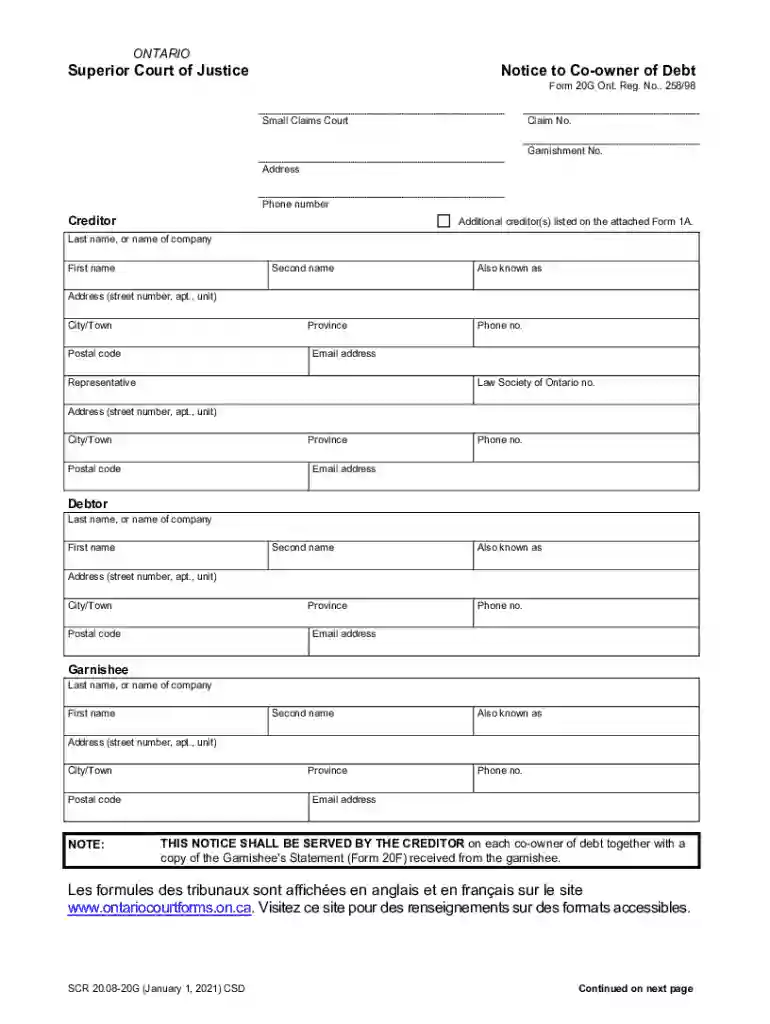
Ontario Superior Court Notice to Co-owner of Debt 2026

Get Form
Ontario Superior Court Notice to Co-owner of Debt Preview on Page 1

Here's how it works

01. Edit your form online
Type text, add images, blackout confidential details, add comments, highlights and more.

02. Sign it in a few clicks
Draw your signature, type it, upload its image, or use your mobile device as a signature pad.

03. Share your form with others
Send it via email, link, or fax. You can also download it, export it or print it out.

Definition & Meaning

The "Ontario Superior Court Notice to Co-owner of Debt" is a formal document used in the legal context, specifically within the Ontario Superior Court of Justice in Canada. This notice informs a co-owner or co-debtor about a debt-related claim or garnishment proceedings initiated against them. It serves as a legally binding notification that one party is seeking to recover a debt jointly owned by multiple parties, ensuring transparency and procedural fairness in debt recovery actions.

  • Legal Context: The form is often used in small claims court when a creditor seeks enforcement actions such as garnishment to collect outstanding debts.
  • Purpose and Functions: Primarily, it aims to notify all co-owners of their legal obligations and any pending legal actions impacting them.

How to Use the Ontario Superior Court Notice to Co-owner of Debt

Using this form requires precision to ensure compliance with legal procedures. The notice should be completed with detailed information about the debt, including all involved parties and the full amount due.

  1. Detailed Completion: Include specific information about the creditor, debtor(s), and any additional creditors listed in attachments.
  2. Delivery: The completed notice must be formally served to all co-owners of the debt, following the legal service requirements applicable in Ontario.
  3. Accompanying Actions: It is often accompanied by other judicial procedures, such as filing claims or requesting a garnishment, making sure that all contrary steps are acknowledged.

Steps to Complete the Ontario Superior Court Notice to Co-owner of Debt

Filling out this form correctly is critical for its acceptance in legal proceedings. Here are detailed steps to complete the notice correctly:

  1. Gather Required Information:

    • Collect details about the debt, including original amount, accrued interest, and outstanding balance.
    • Identify the creditor and all co-owners of the debt with their respective contact information.
  2. Fill Out the Form:

    • Enter information about court identifiers such as claim and garnishment numbers.
    • Clearly list all co-owners and specify the role of each in connection to the debt.
  3. Double-check Details:

    • Verify all entries for accuracy to prevent delays or legal challenges.
    • Ensure that any additional supporting documents, like creditor agreements or prior notices, are attached as required.

Key Elements of the Ontario Superior Court Notice to Co-owner of Debt

Understanding the critical sections of this form ensures complete and accurate submissions:

  • Creditor Information: Clear identification of the creditor entity legally entitled to claim debt recovery.
  • Debt Details: Comprehensive breakdown of the total debt, including interest rates or additional fees applicable.
  • Notification Purpose: Specific legal actions being pursued, such as garnishment or notice of claim.

Legal Use of the Ontario Superior Court Notice to Co-owner of Debt

This notice is utilized within a defined legal framework, contributing to fair judicial processes:

  • Garnishment Procedures: Facilitates legal garnishment, enabling creditors to claim a portion of co-owners' assets or income.
  • Notification Obligation: Legally mandates that co-owners are adequately informed of any proceedings involving shared debts, upholding transparency and due process.

Who Typically Uses the Ontario Superior Court Notice to Co-owner of Debt

Several parties engage with this form within the Ontario legal system:

  • Creditors: Legal and financial institutions seeking debt recovery through Ontario's court system.
  • Co-owners of Debt: Individuals jointly responsible for a financial obligation, requiring legal notification of actions impacting their shared interests.
decoration image ratings of Dochub

Required Documents

Filing this notice necessitates accompanying documentation that substantiates the claim, including:

  • Creditor Agreements: Original contract terms and conditions that outline the debt's nature.
  • Court Filings: Copies of any prior legal decisions, claims, or other official documents pertinent to the garnishment action.

Filing Deadlines / Important Dates

Adhering to specific timeframes is imperative to maintain the notice's legal validity:

  • Service Deadlines: The notice must be served within a period stipulated by Ontario law, typically within a few weeks of initiating the claim.
  • Response Times: Co-owners may have a specific window to respond or dispute the claim, ensuring prompt attention to the notice is essential.

State-Specific Rules for the Ontario Superior Court Notice to Co-owner of Debt

Ontario's legal framework imposes unique requirements:

  • Provincial Regulations: Compliance with Ontario-specific rules around notice serving, garnishment limits, and financial thresholds is critical.
  • Jurisdictional Compliance: Forms and processes must reflect the provincial jurisdiction in which the notice is served, ensuring regional legal requirements are met.

Following these detailed instructions and explanations can optimize the effectiveness of utilizing the "Ontario Superior Court Notice to Co-owner of Debt" in the legal processes.

be ready to get more

Complete this form in 5 minutes or less

Get form

Security and compliance

At DocHub, your data security is our priority. We follow HIPAA, SOC2, GDPR, and other standards, so you can work on your documents with confidence.

Learn more
ccpa2
pci-dss
gdpr-compliance
hipaa
soc-compliance
be ready to get more

Complete this form in 5 minutes or less

Get form