






Definition & Meaning
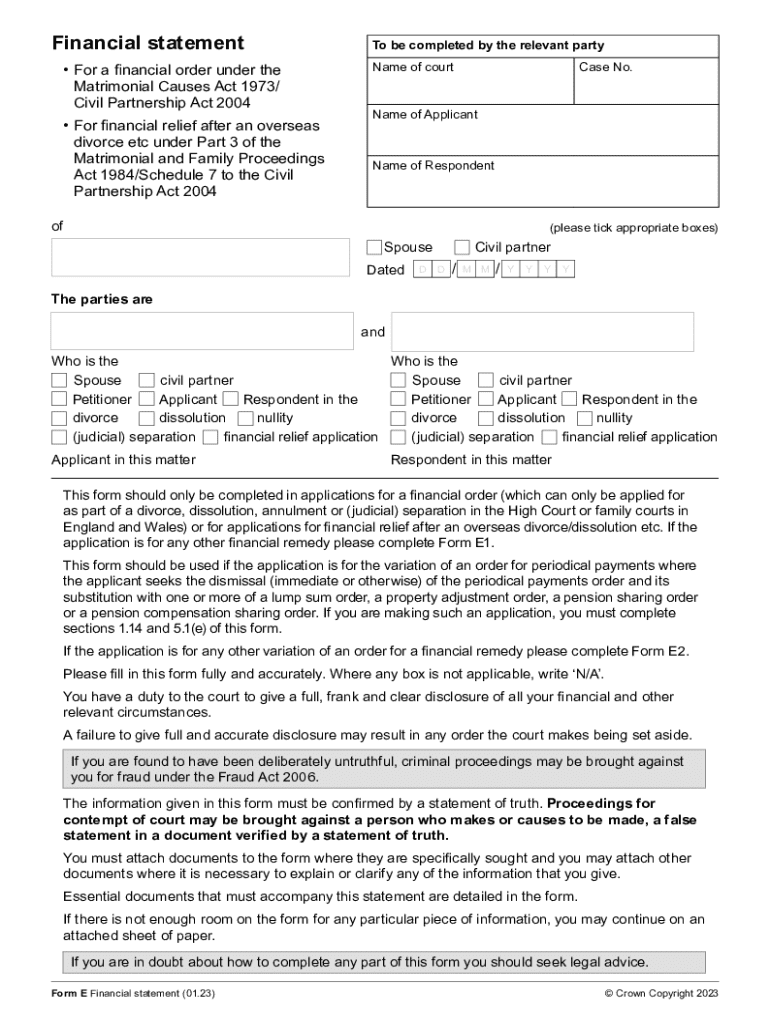
The Form E Financial Statement is a comprehensive legal document that serves as a detailed financial disclosure in divorce proceedings involving financial settlements in the United States. It is primarily used to provide the court and both parties with a clear understanding of each individual's financial situation. The form includes detailed information about income, expenses, assets, and liabilities, which is crucial in proceedings under Matrimonial Causes Act 1973 and Civil Partnership Act 2004. Understanding the meaning and purpose of the Form E is vital for individuals navigating family law cases, ensuring that all financial information is presented accurately and transparently.
How to Use the Form E Financial Statement
Using the Form E Financial Statement requires meticulous preparation and accuracy. Individuals must gather all relevant financial documents, including pay stubs, tax returns, mortgage statements, and bank account details. Once gathered, these documents facilitate the accurate completion of various sections of the form:
- Income and Expenses: Detailed monthly income and living expenses must be declared, reflecting the financial reality of the individual.
- Assets and Liabilities: A factual list of all assets and debts is essential, covering property, vehicles, loans, and other financial obligations.
- Pension and Savings: Information about pensions and other savings must be accurately reported.
Ensuring the form is filled accurately helps avoid legal complications and facilitates a fair financial settlement.
Steps to Complete the Form E Financial Statement
-
Gather Supporting Documents: Collect bank statements, income details, property valuations, and loan agreements.
-
Complete Financial Sections:
- Income: Include salary, bonuses, and other revenue sources.
- Expenses: Detail living costs, bills, and any investments or savings contributions.
-
List All Assets and Liabilities:
- Provide accurate valuations and debts information, ensuring completeness.
-
Review and Verify Entries: Double-check all entries for accuracy to prevent future disputes.
-
Submit the Form: After finalizing, submit to the designated legal representative or court as instructed in divorce proceedings.
Accurately following these steps ensures a complete submission, aiding in achieving an equitable settlement.
Key Elements of the Form E Financial Statement
The Form E Financial Statement encompasses several key elements critical to financial disclosures in divorce cases:
- Personal Details: Includes the names, addresses, and contact information of both parties.
- Income Breakdown: Lists all income sources, emphasizing regular and one-time incomes.
- Property and Assets: Detailed disclosure of all owned properties, vehicles, and financial investments, including retirement accounts.
- Pension Information: Current state and projected value of pensions, including potential income upon retirement.
- Liabilities: A comprehensive list of debts, loans, and financial responsibilities.
Each element is carefully structured to provide a complete financial snapshot, facilitating informed legal decisions.
Required Documents
Completing the Form E Financial Statement necessitates gathering various supporting documents to substantiate every claim made:
- Income Proof: Recent pay slips, contracts of employment, and any other income records.
- Tax Returns: Federal and state tax returns providing historical income data for the last two years.
- Bank Statements: Bank account statements from the previous six months.
- Property Appraisals: Current valuations of owned properties.
- Loan Agreements: Documentation detailing the current status of debts or loans.
These documents authenticate the financial information, ensuring the integrity and credibility of the completed form.
Legal Use of the Form E Financial Statement
The Form E Financial Statement is legally utilized in divorce proceedings to establish financial circumstances fairly and transparently. Under the Matrimonial Causes Act of 1973, it is a mandated component of financial disclosure required by law to facilitate fair division of assets:
- Divorce Settlements: It aids in determining fair spousal support and asset division.
- Court Proceedings: Used as evidence, helping courts understand everyone's financial status.
- Legal Verification: Provides an official record of both party’s financial circumstances, reducing conflicts.
Its legality ensures that all financial matters are settled according to state laws, reflecting fair and equitable disbursement.
Consequences of Non-Compliance
Failing to comply with the requirements of the Form E Financial Statement can incur several legal and financial penalties, including:
- Legal Sanctions: Non-compliance can lead the court to impose fines or adverse legal decisions.
- Adverse Judgments: Courts may rule against non-complying parties, affecting asset distribution.
- Loss of Credibility: Perception of non-disclosure may affect negotiations, harming one's legal standing.
Non-compliance can severely affect the outcome of financial settlements. Therefore, full adherence is critical for a fair legal resolution.
Who Typically Uses the Form E Financial Statement
This form is essential for specific demographics involved in legal family matters:
- Divorcing Couples: Those undergoing legal separation or divorce proceedings.
- Legal Representatives: Attorneys and legal advisors representing clients in such proceedings.
- Court Officials: Judges and clerks utilizing the form to make informed legal decisions.
Understanding the user groups of Form E ensures that it is correctly utilized within its intended legal framework.