
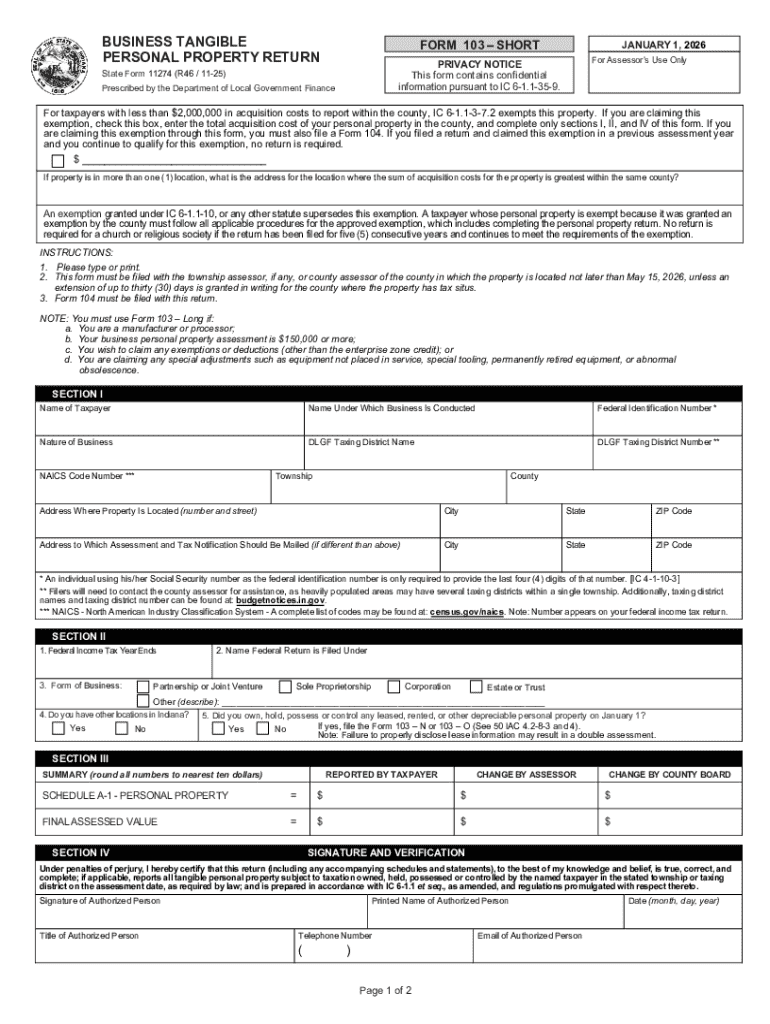







Definition & Purpose of the Indiana Short Form 103
The Indiana Short Form 103 Tangible Personal Property Return is a state-mandated document used for reporting tangible personal property for taxation purposes. It's specifically designed for businesses and individuals who own property that is tangibly significant and used in a business or trade. The form ensures compliance with Indiana property tax regulations, providing a standardized method to declare assets that might not be covered under general income tax filings.
Overview of Tangible Personal Property
- Tangible Assets: Includes machinery, equipment, computers, furniture, and other similar property used in business operations.
- Intended Use: For properties primarily used in producing income, differentiating from purely personal property not subject to these specific tax implications.
- Exclusions: Generally does not apply to real estate or properties owned solely for personal use.
The completion of this form enables the state to levy appropriate taxes, contributing to local infrastructure and services funding.
How to Obtain the Indiana Short Form 103
The Indiana Short Form 103 can be sourced from several locations to ensure ease of access for taxpayers.
Accessible Venues
- Online Download: Visit the Indiana Department of Revenue's official website to download the form in PDF format.
- Local Revenue Offices: Physical copies can be acquired by visiting local tax offices where guidance on filling the form is also available.
- Mail Request: Taxpayers can request a copy via mail from the department if digital access is impractical.
Each method provides multiple opportunities for taxpayers to gather the necessary documentation in a way that suits their preferences or needs.
Steps to Complete the Form
Filling out the Indiana Short Form 103 requires attention to detail and completeness to avoid processing issues.
- Gather Required Information: Compile information on all tangible personal property, including purchase costs and current market value.
- Enter Personal and Business Details: Include the name, address, and taxpayer identification number at the top of the form.
- List Property Assets: Use designated sections to itemize property, specifying type, location, and valuation details.
- Calculate Depreciation: Apply state-approved depreciation methods to assess the current taxable value of each item.
- Signature and Declaration: Complete the form with the taxpayer's signature, affirming the accuracy and truthfulness of provided information.
Understanding each of these steps ensures accuracy and adherence to state taxation guidelines.
Required Documents for Submission
Several documents must be collected and submitted alongside the Indiana Short Form 103 to verify the provided information.
Essential Documentation
- Proof of Ownership: Titles or purchase receipts for each tangible property listed.
- Financial Statements: Documents displaying the cost and depreciation of the assets.
- Appraisal Records: Independent assessments of property's market value, especially pertinent for high-value items.
Proper document preparation can streamline the filing process and minimize discrepancies or the need for corrections.
Filing Deadlines and Important Dates
Adhering to deadlines is crucial when submitting the Indiana Short Form 103 to avoid penalties and fines.
- Annual Filing Deadline: Generally due by May 15 of each tax year.
- Extension Requests: Available through formal submission before the original deadline.
- Late Penalty: Incurs fines and increased interest charges that accumulate monthly until submission completion.
Timely filing helps ensure that businesses remain compliant and avoid unnecessary financial repercussions.
Legal Use and Compliance
The legal framework surrounding the Indiana Short Form 103 governs how it is used to ensure fair tax evaluation.
Compliance Considerations
- Correct Information: Providing accurate property descriptions and values to prevent underreporting.
- Audit Readiness: Maintaining records supporting every entry, ready for state audits if necessary.
- Appropriate Use: Ensures tax obligations are based on tangibly used properties, excluding unintended assets.
Legal compliance with the form strengthens the integrity of the tax system and obliges fairness across taxable entities.
Examples of Use Cases for the Indiana Short Form 103
Different scenarios illustrate the utility of the Indiana Short Form 103 in various business contexts.
Practical Use Cases
- Manufacturing Businesses: Reporting large machinery and tools essential for production processes.
- Service Industries: Declaring office furnishings and computing equipment vital for service delivery.
- Retail Sector: Itemizing display installations and point-of-sale systems utilized in day-to-day operations.
Each example showcases scenarios where tangible assets play critical roles in generating revenue, thus necessitating tax relevancy.
Key Considerations for Business Entities
Types of Entities
- LLC and Corporations: Required to report tangible assets used in business operations.
- Partnerships: May involve shared asset declaration, necessitating comprehensive joint detail.
Understanding entity-specific filing nuances helps ensure the correct submission and compliance with taxation guidelines.
Penalties for Non-Compliance
Failing to file the Indiana Short Form 103 or providing incorrect information can lead to significant penalties.
- Financial Fines: Monetary penalties can accrue per missed deadline day.
- Audit Risks: Increased chances of state audits due to non-compliance or inaccuracies.
- Legal Consequences: More severe breaches involving deliberate misreporting can lead to interrogations and litigation.
Comprehensive awareness of these penalties encourages diligent reporting and filing practices among taxpayers.
Form Submission Methods
Taxpayers have multiple submission options, allowing for flexibility and convenience.
Submission Channels
- Online: Digital submission via the Indiana Department of Revenue's electronic system.
- Mail: Physical forms can be mailed directly to the state's revenue department address.
- In-Person: Hand delivery to local tax offices where direct queries can be solved.
These options cater to diverse preferences, ensuring that all taxpayers can choose a method most convenient for meeting their compliance obligations.




